
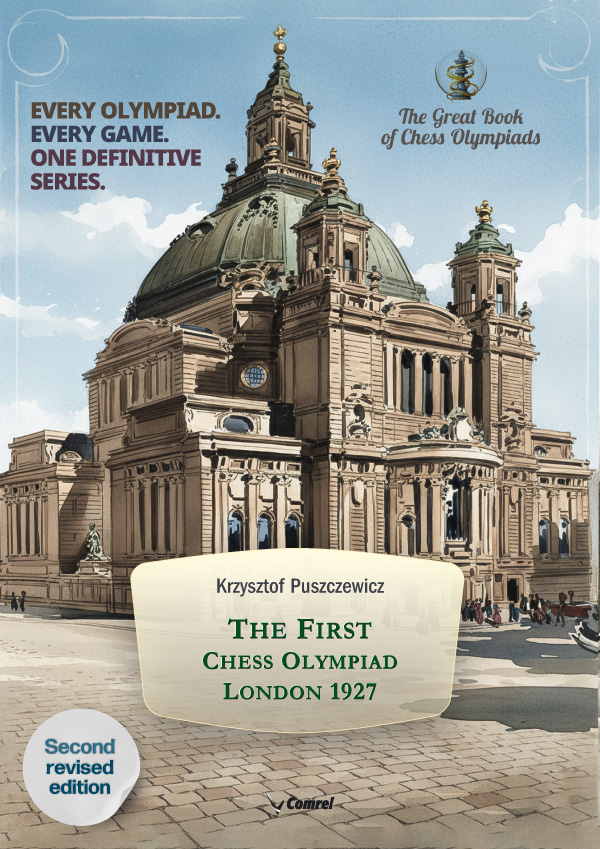
The First Chess Olympiad - London 1927
About this book
The First Chess Olympiad - London 1927
📖 The Great Book of Chess Olympiads - a complete Olympic chronicle
OLYMPIAD FACTSHEET
Brief event overview:
- Location and date: London, Great Britain, July 1927
- Gold medal: Hungary (team: Géza Maróczy, Géza Nagy, Árpád Vajda, Kornél Havasi, Endre Steiner)
- Key figure: Géza Maróczy (Hungary) - a 57-year-old veteran whose solidity and experience led Hungary to a historic first gold.
- Fun fact: This was the first official FIDE Olympiad. Interestingly, teams could freely change the order of players on their boards each round, which is unthinkable today.
Ebook details:
- Author: Krzysztof Puszczewicz
- Series: The Great Book of Chess Olympiads
- Title: 1st Chess Olympiad - London 1927
- Edition: 2
- Year of publication: 2025
- Number of pages: 328
- Format: PDF (high quality, instant download)
- Language: English
Why read this volume?
🔔 The 1st Chess Olympiad was held in London in 1927 and officially opens the cycle of FIDE-sanctioned Olympiads. Despite enormous difficulties in locating original materials (photographs, tournament reports, some game scores), the book has been enriched with rare curiosities, sketches and participant photographs.
The premiere edition appeared in June 2012. After 13 years, this book has received a significant expansion.
This is where it all began. "London 1927" is a foundation of knowledge for every chess fan — you will see how the rules of team competition were born, rules that (with modifications) endure to this day. Discover how Hungary dominated Denmark and England, laying the foundations of their "Golden Generation".
FREQUENTLY ASKED QUESTIONS (Q&A)
Who won the 1st Chess Olympiad in London (1927)? Hungary won, scoring 40 points and finishing ahead of Denmark (38.5 pts) and hosts Great Britain (36.5 pts). The key to their success was the incredible solidity of the Hungarians, who lost the fewest games in the entire tournament.
Did Poland take part in this Olympiad? No. Poland made their Olympic debut the following year, in The Hague (1928). However, this volume is essential for understanding the international balance of power into which the Poles would soon burst (winning gold just 3 years later in Hamburg!).
Does the ebook contain all available games from this tournament? Yes, the book contains the complete collection of available game scores, arranged chronologically (round by round). This allows you to follow the development of each player's form throughout the entire tournament.
What made this Olympiad special? Beyond being "the first one", London 1927 stood out for its gentlemanly atmosphere and experimental rules. Concurrently with the tournament, the 1st Women's World Championship was held, won by the legendary Vera Menchik.
BEHIND THE SCENES
Westminster Central Hall — Where team sport was born
The year 1927. Europe is healing its post-war wounds, and in London 16 nations clash not with bayonets, but with chess pieces. The atmosphere is solemn yet full of unknowns. Nobody yet knows how to manage energy and fatigue in such a long tournament.
Krzysztof Puszczewicz takes you on a journey to an era when chess was the game of café artists becoming sportsmen. You will discover:
- Why powerhouses such as Germany and Austria had to bow before Hungary.
- How Holger Norman-Hansen (Denmark) became the most effective player of the tournament (11 wins!), even though his team finished second.
- What organisational mistakes were made while learning on a "living organism" of a tournament.
This is a story of pioneers who, without computers and databases, were creating opening theory before the eyes of spectators.
WHAT YOU'LL FIND INSIDE
By purchasing this volume, you receive a complete compendium of knowledge about the founding tournament:
- Full round-by-round chronicle: Detailed account of the tournament's progress day by day.
- Unique statistics: Data you won't find online — e.g. the list of unbeaten players (there were only four!).
- Participant gallery: Player profiles from 1927, including period photographs.
- Playing style analysis: See how chess was played nearly 100 years ago — without caution, often sharp and romantic.
EXCERPT FROM THE BOOK
"Only 4 players completed the Olympiad without defeat: Thomas (England), Grünfeld (Austria), Maróczy (Hungary) and Schelfhout (Netherlands). This shows how fierce the competition was in London. In those days nobody calculated — they played for the full point, and draws resulted from material exhaustion, not tactics."
📙 Excerpt from the "Foreword to the second edition" chapter:
"Over 7 years have passed since the first edition of the London Olympiad, and much has changed. As I write these words, the Great Books of Chess Olympiads 1927-1992, 2014-2018 and Women's Olympiads 1957-1992, 2016 and 2018 have been completed. I have gained experience, and many wonderful people have come to my aid. I shall name but a few: Grandmistress Hanna Ereńska-Barlo, Grandmaster Mateusz Bartel, FIDE Master Michał Bartel, the magnificent historian Jan Kalendovský, International Master Marek Matlak, FIDE Master Jacek Matlak, Grandmaster Włodzimierz Schmidt, Grandmaster Vladimir Tukmakov, Grandmaster Sergei Zagrebelny and Wojciech Zawadzki. Not only their vast chess knowledge helped me, but also their enormous experience in chess activities and participation in Chess Olympiads. To all those named and unnamed, I extend my deepest gratitude. Thanks to their help, I gained access to previously unreachable materials, tournament books, lost or incomplete game scores, and fascinating events surrounding the Chess Olympiads."
Other books
45th Chess Olympiad - Budapest 2024
The latest book in the series documenting the 45th Chess Olympiad in Budapest 2024. Full game analysis, statistics and stories. 2200+ rare archive photos and 1500+ tables.
2nd Chess Olympiad - The Hague 1928
Travel back to 1928, a time of great change and technological wonders, which for the chess world became the arena of the 2nd Olympiad in The Hague. This edition was unique — held in the shadow of the 9th Summer Olympic Games in Amsterdam and marked by FIDE's controversial resolution admitting only amateurs. Despite the absence of stars like Alekhine, Rubinstein or Tartakower, the tournament was fiercely contested and marked the historic debut of Poland.
3rd Chess Olympiad - Hamburg 1930
Experience the historic moment when Poland took Olympic gold in Hamburg 1930 - the greatest triumph in the nation's chess history. This unique monograph is the most detailed study of this historic tournament ever produced, based on unique archival sources from the era. Discover a record number of games with original annotations, the complete 17 unbeaten games of Akiba Rubinstein, and rich photographic material that brings history to life. A true collector's gem.