
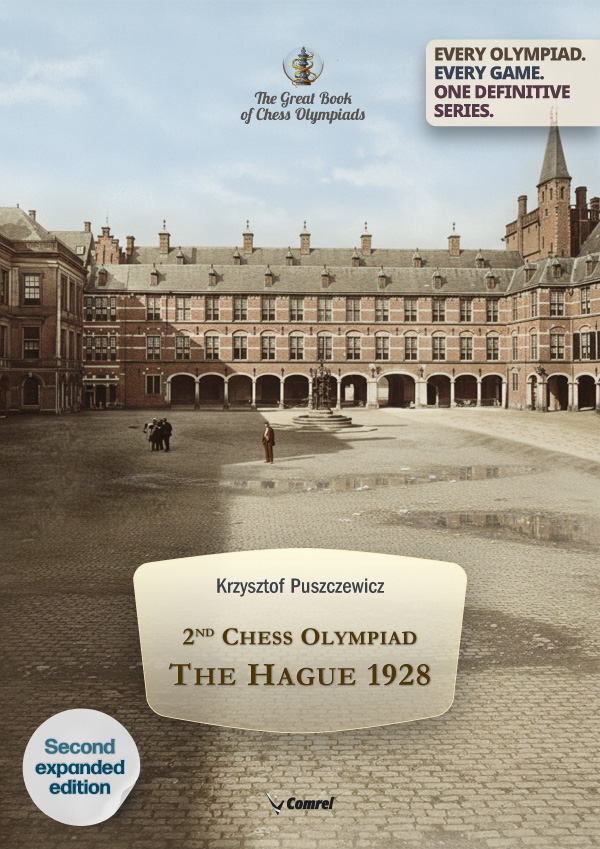
2nd Chess Olympiad - The Hague 1928
About this book
2nd Chess Olympiad - The Hague 1928
📖 The Great Book of Chess Olympiads - a complete Olympic chronicle
OLYMPIAD FACTSHEET
Brief event overview:
- Location and date: The Hague, Netherlands, July-August 1928
- Gold medal: Hungary (team: Géza Nagy, Endre Steiner, Árpád Vajda, Kornél Havasi)
- Key figure: Teodor Regedziński (Poland) — a debutant who dazzled the world, scoring 10 points in 13 games (77% effectiveness!), which was instrumental in Poland's medal.
- Fun fact: This was the so-called "Amateurs' Olympiad". Under FIDE regulations of the time, professionals were barred from competing (which excluded, among others, Akiba Rubinstein and Alexander Alekhine). Concurrently, the Individual Amateur World Championship was held, won by Max Euwe.
Ebook details:
- Author: Krzysztof Puszczewicz
- Series: The Great Book of Chess Olympiads
- Title: 2nd Chess Olympiad - The Hague 1928
- Edition: 2 (Expanded)
- Year of publication: 2026
- Number of pages: 376
- Format: PDF (high quality, instant download)
- Language: English
Why read this volume?
The Great Book of Chess Olympiads takes us on a journey to The Hague of 1928 — a time of extraordinary contrasts. While the world was thrilling to the first transatlantic flights, Fritz von Opel's speed records and Fleming's discovery of penicillin, and Mickey Mouse was making his screen debut, the world's leading chess players were preparing for battle over Olympic medals.
This is a historic moment for Polish sport — the first appearance and the first medal! See how the Polish team stormed onto the stage of world chess, winning a sensational bronze. This volume proves that even without their greatest stars (Rubinstein and Tartakower), the Polish chess school was a powerhouse.
The 2nd Chess Olympiad in The Hague was an event full of challenges and paradoxes:
- In the shadow of great sport: the tournament took place almost simultaneously with the 9th Summer Olympic Games in Amsterdam, which dominated media attention and pushed the chess competition to the sidelines. This means historical materials from the event are exceptionally scarce, making this book an invaluable source of knowledge.
- An amateurs-only tournament: FIDE's controversial resolution barring professionals excluded stars like World Champion Alekhine, as well as Tartakower and Rubinstein. The greatest damage was sustained by the Polish team, which travelled to The Hague with a young and inexperienced line-up, deprived of their biggest stars.
- Poland's historic debut: Despite being weakened, for Polish chess this was a watershed moment — the first ever appearance of a Polish team at a Chess Olympiad. The book pays special attention to the fortunes of our team, presenting profiles of the Polish players and analysing their games.
- Surprises and sensations: The USA, Latvia and Romania also made their debuts. The book features expanded commentary on the most fascinating games, shedding new light on the competition, including the sensational defeat of the favoured Hungarians by the Americans.
- All game commentaries are original from 1928 — authored by the players themselves or chess journalists. The author drew on press materials from 1928 and 1929.
- 🔔BONUS — The Olympic competition took place in the prestigious venue of the Dutch parliament at the Binnenhof. Alongside the team tournament, the Individual Amateur World Championship was held, with Poland represented by Dawid Przepiórka. The book covers these championships chronologically alongside the Olympiad rounds.
FREQUENTLY ASKED QUESTIONS (Q&A)
Who won the 2nd Chess Olympiad in The Hague (1928)? Hungary defended their gold (44 pts), confirming their dominance from London. Silver went to the United States (39.5 pts), and bronze was won by the debuting Poland (37 pts), ahead of Austria and Denmark.
How did Poland perform at the Olympiad in The Hague? Brilliantly! It was the Olympic debut of our team. The squad of Kazimierz Makarczyk, Paulin Frydman, Teodor Regedziński, Mieczysław Chwojnik and Abram Blass finished 3rd. It was in The Hague that the legend of the Polish team was born — a team that would go on to win medals in series throughout the 1930s.
Does the ebook contain all available games? Yes, the book contains the complete collection of surviving games, arranged round by round. This allows you to follow Poland's path to the podium match by match.
BEHIND THE SCENES
A bronze debut in the shadow of the "Great Absence"
The year 1928. Chess players from 17 countries descend on The Hague. Yet in the corridors, talk centres not only on those present, but also on those absent. Why is the great Akiba Rubinstein missing from the Polish team? Why is France playing without Alekhine? FIDE's amateur status rules sparked much controversy, but also opened the door for a new generation.
Krzysztof Puszczewicz reveals:
- How a Polish team, composed of players less well-known on the international stage, taught the favourites a lesson.
- The drama of the fight for silver — could Poland have beaten the Americans?
- The phenomenal form of Teodor Regedziński, who became a "killer" on the lower boards.
This is a story of a tournament in which Poland proved that it was not a "one-man team" (Rubinstein), but possessed a deep pool of talent.
WHAT YOU'LL FIND INSIDE
- Full round-by-round chronicle: Detailed account of the competition, including the decisive medal matches.
- Unique statistics: Results tables, player effectiveness data and analysis of openings used in 1928.
- Participant gallery: Photographs and profiles of players who shaped the history of pre-war chess.
- Polish trail: Detailed analysis of Poland's performance — see the games that won us our first Olympic medal!
EXCERPT FROM THE BOOK
"Despite the absence of their greatest aces, the Polish team played with remarkable passion. Regedziński's result (10 points!) was the sensation of the tournament. In The Hague it became clear that the 'Polish chess school' was not merely a slogan, but a real force to be reckoned with."
Other books
45th Chess Olympiad - Budapest 2024
The latest book in the series documenting the 45th Chess Olympiad in Budapest 2024. Full game analysis, statistics and stories. 2200+ rare archive photos and 1500+ tables.
The First Chess Olympiad - London 1927
London 1927 marks the beginning of the official FIDE Chess Olympiad cycle. The tournament gathered most of the chess celebrities of the era, led by future World Champion Max Euwe. It is one of the least documented Olympiads in literature. Despite this, the author managed to collect a wealth of new, fascinating information and unique photographs.
3rd Chess Olympiad - Hamburg 1930
Experience the historic moment when Poland took Olympic gold in Hamburg 1930 - the greatest triumph in the nation's chess history. This unique monograph is the most detailed study of this historic tournament ever produced, based on unique archival sources from the era. Discover a record number of games with original annotations, the complete 17 unbeaten games of Akiba Rubinstein, and rich photographic material that brings history to life. A true collector's gem.