






2nd Chess Olympiad – The Hague 1928: Complete Description
Summer 1928. In The Hague, 86 chess players from 17 nations compete in the 2nd Chess Olympiad. A young Polish team claims bronze, Isaac Kashdan delivers an 87% masterclass, Hungary wins gold, and Marcel Duchamp plays chess for France.
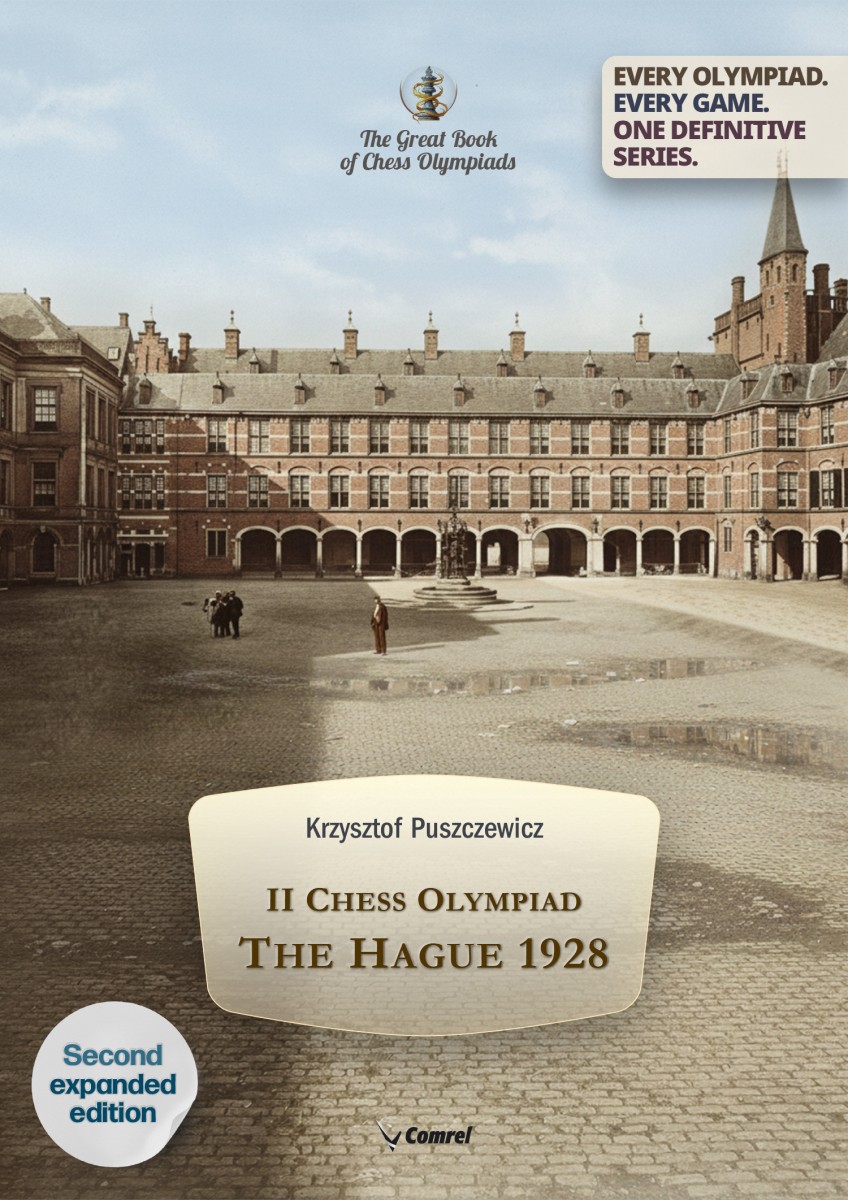
Summer 1928. The Netherlands is buzzing with sport – the IX Summer Olympic Games are underway in Amsterdam, while just a short distance away, inside the historic halls of the Dutch Parliament in The Hague, 86 chess players from 17 nations sit down for the 2nd Chess Olympiad. Nobody suspects that a young, inexperienced Polish team will claim the bronze medal, or that an unknown American named Isaac Kashdan will deliver a performance for the ages with an 87% score. What makes this forgotten Olympiad one of the most dramatic chapters in early chess history?
The full story of the 2nd Chess Olympiad – with 375 pages of analysis, annotated games, and rare photographs from the era – is available in Krzysztof Puszczewicz's monograph from the Great Book of Chess Olympiads series, available in our shop.
Table of Contents
- 1928 – A World on the Brink of Change
- FIDE's Absurd Rule – Professionals Banned
- The Hague vs. Amsterdam – Chess in the Shadow of the Olympics
- Venue and Playing Conditions at Binnenhof
- Participants and Debutants
- Tournament Progress Round by Round
- Hungary – Gold Medal Favourites Deliver
- USA – Debut Silver and Kashdan's Brilliance
- Poland – Bronze Medal on Debut!
- Marcel Duchamp Plays Chess for France
- Final Standings
- Best Individual Performers
- Records, Statistics and Curiosities
- Legacy of the 2nd Olympiad
- FAQ – Frequently Asked Questions
1928 – A World on the Brink of Change
Alexander Fleming discovered penicillin. Walt Disney introduced Mickey Mouse. Fritz von Opel pushed his vehicle to 200 km/h. The first transatlantic flights were taking place, and in Paris, nations signed the Kellogg-Briand Pact – an international treaty against war that technically remains in force today.
As Krzysztof Puszczewicz writes in his monograph, Europe had not yet forgotten the First World War. The times were restless, and people were bursting with energy. Sport was seen as the ideal outlet. In February 1928, the II Winter Olympics took place in Switzerland. In July, the IX Summer Olympic Games opened in Amsterdam – and at the very same time, the 2nd Chess Olympiad began in The Hague.
The choice of the Netherlands as host was no accident. During World War I, Holland had maintained neutrality and afterwards became a seat for international peace institutions. The royal family, headed by Queen Wilhelmina, performed all ceremonial functions. Just one year later, in 1929, the Netherlands – like all of Europe – would plunge into economic crisis.
FIDE's Absurd Rule – Professionals Banned
The Olympiad lost much of its lustre due to an unfortunate resolution passed at the 4th FIDE Congress in 1927, declaring that only amateur players could participate. Ironically, this rule was pushed by England – who then refused to send their own team to The Hague because their best players were professionals!
As a result, the following world-class players were barred from the "Tournament of Nations":
- Alexander Alekhine – the reigning World Champion, from the French team
- Frank Marshall – from the American team
- Ernst Grünfeld – from the Austrian team
- Géza Maróczy – from the Hungarian team
- Savielly Tartakower and Akiba Rubinstein – from the Polish team
For those familiar with the chess landscape of the era, it was clear that Poland suffered the greatest damage – losing two giants, Rubinstein and Tartakower, who had finished 1st and 2nd respectively at the Polish Championship in Łódź in 1927.
The 5th FIDE Congress, meeting in The Hague during the Olympiad itself, repealed the rule almost unanimously – partly thanks to England's vote. But it was too late to change anything.
The Hague vs. Amsterdam – Chess in the Shadow of the Olympics
The IX Summer Olympic Games opened in Amsterdam on 28 July – the seventh day of the Chess Olympiad. Their splendour completely overshadowed the chess competition. The Games featured the royal family, attracted massive media coverage, and carried political significance as the first post-WWI Olympics to allow women's participation, despite protests from Pope Pius IX.
Puszczewicz notes that from a chess-historical perspective, the most significant consequence was that very few documents describing the 2nd Olympiad have survived. Even Dutch sources contain virtually no mentions of the event. Media attention was almost entirely focused on the Amsterdam Games.
Venue and Playing Conditions at Binnenhof
The chess battles took place in the Binnenhof – the historic hall of the Dutch Parliament in The Hague.
Key facts:
- Dates: 21 July – 6 August 1928
- Location: Binnenhof, The Hague, Netherlands
- Format: Round-robin (all-play-all)
- Teams: 17 (4 players + up to 2 reserves)
- Total players: 86
- Games played: 544
- Time control: 1 hour per 20 moves, then 30 minutes per 10 moves
- Schedule: 3 full rounds every 2 days
A notable curiosity: this was the penultimate Olympiad where players could freely choose which board to play on. From Prague 1931 onwards, board order was fixed by playing strength.
Participants and Debutants
Seventeen teams assembled – one more than London 1927. Fifteen from Europe, one from North America, one from South America.
Olympic debutants:
- 🇺🇸 USA – featuring the sensational Isaac Kashdan
- 🇵🇱 Poland – young and ambitious
- 🇱🇻 Latvia – led by Kārlis Apsenieks
- 🇷🇴 Romania – with Miklos Brody and Zeno Proca
Notable absentees: England (victims of their own amateur rule), Yugoslavia, and Finland.
Hungary, the defending champions from London 1927, were the clear favourites. The USA, Poland, Austria, and Czechoslovakia were considered dangerous challengers.
# | Team | Key players
- 01 Argentina Fernández, Maderna, Palau, Reca
- 08 HungaryNagy, Steiner E., Vajda, Havasi
- 10 France Gaudin, Betbeder, Duchamp, Muffang
- 12 USAKashdan, Steiner H., Factor, Tholfsen
- 14 PolandMakarczyk, Frydman, Regedziński, Chwojnik, Blass
- 16 Sweden Stoltz, Jacobson, Stahlberg, Karlin
Tournament Progress Round by Round
Rounds 1–5: Strong Starts from the Debutants
The first round (23 July 1928) brought sensational results from the newcomers. Świat Szachowy (The Chess World), Poland's leading chess periodical, headlined the round: "The Americans' victorious debut." The US team crushed Austria 3.5–0.5 – the only half-point for Austria came from Josef Lokvenc's draw with Herman Steiner. Despite his amateur status, Lokvenc was no beginner – as Puszczewicz notes, he went on to compete in eight more Olympiads, ending his Olympic career only in 1962.
Latvia beat Spain convincingly 3–1, Romania edged Belgium 2.5–1.5, and Poland drew 2–2 with Denmark. Hungary, the defending champions, made a strong start by beating Germany 3–1.
From the match report by Dawid Przepiórka (published in Świat Szachowy): Norman-Hansen gained an advantage over Makarczyk but fell into a common trap. Frydman "confidently achieved an advantage over Andersen." Regedziński had an extra pawn and a completely winning position against Gemzoe but missed a simple combination and actually ended up losing – his only defeat in the entire tournament! Chwojnik played aggressively against Ruben but became indecisive at the critical moment – the game ended in a draw.
The round was fiercely combative: of 32 games played, only 15 ended in draws. A surprise individual result was the defeat of Czechoslovakia's favourite Gilg by Italy's Monticelli, which so "irritated" the Czech player that he squeezed 4 points from his next 4 games.
A great talent appeared in the Swedish team – Gideon Stahlberg (aged 20), who would become the face of Swedish chess for decades to come. In The Hague, however, he lacked the stamina for such a gruelling marathon: after 12 rounds he had 9 points without a loss and seemed set for an individual prize, only to inexplicably lose his last three games. Stahlberg died suddenly of a heart attack during a tournament in Leningrad in 1967.
Rounds 6–11: Hungary Builds a Lead
Hungary, playing without any reserves (as did Denmark, Belgium, and Romania), showed remarkable consistency. Gösta Nagy compiled a phenomenal series in rounds VIII–XIV: 6.5 points from 7 games. Endre Steiner won game after game, while Árpád Vajda remained unbeaten through almost the entire tournament.
Czechoslovakia led independently from rounds IV through IX before their form declined. Meanwhile, Switzerland proved unpredictable – Puszczewicz compares them to the legendary Robin Hood figure Janosik: they took points from the "rich" and gave them to the "poor".
Rounds 12–17: The Dramatic Finale
The second half of the tournament brought increasing tension. Hungary led comfortably, but behind them a brutal battle for the podium raged between the USA, Poland, and Austria. The Americans finished superbly – Kashdan opened and closed the tournament with five consecutive wins each, becoming a genuine scoring machine.
Round XVI (3 August) produced a sensation – Switzerland defeated Hungary 2.5–1.5! Puszczewicz titled this round: "Switzerland… could have changed the result of the Olympiad." Thrown off rhythm after a rest day, the Hungarian team unexpectedly stumbled. After a phenomenal run in rounds VIII–XIV, Nagy lost to Voellmy. Steiner suffered his third defeat – this time against Michel. Only the unbeaten Vajda salvaged a draw against Naegeli. But Hungary's overall lead was already secure.
Meanwhile, the Americans demolished Denmark – the silver medallists from London 1927 – by 3.5–0.5. Kashdan and Herman Steiner continued their winning streaks, joined by Tholfsen, while Ruben salvaged Denmark's only half-point in a draw with Factor. This victory gave the USA a 2-point lead over Poland and Austria with one round remaining.
Argentina finished beautifully – the 18-year-old Carlos Maderna won his fourth game in a row, while Palau scored his second consecutive victory. Latvia celebrated their third straight win by crushing Romania.
Poland, fighting for bronze after four consecutive match victories, drew 2–2 with the Netherlands in round XVI. Chwojnik overstepped the time limit against Weenink. Frydman played "not brilliantly but very skilfully calmed the position at exactly the right moment" and scored an easy, if unexpected, win over Kroone. Makarczyk, exhausted by the gruelling tournament, nearly overstepped himself against Schelfhout, blundered away two pawns, but defended with cold blood through two adjournments – defying premature reports of a Dutch victory.
Austria beat France convincingly and drew level with Poland on points. The question hung in the air: Poland or Austria for the bronze? The final round would decide.
Hungary – Gold Medal Favourites Deliver
Despite two match losses, Hungary won comfortably with 44 points – 4.5 ahead of silver medallists USA. Their dominance was built on remarkable consistency: all four players scored above 66%.
- Gösta Nagy – +9 =5 -2 – 72%
- Endre Steiner – +10 =3 -3 – 72%
- Árpád Vajda – +6 =9 -1 – 66%
- Kornél Havasi – +6 =9 -1 – 66%
Remarkably, Hungary competed without any reserve players – all four played every round without rest. Against the bottom three teams, they dropped just 1.5 points. Despite this, the Hungarians suffered two match defeats – to Poland and to Switzerland – proving that even the strongest team was not invincible.
Puszczewicz highlights the impressive defensive record of Árpád Vajda, who lost only a single game in the entire tournament – in the very last round, against France's Betbeder. His 9 draws in 16 games reflect a solid, positional style that served as the team's anchor. Endre Steiner was the most aggressive player, with 10 wins but also 3 losses. Nagy delivered the most spectacular stretch: 6.5 points from 7 games in rounds VIII–XIV.
USA – Debut Silver and Kashdan's Brilliance
The Americans won silver on their Olympic debut with 39.5 points. The star was Isaac Kashdan (1905–1985), who achieved a staggering 13 points from 15 games (87%) – the highest percentage score of the entire Olympiad.
Kashdan won 12 games, drew 2, and lost just 1. His career would flourish in the following years: he won tournaments in Győr and Stockholm in 1930, and in Frankfurt was only behind Nimzowitsch. He went on to become the first editor of the famous monthly The Chess Review, founded in 1933. Kashdan's dominance in The Hague was such that he contributed the most points of any single player for their team across the entire tournament.
Herman Steiner (1905–1955) was the team's second pillar with 66%. Like the better-known Endre Steiner of Hungary, Herman was born in Hungary but emigrated to New York with his family in 1909 at age 5. He joined a chess club at 16 and achieved his first major success just a year after The Hague, winning the New York State Championship in 1929. The weakest link was Hanauer, who managed only one win in the entire event – unfortunately for Poland, it came against the Polish team in round VIII.
Poland – Bronze Medal on Debut!
This is the chapter Polish chess fans will relish. Poland won the bronze medal in their very first Chess Olympiad! A score of 37 points from 64 games (57.8%) with 17 competing nations was a remarkable achievement.
As Puszczewicz writes, the Hague Olympiad holds a special place in his work because it "opens the history of Polish Olympic chess endeavours." He tried to remain an objective observer throughout the book, but having access to more information about his home country, he allowed himself additional commentary and broader profiles of the Polish players.
The Road to The Hague
At a meeting of the Polish Chess Federation's Board on 12 May 1928, the following squad was selected: 1. Przepiórka, 2. Regedziński, 3. Makarczyk, 4. Frydman, 5. Dr Kohn, 6. Chwojnik, 7. Blass (as a reserve). Przepiórka was to play in the individual tournament A, with the remaining five forming the team. Delegates of the Federation included Domosławski, Orlański, Przepiórka, and Lt. Col. Steifer.
Świat Szachowy assessed the team's chances: "Apart from Dr Kohn and J. Cukierman, this is indeed the strongest squad Poland can currently field. Our team's chances are considerable – we can expect around 5th–6th place, although a higher prize is also within the realm of possibility."
The team was young and inexperienced. Their credentials (age and placing at the 2nd Polish Championship in Łódź 1927): Kazimierz Makarczyk (27, 3rd), Paulin Frydman (23, 5th–7th), Teodor Regedziński (34, 4th), Mieczysław Chwojnik (28, 5th–7th), and Abram Blass (28, 8th).
Team Results
Polish team:
- Kazimierz Makarczyk – 27 – +5 -5 =6 – 50%
- Paulin Frydman – 23 – +6 -5 =1 – 54%
- Teodor Regedziński – 34 – +8 -1 =4 – 77%
- Mieczysław Chwojnik – 28 – +4 -3 =4 – 55%
- Abram Blass – 28 – +4 -3 =5 – 54%
Teodor Regedziński was the team's standout performer with 77% – the third-highest individual percentage at the Olympiad. He won 8 games and lost only once (in round 1).
As Puszczewicz emphasises, Poland sent their strongest available squad – missing only Rubinstein and Tartakower, who were banned as professionals.
The Last-Round Drama
The bronze medal battle between Poland and Austria came down to the final round. Poland faced Romania; Austria faced Germany. Poland appeared to have the easier task.
Regedziński struck first, beating Brody in a miniature. Frydman soon followed by defeating Balogh. Makarczyk, keeping one eye on the Austria–Germany match, agreed a draw with Proca. Poland led 2.5–0.5.
But Blass was struggling and eventually lost. The tension was unbearable – because if Austria's Beutum had won his game against Germany's Blümich, Austria would have overtaken Poland. In the end, Beutum cracked under pressure, lost a pawn, and eventually the game. Poland claimed the bronze by just half a point.
Marcel Duchamp Plays Chess for France
One of the most fascinating figures at the 2nd Olympiad was Marcel Duchamp (1887–1968) – the legendary artist, pioneer of Dadaism and conceptual art, creator of the iconic Fountain and Nude Descending a Staircase, who played chess for France. Duchamp was a passionate chess player who dedicated years of his life to the royal game, treating it with the same seriousness as his art. He reportedly said that "not all artists are chess players, but all chess players are artists."
His presence in the French team alongside Gaudin, Betbeder, Crépeaux, Muffang, and Drezga is one of the most extraordinary episodes in Olympiad history. Duchamp continued his chess career and represented France at subsequent Olympiads as well.
France finished 11th with 31 points. The team's best performer was Muffang, who went through the entire 16-game tournament unbeaten, scoring 78%. Interestingly, another Frenchman – Dresga – also finished without a loss, though he played only 2 games.
It is worth noting that the reigning World Champion Alexander Alekhine, who held French citizenship, was also barred from representing France due to the professionals' ban.
Final Standings
Place | Team | Points | Match pts
- 🥇 1. Hungary44.0 26
- 🥈 2. USA39.5 23
- 🥉 3. Poland37.0 22
- Austria 36.5 21
- Denmark 34.0 18
- Switzerland 34.0 17
- Czechoslovakia 34.0 15
- Argentina 33.5 16
- Germany 31.5 17
- Netherlands 31.5 16
- France 31.0 16
- Belgium 31.0 15
- Sweden 31.0 13
- Latvia 30.0 13
- Italy 26.5 9
- Romania 25.5 13
- Spain 13.5 3
Best Individual Performers
Since players could freely choose their boards, individual prizes were awarded for the highest percentage scores:
- Kashdan – USA – 13/15 – 87%
- Muffang – France – 12.5/16 – 78%
- Regedziński – Poland – 10/13 – 77%
- Nagy – Hungary – 11.5/16 – 72%
- Steiner E. – Hungary – 11.5/16 – 72%
- Rivier – Switzerland – 7.5/11 – 68%
Only 3 players finished unbeaten: Muffang (France, 16 games), Wagner (Germany, 16 games), and Dresga (France, 2 games).
Records, Statistics and Curiosities
- King of draws: Heinrich Wagner (Germany) drew 13 of his 16 games!
- Most wins: Kashdan (12), Steiner E. (10), Nagy and Muffang (9 each).
- Most points for a team: Isaac Kashdan – 13 points.
- 18-year-old Carlos Maderna (Argentina) won 4 consecutive games in the final rounds.
- Swedish prodigy Gideon Stahlberg had 9 points without a loss after 12 rounds, then inexplicably lost his last three games.
- Artist Marcel Duchamp represented France.
- The Hague installed Europe's first traffic light in 1928 – on Laan van Meerdervoort, just as the Olympiad was taking place.
- Argentina and Hungary drew the same starting numbers as in London 1927.
Legacy of the 2nd Olympiad
The 2nd Chess Olympiad in The Hague had consequences far beyond the scoreboard:
First, it hastened the end of the absurd amateur-only rule. The 5th FIDE Congress, meeting during the Olympiad, repealed it almost unanimously – permanently changing competitive chess. From the next Olympiad onwards, all players could participate, raising the sporting level dramatically.
Second, it marked Poland's first Olympic appearance, crowned with a bronze medal – the beginning of a proud tradition. As Puszczewicz writes, The Hague 1928 "opens the history of Polish Olympic chess endeavours." Polish chess would go on to achieve even greater glories, including the women's team silver medal at Baku 2016 and the remarkable 4th place at Batumi 2018.
Third, America's debut with the sensational Kashdan foreshadowed the USA's growing role in world chess – a trend that would culminate in the Fischer era decades later.
Fourth, Hungary's second consecutive gold confirmed their status as the world's strongest chess nation – a position they would hold for years to come.
Fifth, the near-total absence of surviving source material makes Puszczewicz's monograph one of the very few comprehensive accounts of this Olympiad in any language. By accessing complete runs of Świat Szachowy and other contemporary periodicals, the author was able to reconstruct the event "round by round," including descriptions of many games whose scores have been lost forever. The expanded annotations in this second edition shed new light on key encounters – including the sensational and enigmatic loss by Hungary to the Americans.
FAQ – Frequently Asked Questions
Who won the 2nd Chess Olympiad in The Hague 1928?
Hungary won gold with 44 points, ahead of the USA (39.5) and Poland (37). All four Hungarian players – Nagy, Steiner E., Vajda, and Havasi – scored above 66%, playing without any reserves.
How did Poland perform at The Hague 1928?
Poland won the bronze medal in their Olympic debut – a major achievement with 17 teams competing. The star was Teodor Regedziński with 77%, the third-best individual score. The bronze was secured in a dramatic final-round battle against Austria, won by just half a point.
Why were Rubinstein and Tartakower not on the Polish team?
FIDE's 1927 rule banned professionals from Olympiads. Rubinstein and Tartakower, Poland's two strongest players, were classified as professionals. The rule was repealed during the Olympiad itself, but too late to change the team.
How many players participated?
86 players from 17 countries played 544 games between 21 July and 6 August 1928.
Who was the best individual player?
Isaac Kashdan (USA) achieved 87% – 13 points from 15 games (12 wins, 2 draws, 1 loss). It was his international debut.
Did Marcel Duchamp really play in the Olympiad?
Yes! The famous artist represented France as part of their six-player team. France finished 11th. Duchamp was a serious chess player who dedicated years of his life to the game.
Why didn't England participate?
England had pushed for the amateur-only rule at the 1927 FIDE Congress but then realised their own best players were professionals. Unable to field a competitive team, they stayed home – a victim of their own policy.
What made this Olympiad unique?
The 2nd Olympiad was remarkable for: the professionals' ban, running alongside the Summer Olympics in Amsterdam, Marcel Duchamp's participation, the debuts of both the USA and Poland (who both medalled!), and the extremely limited surviving historical records.
How did Denmark perform after their London 1927 success?
Denmark, the silver medallists from London, competed again without any reserves. They didn't medal this time (5th place with 34 points) but left an excellent impression. The disappointment was Holger Norman-Hansen (41%), the hero of the previous Olympiad, while Erik Andersen achieved a strong 66%.
Where was the 2nd Chess Olympiad held?
The tournament took place in the Binnenhof – the historic hall of the Dutch Parliament in The Hague. This was a prestigious location, though contemporary media largely ignored the chess event in favour of the IX Summer Olympics happening simultaneously in Amsterdam.
Is the book available in English?
Krzysztof Puszczewicz's monograph II Chess Olympiad – The Hague 1928 is currently available in Polish. It is the most comprehensive account of this Olympiad in any language, containing 375 pages of detailed analysis, game annotations, photographs, and contemporary press reports. Visit our shop for the latest information on available editions.
Source: Krzysztof Puszczewicz, II Chess Olympiad – The Hague 1928, Great Book of Chess Olympiads, 2nd edition 2025.
Want the full story of the 2nd Chess Olympiad?Get the book in our shop and discover 375 pages of detailed analysis, hundreds of annotated games, and rare photographs from the era!