






Who Will Win the Women's Chess Olympiad in Samarkand?
Three olympiads of data plus the 2026 tournament season point to India as favourites for Women's gold in Samarkand — but Kazakhstan's Bibisara Assaubayeva is having the best season of her life.

Three editions of results say India are the team to beat — but the 2026 season has thrown a curveball from Kazakhstan.
The 46th Chess Olympiad in Samarkand is three months away. Rather than guess, we ran the numbers. The OlympChess database covers every Women's Chess Olympiad since the first edition in 1957, and the last three — Batumi 2018, Chennai 2022, and Budapest 2024 — offer the clearest window into what September might bring. We then checked those trends against the 2026 tournament season to see what holds up and what has shifted.
Here is what the data shows, where the trends point, and where they might mislead.
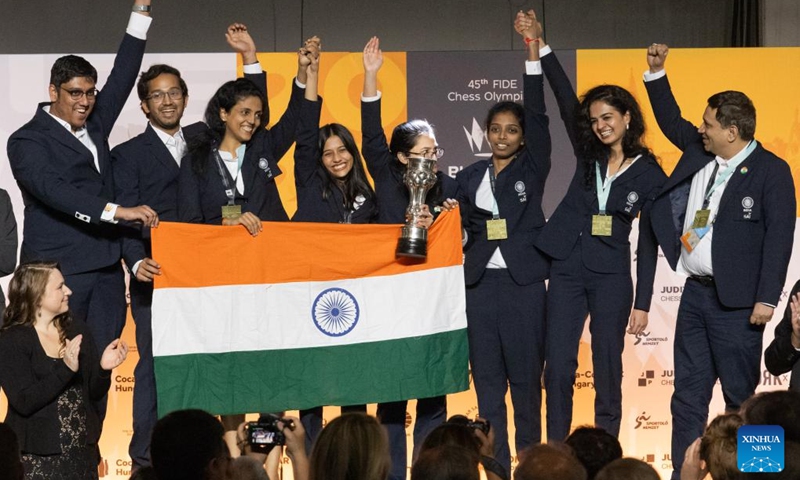
Women's Chess Olympiad Budapest 2024 — India team celebrating gold medal, source: https://www.globaltimes.cn
In this article:
- The trajectory table
- India: the clear favourite — with a question mark
- Kazakhstan: the season that changed everything
- USA: steady and deep
- The fallen giants
- Dark horses for Samarkand
- Our prediction
- Frequently asked questions
- Sources and further reading
The trajectory table
Eleven teams finished in the top 15 at least twice across the last three olympiads. Their trajectories tell the story:

Source: Olympchess.com. "—" means finished outside top 15
Three teams — India, Kazakhstan, and the United States — have improved their finishing position at every olympiad in this window. No other team in the Women's section can say that.
India: the clear favourite — with a question mark
India's rise from 6th in Batumi to gold in Budapest is built on depth, not just one star. Their boards 1–4 averaged an Elo of 2448 and a tournament performance rating of 2462 in Budapest — the only team where average TPR exceeded average Elo across the top four boards.
Divya Deshmukh delivered a TPR of 2608 on board 3 in Budapest and has since earned the GM title, reaching a peak rating of 2510. She competed in the Women's Candidates 2026 after winning the Women's World Cup 2025. Vantika Agrawal scored a TPR of 2558 on board 4 in Budapest. Neither player has turned 23 yet. The trajectory is real.
But the biggest question for India involves someone who was not even on the Budapest squad. Vaishali Rameshbabu won the Women's Candidates 2026 in Cyprus with 8.5/14 and will challenge Ju Wenjun for the Women's World Championship title later this year. The date and venue of that match have not been announced yet. If the match happens before or during the Olympiad, Vaishali might not be available for India's team. If she is available, India's already formidable lineup gains a Candidates winner — and the prediction becomes much simpler.
India's only historical vulnerability: no team has successfully defended a Women's Olympiad title since China's run ended in 2018. Batumi gold winners China finished 7th in Budapest.
Kazakhstan: the season that changed everything
From 10th to 5th to silver. Kazakhstan's Olympiad climb is the steepest in the dataset, driven largely by Bibisara Assaubayeva, who delivered a TPR of 2517 on board 1 in Budapest. She had already scored 2428 on board 2 in Chennai — her promotion to first board has not slowed her down.
The question heading into 2026 was whether Kazakhstan could sustain a podium challenge, or whether Budapest was a peak. The 2026 season has answered emphatically: this is no peak.
Assaubayeva finished second at the Women's Candidates in April, half a point behind Vaishali, making her the first Kazakh player ever to compete in a Candidates tournament.
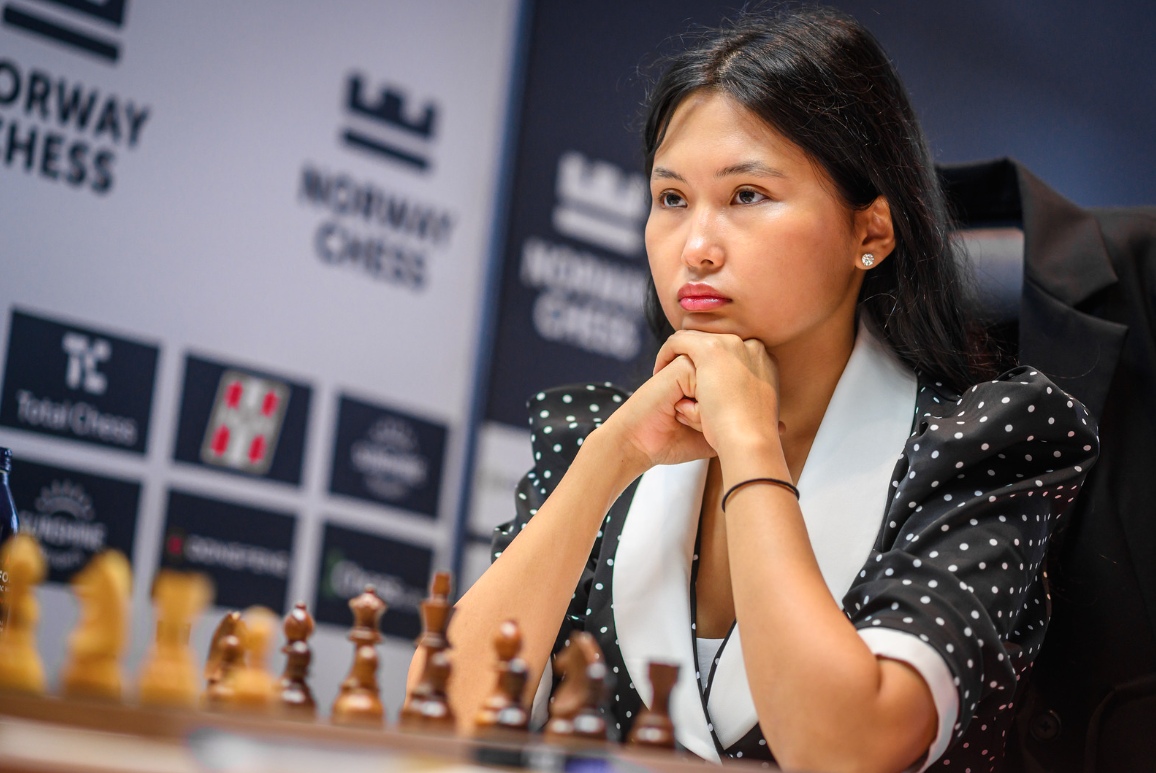
Bibisara Assaubayeva at Norway Chess Women 2026, source: Norway Chess
Then, in May-June, she won Norway Chess Women 2026 — one of the strongest women's events of the year — with a round to spare, reaching a career-peak rating of 2527. At 22, she is the reigning three-time Women's World Blitz Champion and now a full GM.
In our database, Kazakhstan's average team Elo (2347) was the lowest among the top three finishers in Budapest — they overperformed their ratings by 52 points on average. That kind of overperformance is hard to repeat. But with Assaubayeva in the form of her life, Samarkand might be the tournament where Kazakhstan stops overperforming and starts being rated where they belong.
USA: steady and deep
The American team improved from 11th to 4th to 3rd with a remarkably stable squad. Carissa Yip jumped from a TPR of 2291 in Chennai to 2634 in Budapest — the single largest improvement among any player who appeared in both editions on the same board. She is the four-time US Women's Champion (2021, 2023, 2024, 2025) with a current rating of 2482.
The USA's average team Elo of 2373 sits between India's 2448 and Kazakhstan's 2347, suggesting their bronze in Budapest was earned on rating rather than overperformance. US Chess is already seeking captains and trainers for the Samarkand squad, with the application deadline set for mid-June 2026.
The fallen giants
Ukraine won gold in Chennai 2022 and finished 11th in Budapest. The war's ongoing disruption of Ukrainian chess is a factor the database cannot fully quantify, but the numbers are stark: their average team TPR dropped from 2414 to 2347. Anna Muzychuk remains competitive individually — she played in the Women's Candidates 2026 and competed at Norway Chess Women, drawing all nine classical games — but team depth has suffered.
China won Batumi 2018, did not compete in Chennai, and returned in Budapest to finish 7th — despite posting the highest team TPR in the entire field (2462). They scored 34.5 game points, more than gold-winning India's 31, but won fewer matches. This is the Swiss system paradox: massive game-point margins can coexist with middling match-point totals if losses come in the wrong rounds. Zhu Jiner (rated 2578, world no. 2) finished third at the Women's Candidates and competed at Norway Chess — China's individual talent is not the problem. Their challenge is translating it into match-point consistency over 11 rounds.
Georgia, twice a medallist (bronze 2018, silver 2022), slipped to 6th in Budapest. Nana Dzagnidze (current rating 2478), their board 1 anchor, delivered a TPR of 2541 in Budapest — still strong, but the supporting cast scored lower than in previous editions. A generational shift may be underway: Nino Batsiashviliwon the 2026 Georgian Women's Championship and overtook Dzagnidze on the national rating list. Whether that strengthens Georgia's Olympiad squad or signals internal competition remains to be seen.
Dark horses for Samarkand
Armenia (12th → 11th → 5th) has the clearest upward trend outside the top three. Lilit Mkrtchian posted a TPR of 2507 on board 1 in Budapest at age 42 — the kind of veteran consistency that anchors a team.
Spain finished 4th in Budapest, their best ever result, fuelled by Sarasadat Khademalsharieh (TPR 2560 on board 1) and Sabrina Vega Gutierrez (TPR 2505, 86% on board 3). Khademalsharieh made her Spain debut at the Budapest Olympiad after switching federation from Iran. If they maintain this squad, Spain could challenge for a medal again.
Uzbekistan is the host. They finished 19th in Batumi, 24th in Chennai, and 12th in Budapest — a genuine leap. Nodirjanova scored 87.5% on board 4 in Budapest with a TPR of 2460. Home advantage and crowd support could push them into the top 10 for the first time. The 46th Chess Olympiad runs from September 15 to 27 and is expected to surpass Budapest's record of 181 women's teams. A medal remains unlikely for Uzbekistan on current form, but 12th-to-top-10 is the kind of jump this team has already made once.
Our prediction
Based on three olympiads of trend data, updated with 2026 form:

Biggest wildcard: The Vaishali question. If her World Championship match against Ju Wenjun is scheduled for after the Olympiad, India fields a squad with a Candidates winner, a GM rated 2510, and two Olympic-proven stars under 23. That is the strongest Women's Olympiad team on paper in recent history. If Vaishali is unavailable, India is still the favourite — but the gap to Kazakhstan narrows considerably.
Host factor: Uzbekistan in the top 10 for the first time would be a milestone — and Budapest suggests it is within reach.
We could be wrong about all of this. The Swiss system rewards consistency over brilliance, and three months is enough time for squad changes, rating shifts, and the kind of surprises that make the Olympiad worth watching. That is precisely the point.
The data gives us a direction. Samarkand will give us the answer.
Frequently asked questions
Who won the Women's Chess Olympiad in Budapest 2024?
India won the Women's gold medal with 19 match points, their first ever Women's Olympiad title. Kazakhstan took silver with 18 match points, and the United States won bronze with 17.
When is the 46th Chess Olympiad in Samarkand?
The 46th Chess Olympiad takes place from 15 to 27 September 2026 at the Silk Road Samarkand complex in Uzbekistan. Both the Open and Women's sections are played over 11 rounds using the Swiss system, with teams of four players plus one reserve.
Who is the favourite for Women's gold in 2026?
India are the strongest team on paper, with Divya Deshmukh (rated 2510), Vantika Agrawal, and potentially Vaishali Rameshbabu (the 2026 Women's Candidates winner). Kazakhstan, led by Bibisara Assaubayeva in career-best form, are the main challengers.
Will Vaishali Rameshbabu play in the Olympiad?
That depends on the scheduling of her Women's World Championship match against Ju Wenjun. The date and venue have not been announced yet. If the match falls outside the Olympiad window, Vaishali could strengthen India's already formidable squad.
How has Bibisara Assaubayeva performed in 2026?
Assaubayeva finished second at the Women's Candidates Tournament in April 2026 and won Norway Chess Women 2026 in June — with a round to spare. She reached a career-peak rating of 2527 and holds the GM title. At 22, she is the reigning three-time Women's World Blitz Champion.
Sources and further reading
This article draws on:
- FIDE official announcement of the 46th Chess Olympiad (fide.com, 20 April 2026)
- FIDE report on Women's Candidates Tournament 2026 (fide.com, 16 April 2026)
- FIDE report on Norway Chess 2026 results (fide.com, 5 June 2026)
- ChessBase coverage of Women's Candidates rounds 9–14 (en.chessbase.com, April 2026)
- ChessBase report on 2026 Georgian Chess Championships (en.chessbase.com, 6 February 2026)
- Chess.com news report on 2024 Olympiad team announcements and results
- US Chess announcement of captain/trainer positions for Samarkand 2026 (uschess.org, June 2026)
- FIDE rating profiles for current player ratings (ratings.fide.com)
- Wikipedia articles on the 45th Chess Olympiad Women's event, Women's Candidates Tournament 2026, and individual player biographies (accessed June 2026)
- Olympchess database
For readers interested in the deeper history of the Chess Olympiad — every edition from London 1927 to Budapest 2024 — the Great Book of Chess Olympiads series by Krzysztof Puszczewicz remains the most comprehensive English-language chronicle of the event. The next volume in the series will document Samarkand 2026.
The 46th Chess Olympiad begins on 15 September 2026. Read more about the host city in Chess on the Silk Road.