






When One Titan Isn't Enough: What Olympiad History Tells Us About Star-Led Teams
Magnus Carlsen has been the world's best player since 2011. Norway has never finished on a Chess Olympiad podium. We went through eight decades of Olympiad data to ask a plain question: how much can one great player actually do for a team?
In a few months, the strongest players on Earth will gather in Samarkand for the 46th Chess Olympiad. Some will arrive carrying their entire national team on their shoulders. At least one of those players will draw more cameras than anyone else in the hall — and his country has never won an Olympiad medal of any colour.
This is not a prediction about Magnus Carlsen. It is an observation about a pattern, and the pattern is older than he is. The Chess Olympiad is a team event wrapped in an individual sport's mythology, and the gap between those two things has a measurable shape. So we went looking for it — not in opinion, but in the record.
Using the olympchess.com Olympiad database, which holds the games, line-ups and final standings of every Olympiad since 1924, we traced the careers of five players who spent decades as the unmistakable best player on a mid-tier team. The question was deliberately narrow: when a country has one titan and an ordinary supporting cast, what actually happens?
The answer turns out to be consistent enough to be worth sitting with.
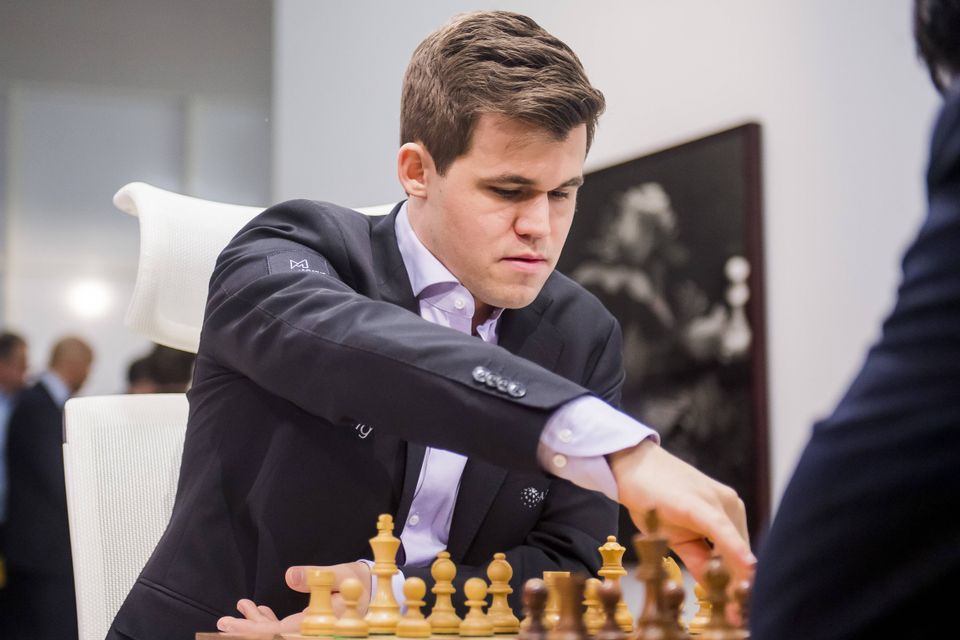
Magnus Carlsen at the chessboard in the colors of Norway
The question, stated plainly
A Chess Olympiad match is decided across four boards. Two match points for a win, one for a draw. Win three boards and lose one, and it counts exactly the same as winning all four — the match is yours. Over eleven rounds, the team with the most match points takes gold.
This scoring has a quiet consequence. A player on board one contributes, at most, one of four results in any given match. A grandmaster who scores 9/11 — a tournament-winning individual performance — has still left three-quarters of every match in other hands. If those hands are unsteady, the brilliance on board one becomes a personal statistic rather than a team result.
That is the structural reason a single star struggles to lift a team. What follows is what the data does with that idea — and where, in one well-documented case, we can watch it happen round by round.
Carlsen and Norway: the best player, the absent podium
Magnus Carlsen of Norway has been the highest-rated player in the world since 2011. He has held the classical world title, won the World Cup, and collected individual gold at team events. By any individual measure he is among the greatest players the game has produced.
Norway's Olympiad record with him reads very differently. Across eight Olympiad appearances between 2004 and 2024, Carlsen's teams finished as follows:
- 2004, Calvià — 39th of 129
- 2006, Turin — 31st of 148
- 2008, Dresden — 21st of 146
- 2010, Khanty-Mansiysk — 51st of 149
- 2014, Tromsø — 29th of 176
- 2016, Baku — 5th of 180
- 2022, Chennai — 59th of 187
- 2024, Budapest — 14th of 188
One genuine near-miss — fifth place in Baku 2016 — and otherwise a scatter of mid-table finishes, twice outside the top fifty. This is the team record of a country fielding the best player alive.
Carlsen's own scores were rarely the problem. His individual results across those events ranged from solid to outstanding, peaking at 83.3% in Chennai 2022 — where, strikingly, his personal excellence coincided with the team's 59th-place finish. He was, in the words of Krzysztof Puszczewicz's monograph on the 45th Olympiad, a leader who would "need substantial help from his teammates to fight for the podium." That sentence was written before a single move in Budapest. It reads, in hindsight, less like a preview than a diagnosis.
Budapest 2024: the pattern, round by round
Because that Olympiad is documented in detail, it serves as a case study — a chance to watch the structural problem unfold across eleven rounds rather than infer it from a final table.
Norway arrived in Budapest seeded sixth, with an average rating of 2670 across a line-up of Carlsen, Christiansen, Tari, Amar and Urkedal. Carlsen alone was rated 2832. The gap between his number and the team's average is, in a sense, the whole story.
He sat out the opening rounds — a routine choice for a star who cannot afford to tire. Norway beat South Korea comfortably without him in round one. Then came round two, and the first crack. Resting Carlsen again, Norway was held to a 2–2 draw by Canada, seeded 50th. The monograph records the detail plainly: of the eighteen top-seeded teams, Norway was the only one not to win its match, despite outrating Canada by more than 100 points on every board. The titan's absence, for a single round, was enough.
His arrival in round three became the tournament's most retold anecdote. With Budapest under heavy rain and the team car stuck in traffic, Carlsen rode a bicycle to the venue, reached the playing hall minutes before he would have forfeited on time, and — lacking his accreditation — had to be let in through the media entrance. He then won with the black pieces, and Norway beat Colombia 3.5–0.5. "I live in a different hotel from the rest of the team," he explained afterwards; with the roads jammed, "the bike could be faster."
For three rounds the team held its course — wins over Slovakia and Austria, Carlsen now playing. Then round six exposed the structure again. Norway lost 1.5–2.5 to Iran, and the monograph is precise about where the match was decided: on the fourth board, where Pouya Idani beat Frode Urkedal. Carlsen, meanwhile, had a serious advantage in the middlegame against Parham Maghsoodloo — and could only draw. The best player in the world did not lose. He simply could not be in four places at once.
Round nine ended Norway's tournament in the most literal way. The chapter's own title names it: Carlsen lost. Vladimir Fedoseev, on Slovenia's first board, beat him in the endgame, and Slovenia took the match 3–1 — removing, as the monograph puts it, any remaining hope of a podium. Norway finished 14th.
And here is the figure that holds the whole article together. On board one, Carlsen scored 6/8 — the fourth-best first-board result of the entire Olympiad, behind only Gukesh and Abdusattorov, ahead of Caruana and Rapport. The best player in the world played like the best player in the world. His team finished 14th. There is a small, telling coda: at the closing ceremony, the monograph notes Carlsen's absence as one of three "shadows" over the celebration — the titan not even in the room when the medals were handed out.
Budapest 2024 is not an anomaly in Norway's record. It is that record in miniature, documented round by round: a single extraordinary board, and not enough behind it.
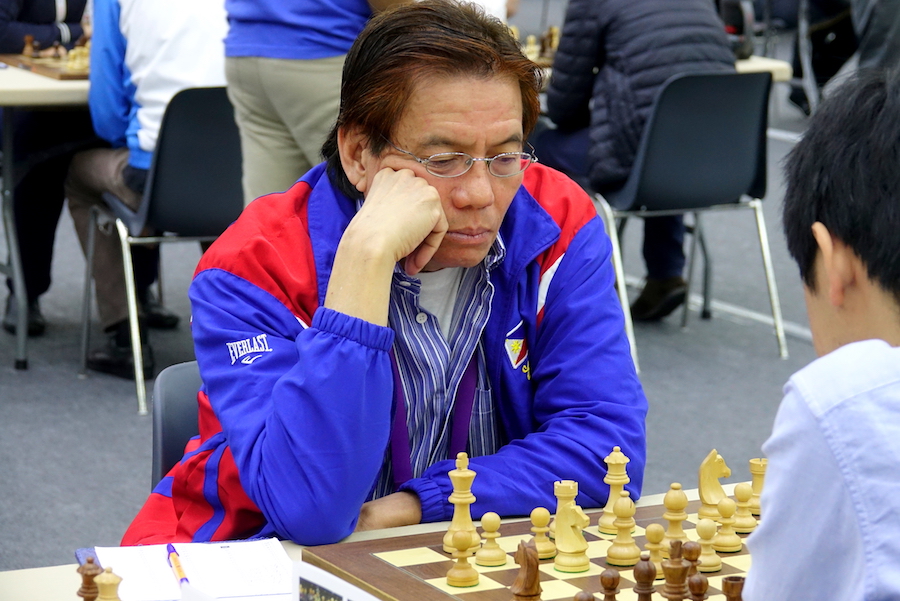
Eugenio Torre at the Chess Olympiad
Eugenio Torre and the Philippines: half a century on board one
If Carlsen's case spans a career, Eugenio Torre's spans an era. Torre, the Philippines' first grandmaster and for decades the standard-bearer of Asian chess, played a remarkable 23 Olympiads between Siegen 1970 and Baku 2016. For most of that span he sat on board one; only late in his career, in his sixties, did he move down the order.
In all those years, the Philippines' best team finish was 7th, at Thessaloniki 1988. Their results otherwise sat in the fourth and fifth tier of the standings:
- Nice 1974 — 11th of 75
- La Valletta 1980 — 15th of 82
- Thessaloniki 1988 — 7th of 107
- Manila 1992 — 31st of 102, on home soil
- Bled 2002 — 39th of 135
Torre's individual contribution was real and sustained. His Olympiad scores ranged from the modest to the excellent — 78.6% at La Valletta 1980, 73.7% at Nice 1974, 73.1% at Dubai 1986 — delivered year after year against the strongest player every opponent could put opposite him.
That last point is the whole of it. Torre routinely faced the best the other side had. Behind him, the Philippines fielded players who could not reliably win the boards he did not. He could deliver his point. He could not deliver the other three. Twenty-three Olympiads; one seventh place.
The pattern repeats
Carlsen and Torre are the clearest cases — one modern, one historical, both genuine board-one giants. The database holds others, and they rhyme.
Veselin Topalov, Bulgaria. A former world champion and, in the mid-2000s, briefly the highest-rated player on the planet. Topalov played nine Olympiads for Bulgaria between 1994 and 2016. His teams' best finish was 5th — in his very first appearance, Moscow 1994 — and after that, nothing better than 14th. At Dresden 2008 he scored a superb 81.3% on board one; Bulgaria finished 14th of 146. A world champion on top board is not, by himself, a podium.
David Navara, Czech Republic. For two decades Navara was the Czech Republic's clear number one — steady, elite and durable across eleven Olympiads from 2002 to 2024. At Istanbul 2012 he posted an outstanding 86.4% on board one; the Czech team that year finished 34th. His teams never placed higher than 11th, at Turin 2006. A country with real chess tradition, a reliable elite leader for twenty years, and not one team medal to show for it.
Pia Cramling, Sweden. The pattern is not a men's-section quirk. Cramling has carried the Swedish women's team across an extraordinary span — twelve Women's Olympiads in our records between Buenos Aires 1978 and Baku 2016, and a competitive career longer still. Her individual scores include 90.9% at Tromsø 2014 and 89.3% at Thessaloniki 1988 — numbers most players never approach. Sweden's best team finish across all those years was 7th, at Lucerne 1982. One of the finest careers the women's game has seen, and the same ceiling.
Five players. Different decades, federations, sections and styles. One shared outcome: a brilliant board-one career and a team that never reached the podium.
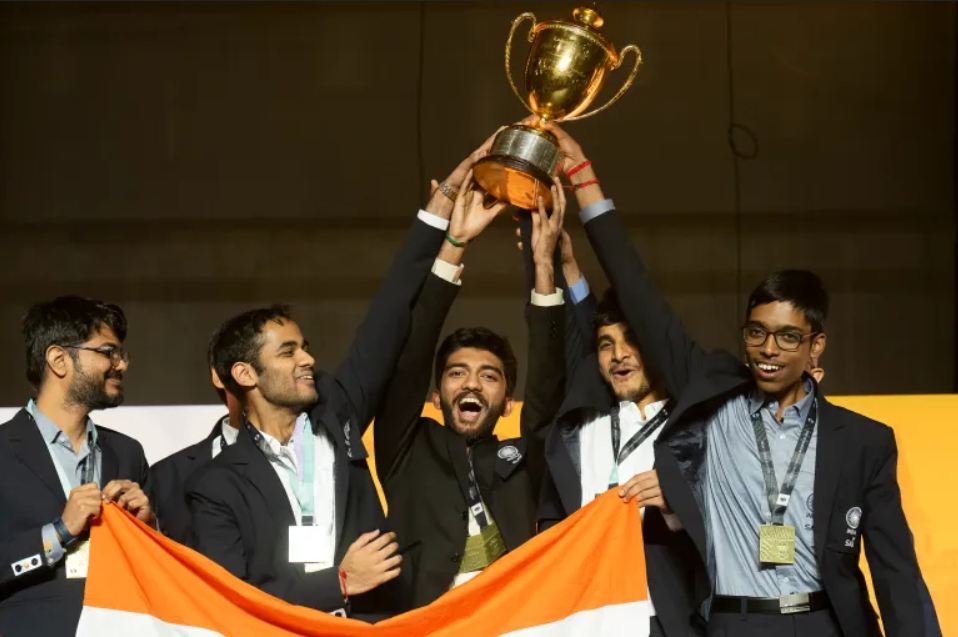
Team India celebrating Olympic gold
What the winners look like instead
The contrast is as instructive as the pattern. Look at who actually wins.
Uzbekistan took gold at Chennai 2022 with a squad whose average age was barely over 20 — five young grandmasters, none of them a singular global celebrity, all of them genuinely strong. India won at Budapest 2024 the same way: depth across all four boards, several elite players rather than one. The Budapest monograph makes the point in passing and often — India did not merely win, they went the entire event without losing a single match, powered by Gukesh and Erigaisi but never dependent on either alone. Neither champion was built around a lone titan. Both were built around the absence of a weak board.
That is what the data points to. It is not that stars do not matter — Carlsen, Topalov and the rest plainly won their own games. It is that the Olympiad rewards the team with no soft spot. Four solid boards beat one extraordinary board and three ordinary ones, almost every time, because the arithmetic of the match insists on it.
What it means for Samarkand
When the 46th Olympiad begins in Samarkand, the temptation will be to scan the top boards for the famous names and assume the famous names decide things. The history gathered here suggests otherwise. The teams that contend will be the ones that can win a match 2½–1½ on a bad day, because their fourth board held — not the ones whose first board won spectacularly while the match slipped away beneath it.
Whether Carlsen plays in Samarkand, and what Norway's line-up looks like if he does, remains to be seen. But the question worth carrying into the event is not "how good is their best player?" It is "how good is their weakest board?" Eight decades of Olympiad results — and one well-documented fortnight in Budapest — suggest that is where medals are actually decided.
History rhymes. In Samarkand, listen for the rhyme on board four.