






Uzbekistan's Golden Generation: How a Nation Became a Chess Superpower
In May 2026, Uzbekistan placed two players in the world's top 5. The four men who took it there were not yet 21 when they won Olympic gold — and they are not done yet.
The view from May 2026
The FIDE rating list for May 2026 contains a sentence that would have been unthinkable a decade earlier: Uzbekistan has two players in the world's top five. Nodirbek Abdusattorov is rated 2780. Javokhir Sindarov, fresh from winning the Candidates Tournament, is rated 2776. Between them sits Magnus Carlsen, who has been there for fifteen years.
This is the team that will defend its Olympic gold in Samarkand in September — on home soil, in front of a country that now treats chess the way other nations treat football. The story of how it happened compresses into about four years and one decisive afternoon in Chennai. The wider context, including what it means for Samarkand 2026, takes a little longer.
Table of contents
- The Chennai breakthrough
- Nodirbek Abdusattorov — the headline name
- Javokhir Sindarov — from prodigy to challenger
- Nodirbek Yakubboev — the steady fighter
- Jakhongir Vakhidov and Shamsiddin Vokhidov — the supporting cast
- Ivan Sokolov — the coach who arrived three months before gold
- The system behind the players
- What this means for Samarkand 2026
- Frequently asked questions
- Sources and further reading
The Chennai breakthrough
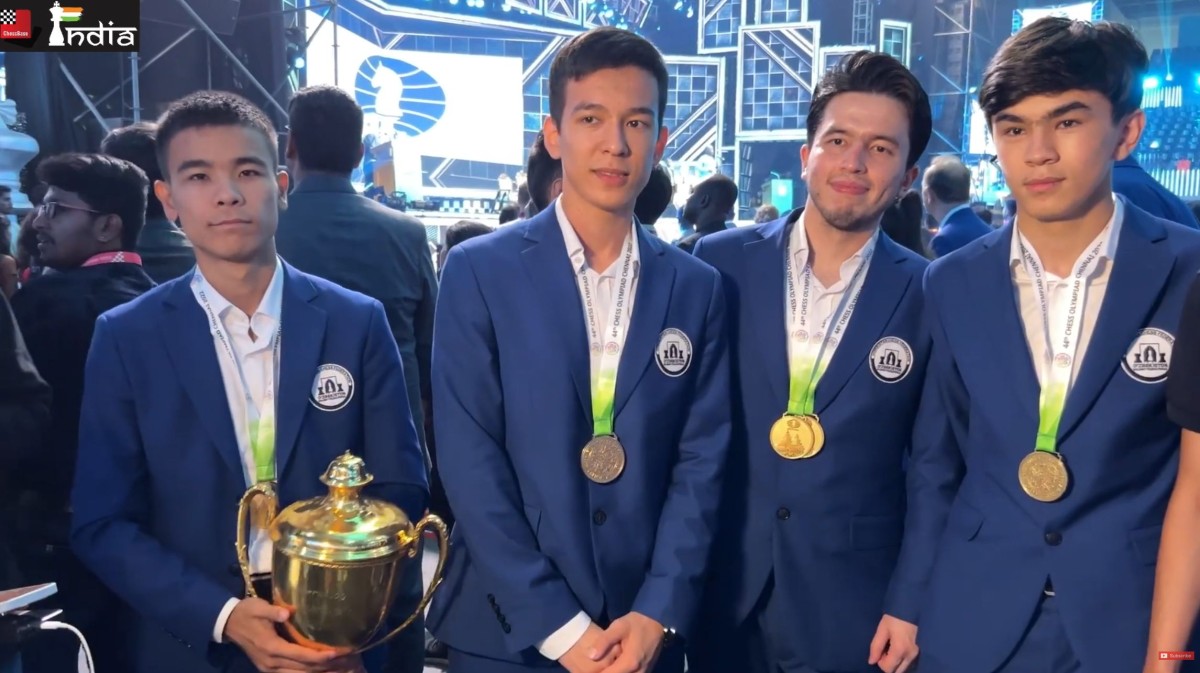
The 44th Chess Olympiad in Chennai, August 2022, was supposed to belong to other people. The United States arrived as top seeds with an average team rating of 2771 — well ahead of India A (2696), Norway (2692), and Spain (2687). Russia and China, both absent, would normally have been favourites. The Uzbek team's average age was 20. Three of its five players had not yet turned 21. Their captain on board one, Abdusattorov, had just turned 17 on the rest day.
They finished eleven rounds undefeated.
The roster, in starting board order, was Abdusattorov (17), Yakubboev (20), Sindarov (16), Shamsiddin Vokhidov (20), and the veteran Jakhongir Vakhidov (27). They scored 19 match points — 8 wins, 3 draws, 0 losses — tying Armenia and winning gold on tiebreaks. India's two teams, one of them a "B" squad composed almost entirely of teenagers including the future world champion Gukesh Dommaraju, finished fourth and third respectively.
Two matches shaped the outcome. In round 10, Uzbekistan met India 2 at the top of the standings. Gukesh, on board one for India 2, had won his first eight games and was the tournament's defining performer. Against Abdusattorov he reached a winning position, then — in ChessBase's phrasing — "lost the thread and blundered, losing on the spot." The match went to Uzbekistan. In round 11, with gold on the line, Uzbekistan faced the Netherlands. The decisive game was on board five, where Jakhongir Vakhidov defeated Max Warmerdam in what chess.com later called "the pivotal game for the entire match". After the match Vakhidov told the press conference: "I played for a win not only for my people but for my board. It was too much pressure."
The teams shook hands. Uzbekistan, ranked eleventh going in, had won. Abdusattorov posted a tournament performance rating of 2803 from the white side of board one. Yakubboev won individual bronze on board two with 8/11 and a 2759 performance — beaten only by Nihal Sarin (gold, India 2) and Nikolas Theodorou (silver, Greece) of the board-two field. President Shavkat Mirziyoyev awarded each player the honorary title "Uzbekiston iftikhori" — Pride of Uzbekistan. According to coach Ivan Sokolov, players received bonuses in the region of $55,000 plus a car, with some receiving "considerably more."
What had happened, as the chess world began to articulate over the following months, was not luck. It was the surfacing of a system that had been quietly producing grandmasters for a decade. Chennai 2022 — chronicled in detail in the Great Book of Chess Olympiads series alongside every previous edition since London 1927 — was the moment the rest of the world noticed.
Nodirbek Abdusattorov — the headline name
Nodirbek Fazliddin oʻgʻli Abdusattorov was born in Tashkent on 18 September 2004. He won the World Youth Chess Championship Under-8 division at the age of 8. At nine, in his home city, he defeated two grandmasters in a single tournament. He was the youngest player ever to enter FIDE's top 100 juniors, at age 11. FIDE awarded him the grandmaster title in April 2018, when he was 13 years, 1 month, and 11 days old.
The headline came in December 2021. At the FIDE World Rapid Championship in Warsaw, Abdusattorov — seeded 69th by rating — tied for first after the Swiss stage with 9.5 out of 13, having defeated the reigning world champion Magnus Carlsen and the reigning world championship challenger Fabiano Caruana along the way. In the playoff against Ian Nepomniachtchi, he scored 1.5 out of 2. At 17 years and 3 months, he became the youngest World Rapid Champion in history and, in any of the three time formats, the youngest world chess champion of any kind — surpassing Carlsen's own record from the 2009 Blitz Championship.
By the time of the Chennai Olympiad eight months later, he was Uzbekistan's board one. He played eleven games, scoring 8.5 out of 11 with a performance rating of 2803, and won individual silver on the top board behind Gukesh. He was 17.
The next four years did not slow down. In Tata Steel Masters 2026 — the most prestigious classical event on the annual calendar — Abdusattorov won outright after thirteen rounds, gaining 20 rating points and moving from twelfth to fifth in the world. He followed it in March 2026 with victory at the Prague International Chess Festival, becoming the only player to have won Prague Masters twice. By April 2026, the FIDE rating list placed him at world number 4 with a rating of 2780. The May list had him at 2780 still, now joined in the top 5 by his compatriot Sindarov.
Uzbek state recognition tracked his results. President Mirziyoyev awarded him an apartment in Tashkent after the 2021 World Rapid title and a car after the Chennai gold — gestures that, taken with similar awards to teammates, signalled how seriously the state was taking the program.
Javokhir Sindarov — from prodigy to challenger
Javokhir Sindarov was born in Tashkent on 8 December 2005, into a family where chess was an everyday presence. His grandfather Komil taught him to play at age four and a half. By 2018, aged 12 years, 10 months, and 8 days, Sindarov had earned the grandmaster title — at the time, the second-youngest in history. He was the youngest player on Uzbekistan's Chennai 2022 roster at sixteen.
Then came the year that changed his career. In January 2025, Sindarov began working with the chess coach IM Roman Vidonyak. By summer 2025, his FIDE rating had crossed 2700 for the first time. As the sixteenth seed in the 2025 FIDE World Cup, he beat Yu Yangyi, Frederik Svane, and José Martínez Alcántara to reach the semifinal — where he met his compatriot Yakubboev. After tiebreaks, Sindarov advanced. In the final, against Wei Yi, the two players drew the two classical games and the first tiebreak game; Sindarov then won the second tiebreak game and the title. He was 19 years, 11 months, and 18 days old. He became both the youngest World Cup winner ever, and the first Uzbek to win it. President Mirziyoyev awarded him the Order of "Mehnat Shuhrati" — Labour Glory.
Qualification for the 2026 Candidates Tournament followed. In Cyprus in April 2026, Sindarov went one further. He won the Candidates — beating, among others, Fabiano Caruana in round 4 — and earned the right to challenge the reigning world champion. The match against Gukesh D is provisionally scheduled for November to December 2026, in a venue still to be announced. When it begins, both players will be 20 years old. It will be the youngest World Chess Championship match in history.
Sindarov's coach Vidonyak has described him as possessing what he calls a "universal talent" — a player who, in Vidonyak's words, "is comfortable playing with either colour" and combines tactical sharpness from his prodigy years with the strategic patience needed at the elite level. The Sindarov who plays in Samarkand in September will be the world championship challenger, two months out from the most important match of his career. Every game he plays on board one or two for Uzbekistan will be analysed obsessively by Gukesh's team. He will be analysing Gukesh's possible play in turn. The Olympiad, for Sindarov, is also a public training camp.
Nodirbek Yakubboev — the steady fighter
Nodirbek Yakubboev was born in Tashkent on 23 January 2002. He took the grandmaster title in 2019, the same year he started establishing himself on the Uzbek national stage with three national championships behind him (2016, 2018, 2020). His older sister Nilufar Yakubbaeva, a Woman International Master, won multiple Uzbek women's national titles in the same period — the family produced two simultaneous national champions in 2020.
His Chennai 2022 performance was, in many ways, the quiet engine of the gold-medal run. On board two, against the strongest second boards in the world, Yakubboev scored 8 out of 11 (+6 −1 =4) for a performance rating of 2759. That earned him individual bronze for board two — behind India 2's Nihal Sarin (gold) and Greece's Nikolas Theodorou (silver). Asked in the closing press conference whether he had been aware of his individual medal chances heading into his board-two game against Jorden van Foreest in the final round, Yakubboev replied: "Team medal is more important than individual."
The career arc since has been steady rather than meteoric. In October 2023 he won the Qatar Masters, defeating Abdusattorov in a blitz tiebreak — in a field that had included Magnus Carlsen and Hikaru Nakamura. In June 2024, as the bottom-seeded player in the UzChess Cup Masters in Tashkent, he won outright, again with Abdusattorov second. In August 2024, he added the Abu Dhabi International Chess Festival Masters with 7/9. In late 2025, in the FIDE World Cup that his compatriot Sindarov would ultimately win, Yakubboev reached the semifinal before losing to Sindarov in tiebreaks, then lost the third-place playoff to Andrey Esipenko. By December 2025, his rating peaked at 2691 and he was ranked around 36 in the world.
One incident from the 2025 Tata Steel tournament drew controversy. Yakubboev declined to shake hands with four female opponents, citing religious reasons. The episode generated significant debate in the chess press. Yakubboev later apologised directly to GM Vaishali Rameshbabu, expressing respect for her as a player; both players ended the conversation on respectable terms. The episode is part of his record. So is the way it was resolved.
What attackingchess.com called "the quiet fighter" is, in chess.com's earlier characterisation, "as classical as it can be" — a stylistic compliment from a chess.com article praising the technical depth and positional clarity of the Uzbek school. Yakubboev's games against grandmasters like Evgeny Tomashevsky, where his opponent at times "could barely move," sit comfortably alongside the classical heritage of Akiba Rubinstein and José Raúl Capablanca — at least, that is the comparison chess.com chose to draw.
Jakhongir Vakhidov and Shamsiddin Vokhidov — the supporting cast
Two players from the Chennai 2022 roster share variations of the same surname and are sometimes confused. They are different people.
Jakhongir Vakhidov was the team's veteran in Chennai at age 27 — born around 1995, the only player on the roster in his late twenties when the rest were teenagers or barely into their twenties. He played board five (reserve) in Chennai. His final-round game against Max Warmerdam on board five was the decisive moment of the Olympiad — chess.com identified it as the Game of the Day for round 11 and the moment Uzbekistan secured gold. Vakhidov's role on the team has been the role of every good reserve and senior player on a young squad: stability, experience, and the willingness to take the table that the captains decide must be won.
Shamsiddin Vokhidov is a different player — 20 years old at Chennai 2022, born around 2001 or 2002. He also played as part of the Chennai squad and is part of the broader Uzbek elite of the 2020s. He has been mentioned by chess.com in features on the Uzbek school as one of the talents whose style typifies the classical-chess foundation that runs through the federation's coaching.
Both players are part of why Uzbekistan, in 2026, has not just a top of the ratings list but a depth. The Olympiad is a team event; depth wins it.
Ivan Sokolov — the coach who arrived three months before gold
The story of how Ivan Sokolov became Uzbekistan's head coach is more accidental than the gold medal it produced would suggest. In May 2022, Sokolov — Dutch-Bosnian grandmaster, former world top 12, original plan to commentate at the Chennai Olympiad — was approached by the Uzbekistan Chess Federation during the Sharjah Masters. They asked him to coach the national team instead. He accepted, cancelled the commentary contract, and flew to Tashkent at the end of June.
He had under three months to prepare a team for the Olympiad.
The first meeting in Tashkent included Yakubboev, Sindarov, Vakhidov, and Shamsiddin Vokhidov. Abdusattorov, then playing in Biel, joined later. Sokolov's methodology, by his own account, focused on middlegame structures and decision-making in tournament fights rather than on opening novelties. "I told them don't expect me to work on positions to find some blockbuster novelties," he said in an interview after the Olympiad. "I was not doing this as an active player and I'm not going to do it here either. But I can improve situations at other levels." He built databases of middlegame positions arising from the openings the team played, organised by structure rather than by opening name.
Sokolov's coaching résumé predated Uzbekistan. He had worked with the UAE national team from 2013 to 2016, coaching Salem Saleh to the Asian Championship. He moved to Iran in 2016, working with the team that included Alireza Firouzja and Parham Maghsoodloo. As a player himself, Sokolov had been world number 12 three times in the 1990s and early 2000s, and had defeated five world champions in classical games: Garry Kasparov, Vladimir Kramnik, Viswanathan Anand, Veselin Topalov, and a young Magnus Carlsen. He brought to Tashkent the perspective of someone who had been at the elite himself and who had then worked exclusively with young teams ambitious enough to disrupt the established order.
After Chennai 2022, Sokolov took a break from Uzbekistan and coached Romania at the 2024 Budapest Olympiad. Uzbekistan was captained that year by former World Champion Vladimir Kramnik, and won bronze. Sokolov returned to the Uzbek federation in 2025. In November 2025, chess.com named him Coach of the Month, citing both the Chennai Olympiad gold and his European Team Championship results in 2025, where his teams finished first and fifth. He is, as of 2026, head coach of the Uzbek squad heading into Samarkand.
The system behind the players
Four grandmasters peaking in the same generation is not coincidence. The Uzbek federation invested deliberately in the infrastructure that produced them.
The most visible signs are state-level rewards. After the 2021 World Rapid title, President Mirziyoyev awarded Abdusattorov an apartment in Tashkent. After Chennai 2022, the team received presidential congratulations by phone during the closing match, plus the "Uzbekiston iftikhori" honorary titles. The chess.com Sokolov interview mentioned reported bonuses of approximately $55,000 per player plus a car, though Sokolov noted the actual figure was higher for some. After Sindarov's Candidates win in April 2026, Mirziyoyev presented him with the Order of "Mehnat Shuhrati" — Labour Glory, a national civilian decoration.
The less visible signs are tournaments and coaching. The UzChess Cup Masters, held in Tashkent, has become one of the strongest annual closed tournaments in the region. The Uzbek Chess Championship — won three times each by Yakubboev — is a serious testing ground rather than a token title. Coaching pipelines include Sokolov at the national-team level and IM Roman Vidonyak working with Sindarov individually since January 2025. Domestic events provide a steady playing schedule without the cost of constant international travel for the country's young players.
Regional context matters too. Uzbekistan is not the only Central Asian republic producing serious chess. Kazakhstan's Bibisara Assaubayeva, a three-time Women's World Blitz Champion, sits in the world women's top 10 as of May 2026. Kazakh men's chess has also strengthened. The picture is one of a regional cluster, with Uzbekistan currently leading but not isolated.
A note from the editor: the comparison that follows is editorial observation rather than a claim drawn from a single cited source. The Uzbek federation today appears to play a role broadly comparable to what the Indian All India Chess Federation has played for Indian chess — investment in coaching, identification of prodigies early, financial support tied to results, and visible state backing that signals to a country's parents that chess is a serious profession. The Indian model has produced a world champion (Gukesh) and an entire generation of 2700+ grandmasters. The Uzbek model has produced an Olympic gold and two players in the world top 5. The next ten years will show how much further both can go.
What this means for Samarkand 2026
Uzbekistan goes into Samarkand 2026 as defending champions on home soil, with the world number 4 on board one and the world championship challenger on board two. The team is at its competitive peak by every measurable indicator.
Three caveats apply.
First, defending Olympic gold is harder than winning it. In Budapest 2024, two years after Chennai, Uzbekistan won bronze — a medal, but not a defended title. India won the Open section that year (and the Women's as well); the United States took silver. The Uzbek team in Budapest fielded the same five players as Chennai, with former World Champion Vladimir Kramnik captaining instead of Sokolov. Individual standouts included Abdusattorov's silver on board 1 (9/11) and Shamsiddin Vokhidov's gold on board 4 (8/10). The team finished tied on 17 match points with the United States and Uzbekistan, with tiebreaks deciding the medal order.
Second, home-soil pressure is real. The Olympiad is being held in Samarkand for the first time. The state, the federation, and the country expect a result. Three of Uzbekistan's top players are 21 or younger as of September 2026; one is 24. Managing the expectation along with the chess is its own preparation.
Third, the competition has caught up. India fields two teams of staggering depth — Gukesh as world champion, Praggnanandhaa, Erigaisi, Vidit, Harikrishna in the open section. The United States arrives with Caruana, Nakamura, Aronian, So, and Robson. China is rebuilding around Wei Yi and Yu Yangyi. The teams that finished in Uzbekistan's slipstream in 2022 have spent four years preparing for a rematch.
What Samarkand 2026 will likely show is whether the Uzbek model — early identification, state backing, focused coaching, deliberate event-hosting at home — is reproducible across an Olympic cycle. Chennai 2022 was the breakthrough. Samarkand 2026 is the test.
Whatever happens in September, the rating list is already out. Two players from a country of 36 million in the world's top five. A challenger for the world title two months after the Olympiad. A coach who has built a methodology that, after four years, has not stopped producing results.
It is, by any historical measure, a golden generation.
Frequently asked questions
Who are the players in Uzbekistan's golden generation?
The core group, all grandmasters, are Nodirbek Abdusattorov (born 2004, world number 4 in April 2026 with a rating of 2780), Javokhir Sindarov (born 2005, World Cup 2025 winner and Candidates 2026 winner, rated 2776 in May 2026), Nodirbek Yakubboev (born 2002, three-time Uzbek Champion and World Cup 2025 semifinalist), Jakhongir Vakhidov (born around 1995, the senior figure who played the decisive game in Chennai 2022), and Shamsiddin Vokhidov (born around 2001, part of the broader Uzbek elite of the 2020s).
How did Uzbekistan win the 2022 Chess Olympiad?
Uzbekistan won the 44th Chess Olympiad in Chennai with 19 match points, undefeated across eleven rounds (8 wins, 3 draws). They tied with Armenia on match points and won gold on tiebreaks. The decisive moments were a round 10 victory over India 2 (in which Abdusattorov defeated Gukesh on board one) and a round 11 victory over the Netherlands, where Jakhongir Vakhidov won the deciding game on board five against Max Warmerdam.
What was the average age of the Uzbek team at Chennai 2022?
The five players were Abdusattorov (17), Yakubboev (20), Sindarov (16), Shamsiddin Vokhidov (20), and Jakhongir Vakhidov (27). Average age: 20.0. This was the youngest team ever to win Olympic gold in the modern history of the event.
Who is Ivan Sokolov?
Ivan Sokolov is a Bosnian-Dutch grandmaster, born in 1968, who was a top-15 world player in the 1990s and 2000s. He has defeated five world champions in classical games — Kasparov, Kramnik, Anand, Topalov, and Carlsen. As a coach, he has worked with the United Arab Emirates (2013–2016), Iran including Alireza Firouzja (2016–2019), and Uzbekistan (since May 2022). He led Uzbekistan to gold at the Chennai 2022 Olympiad, took a break during the Budapest 2024 cycle (when he coached Romania and Vladimir Kramnik captained Uzbekistan to bronze), and returned as head coach for Samarkand 2026.
Why is Sindarov playing in the World Chess Championship?
Javokhir Sindarov won the FIDE World Cup in 2025, qualifying for the 2026 Candidates Tournament. He then won the Candidates in Cyprus in April 2026, earning the right to challenge the reigning world champion, Gukesh D of India. The match is provisionally scheduled for November to December 2026. Both players will be 20 years old at the start of the match, making it the youngest World Chess Championship in the history of the title.
Will all four Uzbek stars play in Samarkand 2026?
Final team rosters for Samarkand 2026 are confirmed by FIDE closer to the start of the event. The expected core is Abdusattorov, Sindarov, Yakubboev, Vakhidov, and Vokhidov — substantially the same group as Chennai 2022, with the players now four years more experienced. Whether Sindarov plays board one or board two will likely depend on team management around his upcoming World Championship match.
How does Uzbekistan compare to India in modern chess?
India has the reigning World Champion (Gukesh), plus Praggnanandhaa, Erigaisi, Vidit, Harikrishna, and a deep women's program — arguably the strongest national chess programme of the 2020s overall. Uzbekistan has the most recent Olympic gold (Chennai 2022), two players in the world top 5, and the challenger for the next World Championship. Both nations represent the geographic and demographic shift of elite chess toward Asia. The Olympiad in Samarkand and the World Championship in late 2026 will be measured against this broader regional context.
What is the Uzbek system that produces these players?
It combines state-level financial reward for results (apartments, cars, civilian honours), focused coaching (Sokolov at the national-team level, IM Vidonyak with Sindarov individually), domestic tournaments of increasing strength (UzChess Cup), and federation-level talent identification that begins in the youth competitions. Three of the four headline names took the grandmaster title at 13 or younger.
Sources and further reading
This article draws on:
- FIDE Chess Olympiad 2022 official results and individual board prize standings (fide.com)
- ChessBase: "The winners of the 44th Chess Olympiad (Open)", 10 August 2022
- chess.com: "Uzbekistan Wins Gold In Open; Ukraine In Women's", round 11 report 2022
- chess.com: "Interview: Captain Ivan Sokolov On Coaching Gold-Winning Uzbek Chess Squad", August 2022
- chess.com: "Chess.com Coach of the Month GM Ivan Sokolov", November 2025
- chess.com: April 2026 FIDE Ratings article
- ChessBase: FIDE ratings March 2026 and May 2026
- kun.uz: "FIDE April update: Abdusattorov retains world number four as Sindarov nears top 10"
- Wikipedia: Nodirbek Abdusattorov, Javokhir Sindarov, Nodirbek Yakubboev, Ivan Sokolov (cross-verified with primary sources where possible)
- Grokipedia: Nodirbek Yakubboev (cited Uzbek presidential decree for honorary title)
- attackingchess.com: profile of Yakubboev at 2025 World Cup
- ChessMood: post-Olympiad interview with Ivan Sokolov on coaching methodology
- European Chess Union closing-day Olympiad report, August 2022
For readers interested in the deeper history of the Chess Olympiad — every edition from London 1927 to Budapest 2024 — the Great Book of Chess Olympiads series by Krzysztof Puszczewicz remains the most comprehensive English-language chronicle of the event. The Chennai 2022 volume documents the breakthrough described in this article; the Samarkand 2026 volume will, in due course, document how this generation defended (or did not defend) the gold they won.
Chess on the Silk Road returns to Samarkand from 15 to 28 September 2026. We will be covering it from the first round onward.