






Samarkand for Visitors: A Practical Guide to the 46th Chess Olympiad's Host City
Thousands of players and fans will fly into a city most of them have only read about. Here is the Samarkand they will actually walk through — how to arrive, where people stay, what to see, and how to feel the place between rounds.
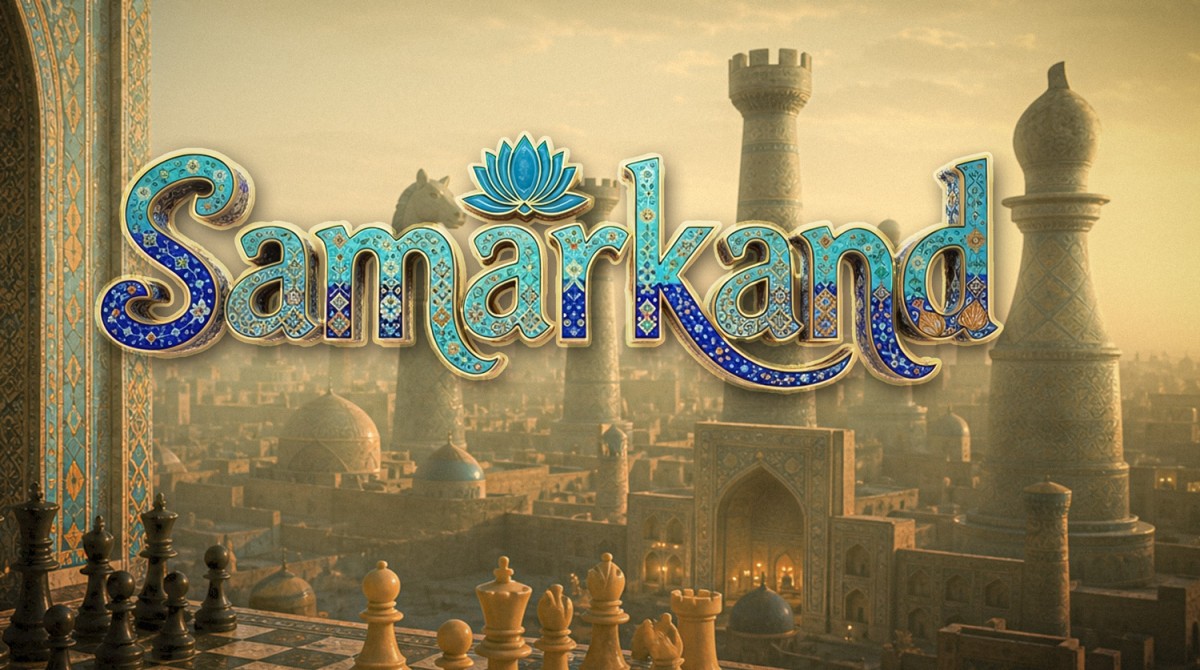
For two weeks in September 2026, several thousand people will do something Samarkand has not seen on this scale in its 2,700-year history: arrive all at once, from nearly 190 countries, to play and watch chess. Most have never set foot in Uzbekistan. Many know the word Samarkand only as a sound from old poems and atlases — somewhere east of almost everything.
This article is for them. It gathers the ordinary things any traveller looks up before landing in an unfamiliar city — how to get in, how to get around, where people stay, what is worth a free afternoon — so a chess player heading to the 46th Olympiad does not have to assemble it from a dozen browser tabs.
One thing said up front: everything below is compiled from publicly available sources — travel guides, official portals, transport sites, weather records. OlympChess has not checked these details on the ground, and we are not a travel agency. Treat this as a tidy starting point, not a replacement for the official source — especially for visa rules, schedules, and prices, all of which move. Where something changes, we say so and point you to where to look.
And a word on tone: we write as observers, not authorities. We describe what visitors generally do and what the city generally offers. Samarkand, for what it is worth, tends to outrun the expectations people bring to it.
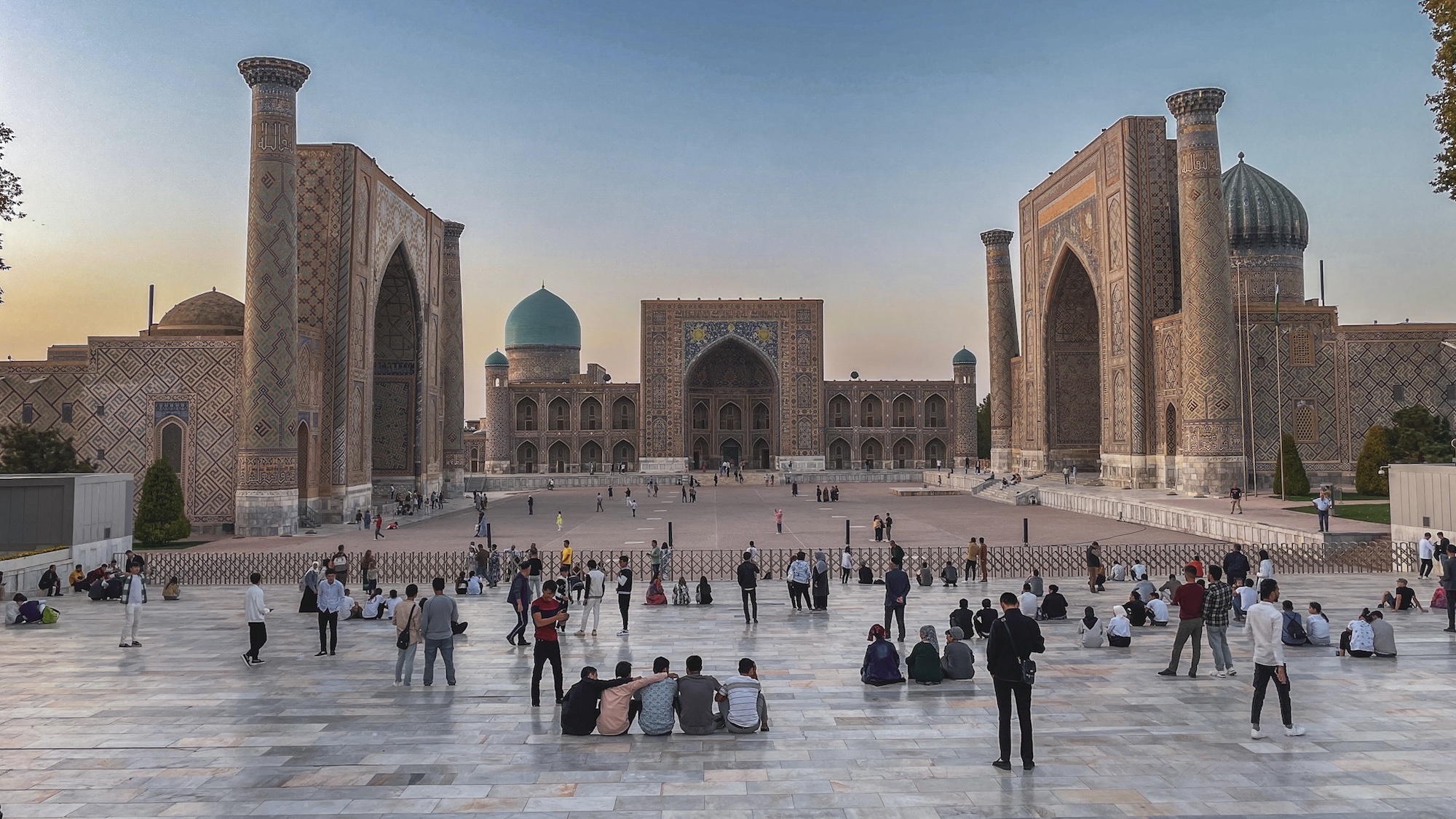
Registan Square, the symbolic heart of Samarkand
Why this city earns the trip
First, the case for caring. FIDE did not pick Samarkand off a map at random.
It is one of the oldest continuously inhabited cities in Central Asia — already ancient when Alexander of Macedon took it in 329 BC — and for centuries it sat on the Silk Road, the trading network along which goods, ideas, and the game of chess itself travelled west from India toward Persia and Europe.
The Samarkand most visitors picture belongs to one stretch of time: the late 14th and 15th centuries, when the conqueror Timur (Tamerlane) made it his imperial capital and dragged in craftsmen from across the conquered world to build it. His grandson Ulugh Beg — a ruler who was also a serious astronomer — added an observatory and a court culture of science and learning. What survives from that era is why UNESCO inscribed Samarkand as a World Heritage Site in 2001, naming it a crossroads of cultures and a landmark in the history of Islamic architecture.
For a chess traveller the symbolism is almost too tidy: a game that crossed Asia along these roads, returning for its largest team event to one of the road's great cities. You do not need to care about any of that to enjoy the trip. But it is there, under your feet — and it is part of why a free afternoon in Samarkand lands differently than a free afternoon anywhere else on the Olympiad circuit.
Getting there
Samarkand has its own international airport — Samarkand International Airport, code SKD — recently rebuilt and only a short drive from the centre. That is the line most travellers want to hear: you can, in principle, fly straight in.
The reality is more layered, and worth knowing before you book:
- Direct international flights to SKD exist, but they are limited and partly seasonal. The airport reaches a couple of dozen destinations, weighted heavily toward Russia, Central Asia, and regional hubs, with some routes running only in the warmer months. For most intercontinental travellers, a direct flight all the way to Samarkand simply will not be an option.
- Tashkent is the real gateway. Uzbekistan's capital has the country's largest international airport and far broader long-haul reach — Turkish Airlines and a spread of regional and European carriers serve it. The usual pattern for a visitor from Western Europe, the Americas, or East Asia: fly into Tashkent, then continue to Samarkand.
- The Tashkent–Samarkand leg is the easy part. There is a short domestic flight, but the better option for most people is the high-speed Afrosiyob train, which covers the roughly 300 km in around two hours on a comfortable modern service. City centre to city centre, no airport security ritual, and a window onto the country in between — for many visitors the train wins on every count.
Because the Olympiad runs in mid-to-late September and demand will be unusually bunched up, the advice here is the boring kind: book early, and lock in the Tashkent–Samarkand connection — flight or train — as soon as your international ticket is set. Train seats in particular are finite and disappear fast.
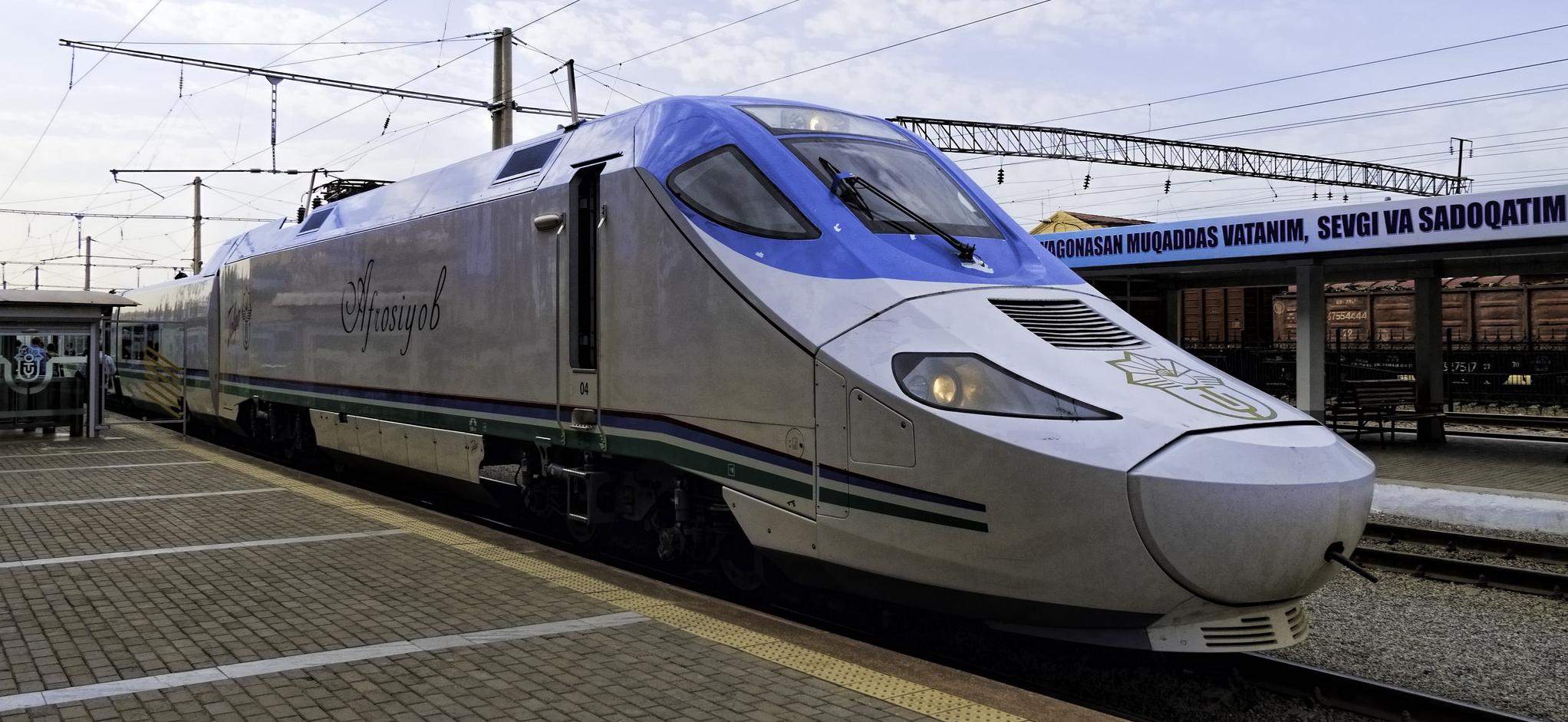
he Afrosiyob train links Tashkent and Samarkand in about two hours
A word on visas
Here is a genuinely good piece of news for Olympiad travellers: Uzbekistan has spent recent years tearing down the visa wall that once made the country a project to visit.
As of 2026, citizens of a long list of countries — the EU and Schengen states, the UK, the US, Canada, Australia, New Zealand, Japan, South Korea, and many more — can enter visa-free for short stays, usually up to 30 days. Travellers from many countries outside that list use the official e-visa system, applied for online in advance at the government portal e-visa.gov.uz, with modest fees and a turnaround usually measured in a few business days.
Two cautions, because visa rules are exactly the thing that changes and exactly the thing you do not want to get wrong:
- Eligibility and length of stay depend on your specific passport. Check the current rule for your own nationality before you travel — not a teammate's, not this article's.
- Use only the official e-visa portal. Visa systems attract lookalike sites that charge a markup for nothing.
For a national federation moving a delegation, this is the part to settle early rather than late.
Getting around the city
Samarkand is not a hard city to move through, and visitors lean on a small, predictable set of options.
Taxis and ride apps. The most convenient tool for a visitor is the Yandex Go app, widely used across Uzbekistan. It shows the fare before you commit, which removes the single most stressful part of taking a taxi abroad — the haggle. Street taxis exist (often just an ordinary driver pulling over for you) and they are cheap, but they need bargaining and a bit of nerve. The app is the low-friction default.
Buses and trams. Samarkand has city buses and a tram line, both cheap and heavily used by locals. For a short-stay visitor sticking to the centre, you will rarely need them — but they are there.
On foot. This is the part worth underlining. The cluster of monuments most people come for is compact, and the historic core is largely walkable — the headline sights are ten to twenty pleasant minutes apart, not a cross-town trek. For a player with an afternoon free between a morning round and an evening meal, the centre is comfortably yours on foot.
Orientation, broadly. It helps to know Samarkand has two faces. There is the historic city — the streets around Registan and the great monuments — and the modern city, mostly to the west, where the bulk of Samarkand's roughly half a million residents actually live and work. The airport and the train station each sit a short ride from the centre. You do not need a detailed mental map before you land; you need only the rough shape — sights clustered, centre walkable, a ride app to bridge anything longer.
Where visitors usually stay
We do not rank hotels, and a chess traveller's bed is often booked by a federation or a tour operator rather than chosen freely. But the question behind "where should I stay" is really a question about neighbourhoods — and that we can usefully describe.
Most visitors who choose their own lodging drift toward the historic centre, near Registan. The logic is plain: it puts the major monuments within walking distance and drops you inside the part of the city you came to see. Samarkand has expanded its accommodation a great deal in recent years — international-branded hotels, mid-range options, family-run guesthouses, hostels — across a wide spread of budgets, and a large share of them sit exactly where that instinct points.
A second cluster sits in the modern city to the west. Staying there usually means lower prices and a more everyday, local texture, traded against a short ride to the monuments. And here is a point worth holding onto: if your days are anchored at the Olympiad playing venue rather than at the tourist sights, proximity to that venue may matter more than proximity to Registan — a reason not to over-optimise for the historic centre until the official venue location is confirmed.
Two honest, non-specific cautions. First, September 2026 will be a high-demand window — the Olympiad lands in what is already a popular travel season and adds thousands of beds' worth of pressure on top. Book early. Second, prices and availability shift constantly, so any number we printed would be stale before you read it. Check current rates yourself, on whichever platform you trust.
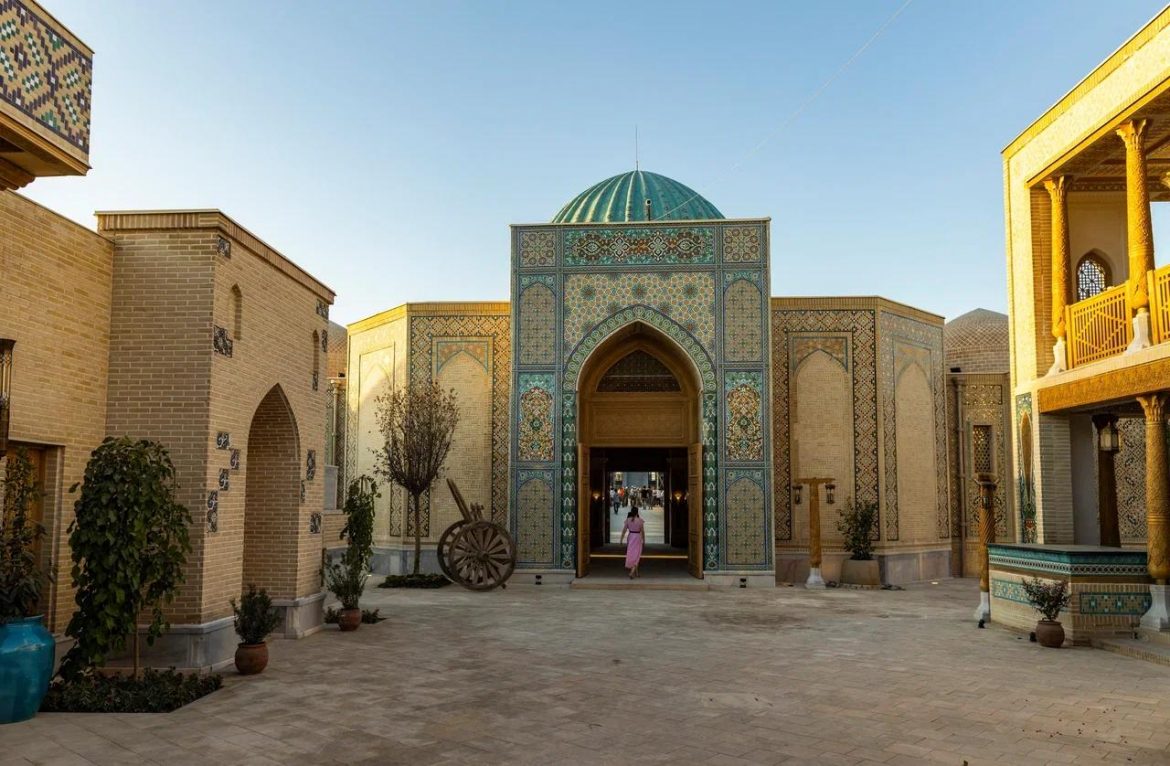
The historic centre is walkable and concentrated
What visitors come to see
Samarkand's monuments are the reason the word carries the weight it does. With even a couple of free afternoons spread across two weeks, a visitor can see the essential ones without rushing. Here is what people generally make time for.
Registan Square. The image that means "Samarkand". Three monumental madrasahs — Islamic schools — face onto a single public square: the Ulugh Beg Madrasah (early 15th century), and the Sher-Dor and Tilya-Kori madrasahs, both added roughly two centuries later. The scale, the symmetry, the tilework — it is one of the most photographed sights in Central Asia. It fills up from mid-morning on; visitors who want it quieter and better lit come near opening time or toward sunset. A small thing worth knowing: there is a café on an upper floor of one madrasah, and a coffee with that view is a fine reward for an early start.
Gur-e-Amir. The mausoleum of Timur — a compact building under a fluted turquoise dome that has echoed through architecture far beyond Uzbekistan. Central, easy to fold in with other stops, and for many visitors the single most beautiful interior in the city.
Bibi-Khanym Mosque. Once among the largest mosques in the Islamic world, raised at the peak of Timur's power and named, by tradition, for his wife. Much restored, still vast — and a handy anchor, because the city's great bazaar sits right next door.
Shah-i-Zinda. A narrow avenue of mausoleums climbing a slope, layered up over centuries. Plenty of visitors name it their favourite corner of Samarkand: the tilework is dense and intricate, and the lane-like shape makes it feel intimate where the grand squares feel monumental.
Ulugh Beg Observatory. What is left of the 15th-century observatory built by the astronomer-ruler — the surviving curved track of a giant instrument once used to measure the sky with startling accuracy. It sits a little further out and runs lighter on spectacle than the madrasahs, but for anyone drawn to the science-and-learning thread of Samarkand's story, it rewards the detour. Chess players, who tend to respect a precise calculation, may feel at home here.
A practical note across all of them: the monuments are ticketed, fees are modest, and the prices change — which is why we are deliberately printing no numbers. Pay at the gate, keep small local currency on hand for it, and treat any figure on an older blog as a rough hint, not a quote.
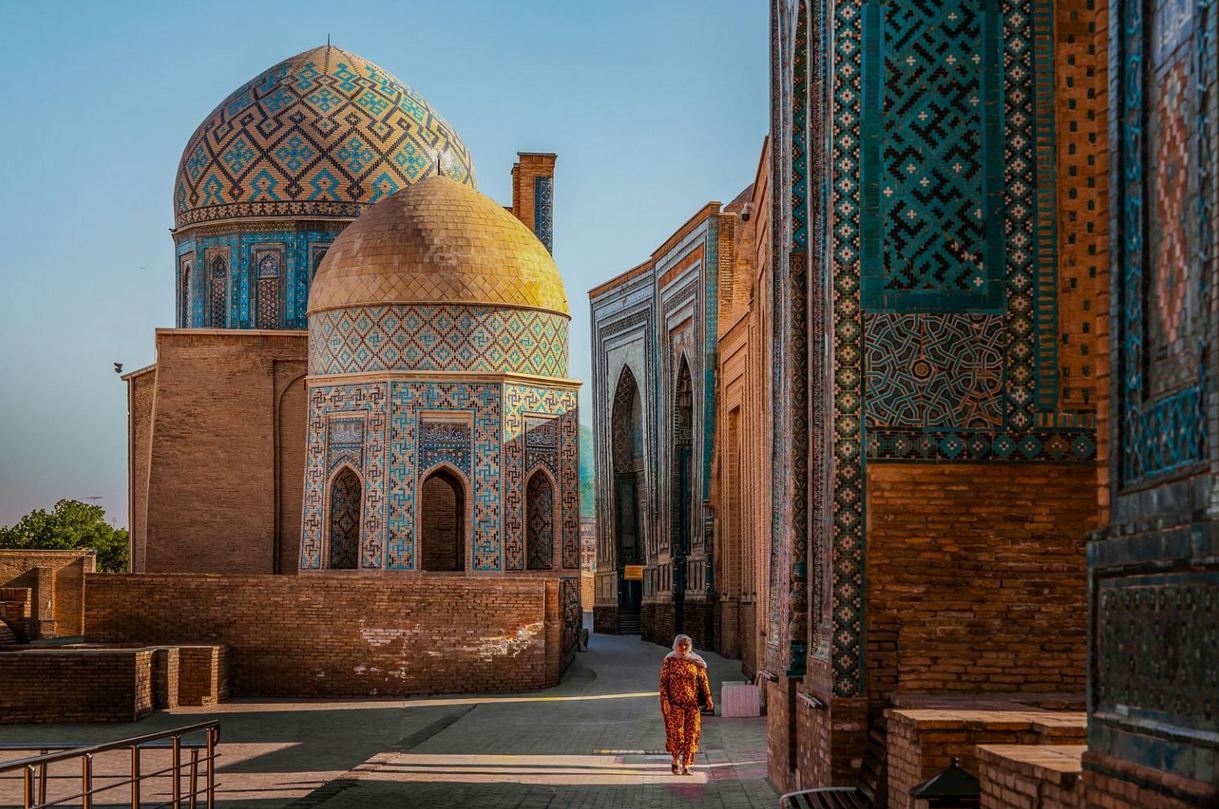
Shah-i-Zinda, a favourite of many visitors
Food, bazaars, and local life
The monuments are why people come. The everyday texture is often what they remember.
The bazaar. Next to Bibi-Khanym sits Siyob (Siab) Bazaar, Samarkand's largest and oldest market. Go not to buy anything in particular but to watch the city work — stalls of dried apricots, raisins, nuts, and spices; the round Samarkand bread, a local point of pride, stamped with patterns; cheeses, sweets, and the seasonal flood of a September harvest: grapes, melons, pomegranates, figs. It is a sensory hour, a free one, and a short walk from the major monuments.
The food. Uzbek cooking pays back the curious eater. A few dishes you will meet again and again:
- Plov — the national dish: rice cooked down with meat, carrots, and onion, with variations from region to region. Samarkand has its own style, where the ingredients are layered and steamed rather than stirred together — and locals will happily tell you why theirs is the right way.
- Lagman — hand-pulled noodles, served as a soup or fried with vegetables and meat. Watching it pulled is half the pleasure.
- Samsa — a baked pastry parcel of meat or pumpkin, often hooked straight out of a clay oven and worth eating hot.
- Shashlik — skewered grilled meat, the dependable backbone of an Uzbek meal.
- Bread, tea, fruit — bread turns up with nearly everything, green tea is the social default, and the September fruit is, by wide agreement, very good indeed.
Portions run generous, prices are gentle by Western European or North American standards, and the country's habit of hospitality means visitors are more often over-fed than short-changed. A modest tip — around ten percent — is normal courtesy in a restaurant.
Tea and the pace of things. The chaikhana — teahouse — is a real institution: a place to sit, drink tea, and let the afternoon slow to a stop. For a player carrying the fatigue of a long round, an hour in a teahouse may do more good than another hour of opening prep. We say that as observers, not coaches — but the option is there, and it is very Samarkand.
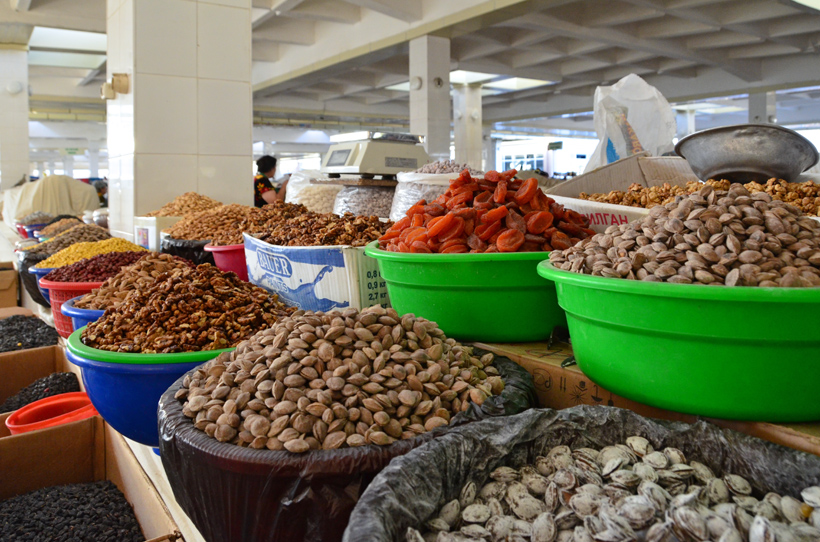
Siyob Bazaar, beside Bibi-Khanym Mosque
Practical notes worth knowing before you land
A handful of small, durable facts that smooth the first day in any unfamiliar city.
Weather. September is one of the best months to be in Samarkand — part of the reason the Olympiad sits where it does. Historically the month brings warm but easy days, with highs commonly in the mid-20s Celsius (mid-to-high 70s Fahrenheit) and cooler weather in the second half. Evenings turn cool, and rain barely shows up — Samarkand Septembers are dry and bright, often logging just a day or so of rain across the whole month. Pack for warm days and noticeably cooler nights, bring sun protection for daytime sightseeing, and count on pleasant evenings outdoors.
Money. The local currency is the Uzbek som. Cards are increasingly accepted in hotels and larger places in a city of Samarkand's profile, but cash still earns its keep — for the bazaar, for monument entry, for small purchases and tips. Carry some local currency; do not lean on a card alone.
Connectivity. A local SIM or an eSIM is the simplest way to stay online independently of hotel Wi-Fi. For a player who wants reliable mobile data — for maps, for the ride app, for following the rest of the Olympiad — it is worth sorting out early.
Language. Uzbek is the state language and Russian is widely understood. English is less universal but increasingly present in the tourism and hospitality side of a UNESCO city that has spent years opening up to the world. A translation app covers the gaps, and a few words of greeting are appreciated far out of proportion to the effort.
Safety and the ordinary. Samarkand is generally regarded as a comfortable, welcoming city for visitors. The advice is the universal advice for arriving anywhere new: keep an eye on your belongings in crowded spots like the bazaar, use the ride app rather than unmarked cars late at night, and carry your passport or know how your hotel handles registration. None of this is Samarkand-specific — it is just the baseline of being somewhere unfamiliar.
If you have a full day spare
The Olympiad schedule includes rest days, and some delegations arrive early or leave late. Visitors with a clear day sometimes use it to step outside the city.
Shahrisabz, Timur's birthplace, lies a drive away over a mountain pass — a smaller town with its own monumental ruins and a quieter air. Bukhara, another of the great Silk Road cities, is further but reachable by train, and for many travellers it is a highlight of Uzbekistan in its own right — a denser, more lived-in old city than Samarkand's monument-and-square layout. Neither makes a casual outing mid-schedule, but for anyone bookending the Olympiad with extra days, they turn a chess trip into a real encounter with the country.
We will not draw an itinerary here — that is beyond our remit, and beyond what one article can responsibly fix in advance. The point is only that Samarkand works as a gateway as much as a destination, and the players and fans who treat it that way tend to fly home with more than results.
Useful links and where to check
A traveller heading somewhere new wants a short list of places to verify things at the source. Here is ours — kept deliberately short, because Uzbekistan's official tourism web presence is patchy, and a long list of half-official links would help nobody. Each entry below is either a genuine official source or a clear pointer to where to look.
- Visas — e-visa.gov.uz. The Uzbek government's official e-visa portal. Use it to check whether your nationality needs a visa at all and, if so, to apply. This is the one link to bookmark. Treat any other site offering "Uzbekistan visa services" with suspicion.
- Flights into Samarkand — samarkandairport.com. The official site of Samarkand International Airport (SKD), with airport transport details and contacts. Useful for confirming how to get from the terminal into town.
- Trains — the official Uzbekistan Railways website and the "UzRailway" app. The Afrosiyob between Tashkent and Samarkand is best booked through the national railway's own channels. Be careful here: a swarm of third-party resellers ranks highly in search and looks semi-official. Book through the railway's own site or its official app, not a lookalike. Tickets open a fixed window — around 45 days — before departure, and Afrosiyob seats sell fast in a high season, so set a reminder.
- Ride-hailing — the Yandex Go app. Install it from your phone's app store before you arrive. It is the standard tool for getting around Samarkand and shows fares upfront.
- History — the UNESCO World Heritage listing for Samarkand. For the real historical and cultural background (inscribed 2001), the UNESCO World Heritage Centre's page is an authoritative, non-commercial source — better than a tour operator's summary.
One thing on the ground rather than online: Samarkand has a tourist information centre about a ten-minute walk from Registan, open daily, where staff and student guides help visitors with maps, orientation, and local tours. It is a genuinely useful first stop after you arrive. In fairness, it is a privately run operation rather than a government office — well regarded and helpful, but not an "official" body. We flag it as a practical landmark, not as an endorsement of any tour it sells.
When in doubt, the rule for any unfamiliar city holds here too: prefer the official source, distrust sites that merely look official, and check anything time-sensitive — visa rules, schedules, prices — close to your travel date rather than months ahead.
The city you will actually walk through
Strip away the poetry and Samarkand in September is a manageable, welcoming, walkable city with a good airport-and-train spine, a compact core of extraordinary buildings, generous food, and a climate that behaves itself.
Keep the poetry and it is one of the oldest cities on earth — a Silk Road capital, a place chess itself passed through on its long journey west.
A player flying in for the 46th Olympiad gets both at once. The board will be the same 64 squares it always is; the city around it will be like nowhere else the Olympiad has been. So our advice, for whatever an observer's advice is worth: leave one afternoon unbooked, walk to Registan, and let the place do what it has been doing to travellers for two and a half thousand years.
Following the 46th Chess Olympiad? OlympChess is publishing a running chronicle of Samarkand 2026 — explore the coverage and the Great Book of Chess Olympiads series.