






Chess on the Silk Road: How the Game Reached Samarkand, Thirteen Centuries Before the Olympiad
The oldest clearly recognizable chess pieces on Earth were dug out of a mound in Samarkand. Thirteen centuries later, the world's best players are coming back to the same city — closing a loop the game itself opened along the Silk Road.
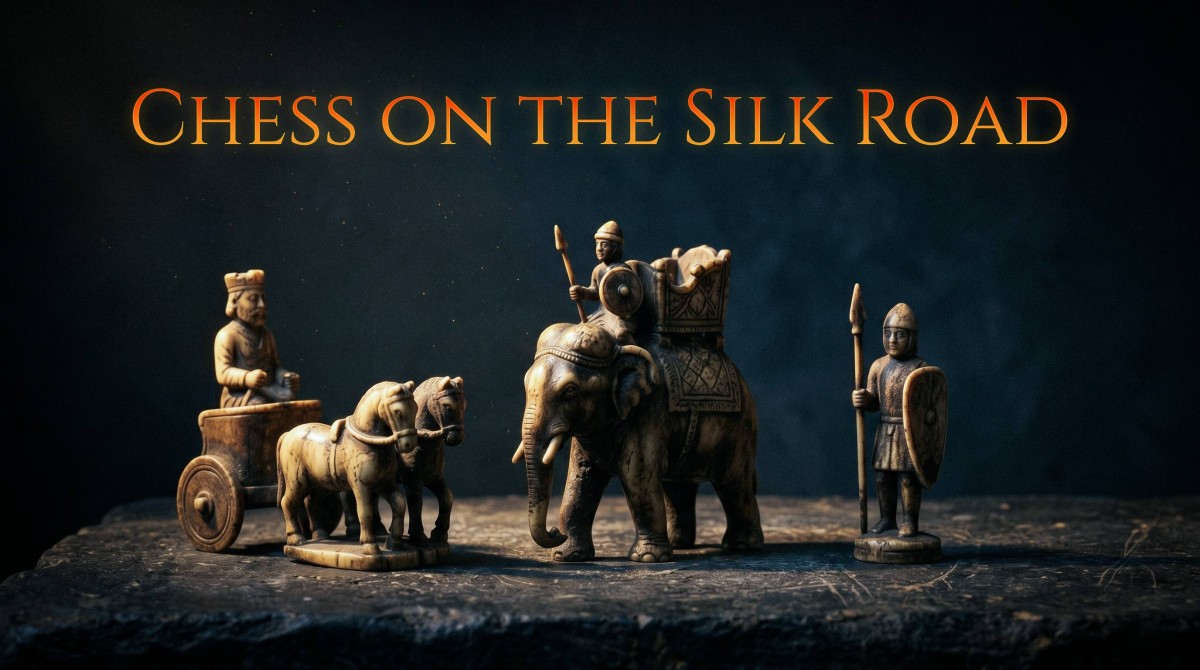
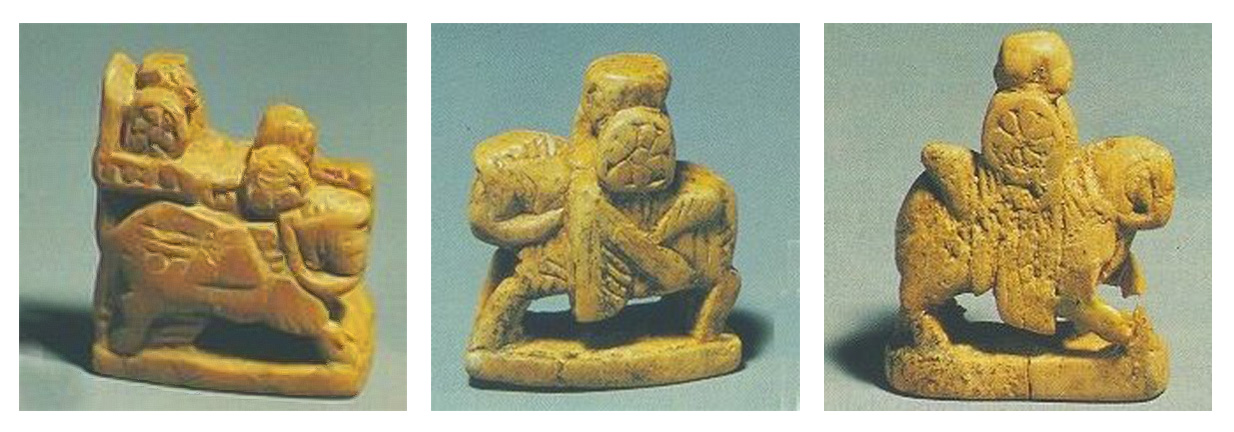
In 1977, an archaeologist named Yuriy Buryakov was working through the layers of a vast earthen mound on the edge of Samarkand. The mound is called Afrasiab — the ruined site of the city that stood here before the Mongols levelled it in the thirteenth century. Among the pottery and bone, his team lifted out seven small figures carved from ivory: a ruler on a chariot, mounted riders, an elephant carrying a soldier, foot soldiers. They were worn smooth, the way objects get when human hands turn them over thousands of times.
They were chess pieces. And they are, as far as anyone has been able to establish, the oldest clearly recognizable chess pieces ever found anywhere in the world.
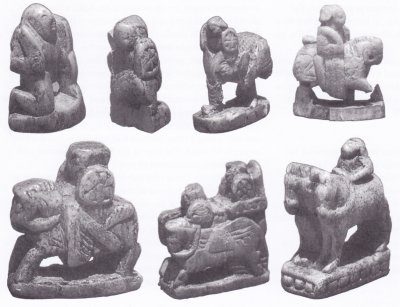
The Afrasiab chessmen, the oldest known chess pieces, found near Samarkand
In September 2026, the strongest players alive will gather a short drive from that mound for the 46th Chess Olympiad. It is tempting to call that a coincidence — a modern tournament that happens to land in a photogenic old city. It is closer to the truth to call it a return. The game did not arrive in Samarkand for the first time in 2026. It passed through here more than a thousand years ago, on the same road that carried silk, paper, and ideas between China and the Mediterranean. The Olympiad is chess coming back to one of the stations on its own journey.
This is the story of that road...
In this article
- The road the game travelled
- Seven pieces in the dust
- Why Samarkand was on the road at all
- The caravanserai
- The road comes back
The road the game travelled
Chess does not have a single inventor or a single birthday, and historians still argue about its earliest steps. The mainstream account, and the one with the strongest chain of evidence, runs like this: the game began in India.
Sometime around the sixth century, during or near the Gupta period, Indian players were using a game called chaturanga. The word means "four divisions" — a reference to the branches of an ancient army: infantry, cavalry, elephants, and chariots. Those four divisions are the direct ancestors of the pawn, knight, bishop, and rook that sit on a board today. The earliest reliable literary mention appears in Sanskrit writing of roughly 600 CE. The rules were not identical to modern chess, but the central idea was already there: different pieces with different powers, and a game that ends when the king has nowhere to go.
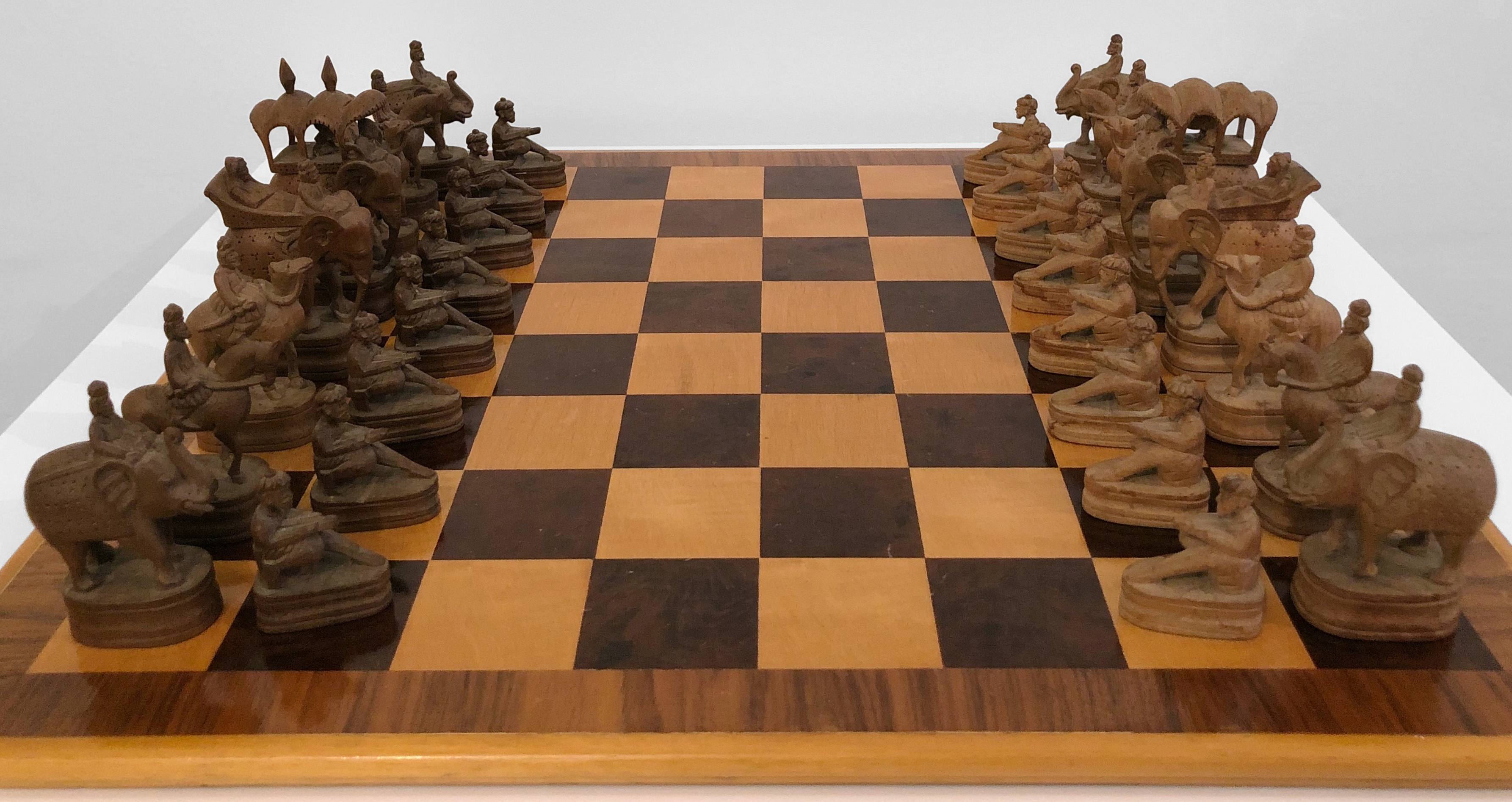
Chess set from Rajasthan, India (https://commons.wikimedia.org/w/index.php?curid=110372511)
From India the game moved west into Sassanid Persia, where it became chatrang, and later, in Arabic, shatranj. The transmission left fingerprints in the language itself: the Persian shah (king) and farzin (vizier) replaced the Indian terms, and the phrase a player called out when the king was trapped — shah mat, "the king is helpless" — survives in almost every European language as some version of "checkmate." A famous Persian text, the Chatrang-namak, tells the story as a riddle: an Indian king sends the game to the Persian court as a challenge, and a wise vizier deciphers it. Whether that tale is history or legend, it captures something real about how the game moved — as a thing worth showing off, traded between courts the way other luxuries were.
When Arab armies conquered Persia in the seventh century, they took to the game with enthusiasm. In Baghdad, the Abbasid caliphs became its patrons, and the first true chess theorists appeared: masters such as al-Adli, around 840, and as-Suli, around 920, who produced the earliest known opening analysis and endgame studies. From the Islamic world the game spread outward along every route the culture took — into North Africa, into Sicily and Spain by the tenth century, into the Byzantine world, and from there into the rest of Europe, where it would slowly mutate into the faster game we play now.
Strip the dates away and the shape is simple: Indian origin, Persian transmission, Arab refinement, European reinvention. (A note for the curious: a minority of scholars argue for a Persian rather than Indian origin, partly on the strength of the very pieces this article is about. The debate is real and unsettled; we follow the mainstream India-first account here, while flagging that it is not unanimous.)
What matters for Samarkand is the middle of that journey. The road from India to Persia to the Mediterranean did not run through empty country. It ran through Central Asia — and its single most important city was Samarkand.
Seven pieces in the dust
The Afrasiab pieces are extraordinary for three reasons, and each one is worth slowing down on.
The Afrasiab archaeological mound on the edge of modern Samarkand
The first is age. Dating ancient objects is rarely clean, but here the case is unusually good. The figures were found in a layer that also contained a coin datable to before 712, and most specialists place the set between the late sixth and early eighth centuries — comfortably around the year 700. That makes them the oldest set of unmistakable chess pieces known to exist. Older candidates turn up from time to time, but they tend to be single objects whose identity is arguable. The Afrasiab seven are not arguable. They are recognizably chessmen.
The second is what they look like. These are not the abstract cylinders and discs that later Islamic chess sets adopted once religious objection to human and animal images took hold. The Afrasiab pieces are little sculptures: a figure on a chariot, riders on horseback, an elephant bearing an armed man on its back, and rank-and-file soldiers. They are, in other words, chaturanga made solid — the four divisions of an Indian army, carved by a craftsman in Central Asia. You can see the whole transmission story compressed into a few centimetres of ivory.
The third is the wear. The pieces are heavily rubbed and rounded, the surface softened by handling. Nobody buries a brand-new ornament. These were played with — picked up, set down, and picked up again, over and over, by people living in Samarkand around the year 700. They are not a relic of the idea of chess. They are the residue of actual games.
A footnote, honestly labelled as one: even older objects have been pulled from Uzbek soil. At Dalverzin-Tepe, in the south of the country, excavators found small ivory figures — an elephant and a bull — dating to around the second century. Some have called them proto-chess pieces. The Russian chess historian Isaak Linder argued they belong to a forerunner of the game rather than to chess proper, and that caution is wise; two figures are not a board. We mention them not as proof of anything, but because they hint that the region's relationship with board games of this family runs very deep indeed.
Why Samarkand was on the road at all
To understand why the oldest chess pieces on Earth ended up in Samarkand specifically, you have to understand what Samarkand was.
For most of the first millennium, the city was the heart of Sogdiana — the homeland of the Sogdians, a people who were, more than almost anyone else, the merchants of the Silk Road. Samarkand sat at a hinge point on the network of routes linking China to Persia, India, and the Mediterranean. Goods passed through it; so did languages, religions, and the craftsmen who made luxury objects for wealthy travellers. A delicately carved ivory chess set is exactly the sort of high-value, low-weight item that moved along such routes — and exactly the sort of thing a Sogdian merchant household might own.

The 7th-century Afrasiab murals depicting ambassadors at the Sogdian court of Samarkand (https://commons.wikimedia.org/w/index.php?curid=21437830)
We have a remarkable window into that world, found in the same mound as the chessmen. The Afrasiab murals, painted around the middle of the seventh century, show a procession of ambassadors at the Samarkand court — including Chinese figures carrying bolts of silk and strings of silkworm cocoons. They are among the finest surviving examples of Sogdian art, and they make the abstract phrase "cultural crossroads" suddenly concrete. This was a place where a Chinese envoy, a Persian noble, and an Indian trader might pass through the same hall in the same season. A game that travelled from India toward Persia would not skip a city like this. It would stop here, and stay a while.
That is the quiet argument the chessmen make. They are not evidence that chess was invented in Samarkand — it almost certainly was not. They are evidence of something subtler and, in a way, more interesting: that by around 700, the game had already reached deep into Central Asia and become part of daily life there, on the road between its Indian cradle and its Persian and European futures.
The caravanserai
There is a reason this series is called Caravanserai, and this is the article where the name earns itself.
A caravanserai was a roadside inn built along the trade routes of Asia and the Middle East — a walled courtyard where a caravan could stop for the night, water its animals, store its goods behind a locked gate, and rest. They were spaced roughly a day's travel apart, and they were far more than shelter. A caravanserai was where a merchant from Bukhara shared a fire with a pilgrim from Persia and a trader from China; where prices were compared, news exchanged, and contracts struck; where, inevitably, people who had nothing in common but the road sat across from one another with time to kill.
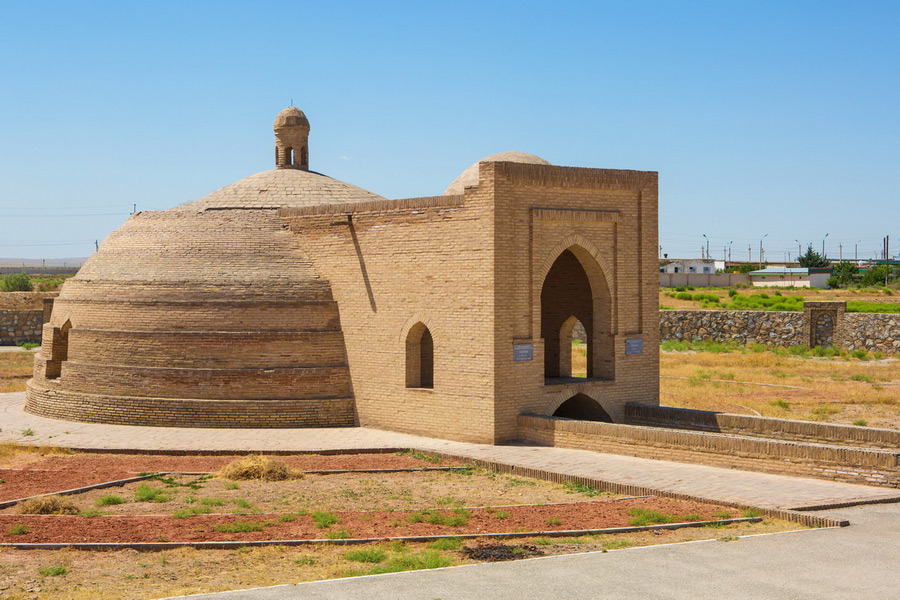
A real Silk Road caravanserai - the Rabati Malik caravanserai (Uzbekistan). The kind of roadside inn where travellers and ideas met.
Time to kill, and a board between them. It is not hard to imagine where a game like chess actually spread: not in royal proclamations, but in exactly these rooms, taught by one traveller to another as a way of passing a long evening. Chess is a portable, language-independent argument. Two people who cannot exchange a sentence can still play a full game and understand each other perfectly by the end of it. That is precisely the kind of cultural cargo a caravanserai was built to move.
So the metaphor for this Olympiad is not decorative. Samarkand 2026 is, for two weeks, a caravanserai on a grand scale — a place where roughly 190 national teams arrive from every direction, set down their bags, and sit across boards from people they could not otherwise speak to. The format is new; the essential transaction is thirteen centuries old.
The road comes back

Samarkand today (photo journalofnomads.com)
Most host cities of a Chess Olympiad have a chess history measured in decades — a strong club, a famous tournament, a local grandmaster or two. Samarkand's chess history is measured in millennia, and the evidence is in a glass case in the State Museum a few minutes from where the games will be played.
That is the rare thing this Olympiad offers, and it is worth saying plainly to a global audience that may be arriving at the name "Samarkand" for the first time. When the players walk to the board in September, they will be doing, in a renovated and televised form, what people did in this city around the year 700: moving carved kings and elephants across squares, trying to trap the other side's ruler. The pieces are finer now and the clocks are digital, but the road is the same road.
Chess travelled the Silk Road once, carried west out of India by traders and courtiers and the strangers who shared a caravanserai for a night. In 2026 it travels back, carried by aeroplane and broadcast feed, to a city that held some of its earliest surviving pieces all along. History does not often close a loop this neatly. When it does, it is worth stopping to notice — somewhere on the old road, with a board between you and someone you have just met.
Sources and further reading: the spread of chess from Indian chaturanga through Persian shatranj to Europe is documented by UNESCO's Silk Roads Programme and the Encyclopædia Britannica; the Afrasiab chessmen and their dating are described by multiple chess historians and held at the State Museum of Samarkand. For the full chronicle of the modern Chess Olympiads, see the Great Book of Chess Olympiads series in the olympchess.com catalogue.