






A Century Without a Medal: France's Samarkand Squad - minus Firouzja
France has named five grandmasters for Samarkand 2026 — without its number one. The Firouzja rift, the squad's records, and a century-long climb from mid-table to the elite that has never once produced an Olympiad medal.

When the French Chess Federation released its squad for the 46th Chess Olympiad on 13 May, the news was less about the five names on the list than the one missing from it. Alireza Firouzja — France's number one and, at the time, the ninth-highest-rated player in the world — will not travel to Samarkand. For the third Olympiad running, the team that paid to bring him into the French fold will play without him.
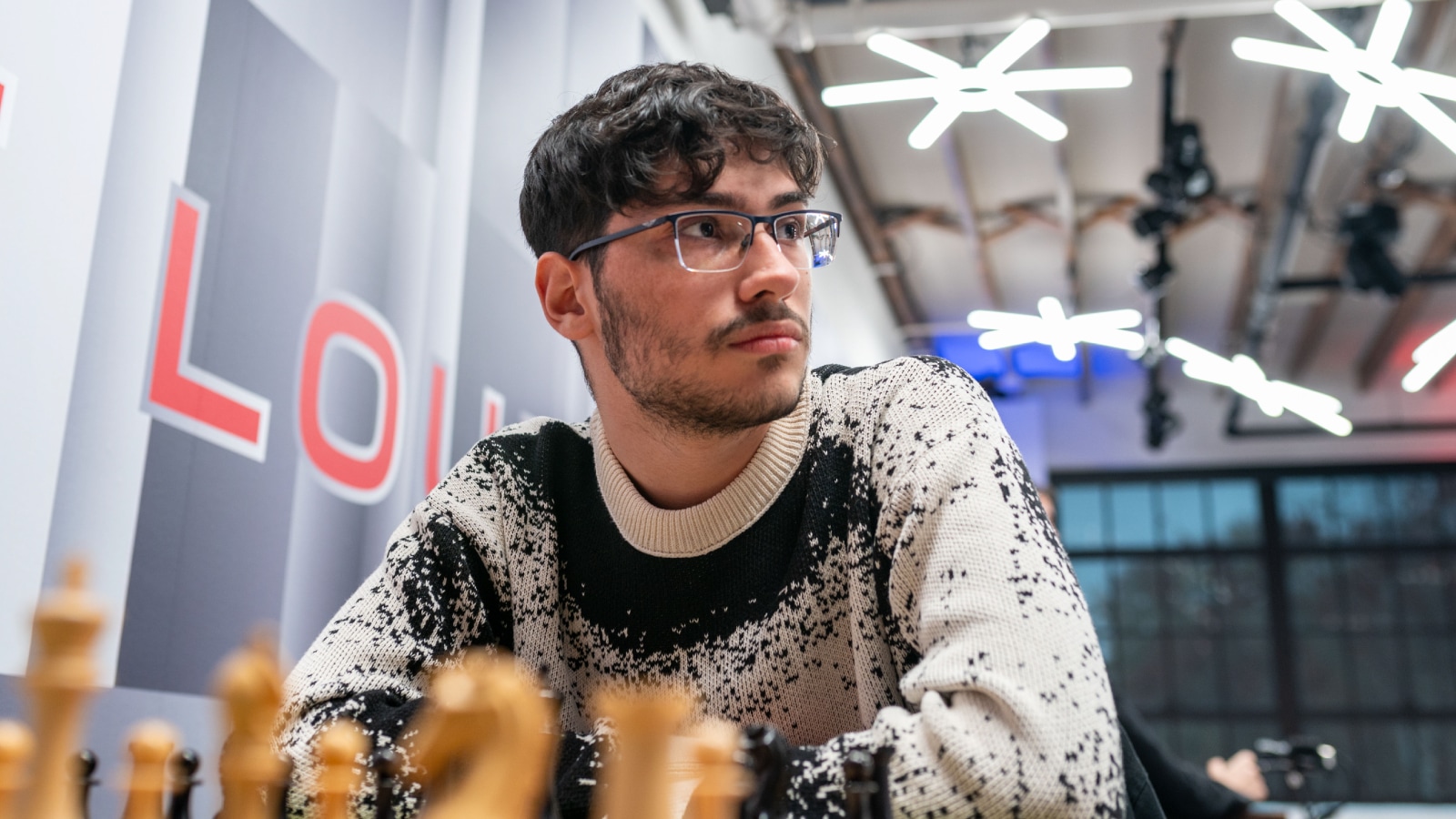
Alireza Firouzja - France's number one, and absent from a French Olympiad team for the third time running, photo: Saint Louis Chess/Crystal Fuller
The five who are going
France's open team for Samarkand is built on continuity. The board order has not been officially fixed, but the five selected are Maxime Vachier-Lagrave, Etienne Bacrot, Maxime Lagarde, Jules Moussard, and Marc'Andria Maurizzi, captained by Sébastien Maze in a non-playing role.
Four of those five played together in Budapest two years ago. The only change from the 2024 lineup is Moussard coming in for Laurent Fressinet — and on Olympiad record alone, that is an upgrade rather than a like-for-like swap. Moussard has one Olympiad to his name, Chennai 2022, where he scored 8/11 (72.7%) for a 2767 performance — the best single-event return of anyone in this squad's debut.
The team's stated average rating is around 2667, which places France eighth among FIDE's top federations. On the olympchess strength table for Samarkand, that lands France seventh by squad rating, narrowly inside the chasing pack behind the United States, India, China, Uzbekistan, Germany, and Azerbaijan.
Why Firouzja is not on the list
The federation has rarely addressed the rift with its strongest player as plainly as it did here. The message, in effect, was that Firouzja will not be selected again until he shows more commitment to the national team. The Iranian-born grandmaster moved to France in 2019 and gained citizenship in 2021, immediately overtaking Vachier-Lagrave as France's number one — but he has never played an Olympiad for the country.
The rating arithmetic of his absence is smaller than the symbolism. With Firouzja, France's top-five average would sit near 2667; without him, dropping to the next-highest player, it falls to roughly 2644. A difference of around 23 rating points across a five-board team is real but not decisive. The larger cost is at board one, where Firouzja's individual ceiling is simply higher than anyone else France can field.
His own calendar tells part of the story. Firouzja is committed to a string of elite individual events through the autumn — the Grand Chess Tour, Norway Chess, and a likely Esports World Cup appearance for Team Falcons. The Olympiad, a two-week team commitment with no appearance fee, has consistently lost out to those priorities.

Maxime Vachier-Lagrave, France's number two now leading the squad in Firouzja's absence, photo: Lennart Ootes
MVL and Bacrot: the spine
With Firouzja out, Vachier-Lagrave leads. He is no stranger to the role — and no stranger to interruptions of his own, having sat out Chennai 2022 before returning in Budapest. Across eight Olympiads since Turin 2006, his record is steady and, if anything, sharpening with age: his board performance has climbed from 2563 as a teenager in Turin to 2775 at Batumi 2018 and 2751 (7/10) in Budapest 2024. He has been France's most reliable Olympiad presence for nearly two decades.
The longer thread, though, runs through Etienne Bacrot. He first played the Olympiad in Yerevan 1996 — as a 13-year-old, on board one, scoring 7/10. Thirty years later, after being left out of last year's European Championship in a dispute with the federation, he is back. His selection marks a quiet smoothing-over of that disagreement.
Bacrot also holds this squad's single best Olympiad performance: a 2833 rating performance at Turin 2006, scoring 6/8. That tournament was, not coincidentally, one of France's two best Olympiad finishes ever. The team's high-water mark and Bacrot's high-water mark arrived in the same fortnight.
The record nobody mentions
Here is the figure that frames everything else. In 43 open Olympiad appearances, France has never won a medal. Not gold, not silver, not bronze. No French player in this squad has ever taken an individual board medal either.
France's ceiling has been seventh place, reached twice — Thessaloniki 1984 and Turin 2006. In 1984 the podium was the USSR, England, and the United States; in 2006 it was Armenia, China, and the United States. France finished just outside both times, close enough to see the medals and never close enough to touch them.
This is the paradox worth sitting with. France has produced genuine world-class individual talent for decades — Bacrot the teenage prodigy, Vachier-Lagrave a former world number two and blitz world champion, and now Firouzja, a 2800 player still in his early twenties. And yet the team result has stubbornly refused to follow the individual brilliance.
Which is what makes the Firouzja decision so striking on its own terms. A federation with no Olympiad medals in its history has chosen — for reasons of commitment and team cohesion, not weakness — to leave out the one player most likely to lift its ceiling. That may well be the right call for the dressing room. It is hard to argue it improves the odds of a first medal.
France through the decades: a slow climb to the front
The "never a medal" line is true, but on its own it flattens a more interesting story. France did not spend a century as an also-ran. It climbed — steadily, across three generations — from the lower half of the field into the genuine elite. The cruel part is the timing: France arrived at the front of the room just as the room got far more crowded.
A note on how to read the numbers. Raw finishing places mislead, because the Olympiad grew from 16 teams in 1927 to 188 in Budapest 2024. A 13th place in a 16-team field and a 13th place in a 188-team field are not remotely the same achievement. The fairer measure is where France finished as a share of the field — its percentile. By that yardstick, the arc is clear.
The world-champion era that went nowhere (1927–1939)
France's early Olympiad teams carried a startling name on board one: Alexander Alekhine, the reigning world champion, who played for France through the 1930s and posted scores like 13½/18 at Prague 1931. A sitting world champion at the top board, and France still finished mid-table — typically around the 60th–75th percentile of the field. The lesson that would haunt France for decades was already visible: one great name at board one does not make a team.

Alexander Alekhine, photographed during the 4th chess Olympiad, in July 1931. Source: David Llada - Chess & Photography
The wilderness (1950s–1970s)
Through the post-war decades France drifted. The database does not even record a final placing for several of these Olympiads, and where it does, the picture is unflattering — 26th of 48 at Haifa 1976, 36th of 66 at Buenos Aires 1978. France was present, but not competitive, hovering around the middle of the pack with no board-one star to mask it. This was the genuine low point.
The Spassky leap (1980s)
Then came the jump that changed France's standing — and again, it arrived on the shoulders of an émigré world champion. Boris Spassky, the tenth world champion, settled in France and anchored its board one through the 1980s. With Spassky leading, France produced the first of its two best-ever results: seventh at Thessaloniki 1984, a finish inside the top 8% of an 88-team field, backed up by tenth at Dubai 1986. For the first time, France was a team a medal contender had to take seriously.

Boris Spassky on board one for France, Thessaloniki 1984 - the tournament that lifted France to seventh, its best Olympiad finish until then. Source: wikimedia.org
The decade was not uniform — a 31st at the 1988 Olympiad shows how thin the squad still was below the top board. But the ceiling had been raised, and it would not drop back to the wilderness years again.
The home-grown breakthrough (1990s–2000s)
The 1980s lift was built on an import. What followed was different: France started producing its own elite players. Joel Lautier carried board one through the 1990s with performances climbing past 2700, and a teenage Etienne Bacrot arrived in 1996. By Turin 2006, France fielded a fully home-grown top order — and matched its all-time best, seventh of 148 teams, a top-5% finish. Bacrot's 2833 performance on board one at that event remains the finest individual Olympiad showing in French history.
For the first time, France's strength was domestic and renewable, not borrowed from a champion in exile.
The elite era — and the moving target (2010–2024)
Here is the quietly remarkable part. Across the 2010s, France's average finish sat inside the top 8% of the field — its strongest sustained decade ever: eighth at Baku 2016, ninth at Batumi 2018, tenth at Khanty-Mansiysk 2010. The arrival of Maxime Vachier-Lagrave, a future world number two, gave France a board-one player of a calibre it had only ever rented before.
And yet no medal came. The reason is the crowd. As France finally reached the front, the chasing pack thickened — Armenia, Azerbaijan, India, Uzbekistan, China and the United States all fielding 2700-deep teams. France kept finishing seventh to fifteenth not because it slipped, but because the bar for bronze kept rising. In percentile terms France has never been stronger; in medal terms it has never been closer, or more stuck.
The pattern, in one line
Lay the eras side by side and a single thread runs through all of them. France has twice been led by a world champion — Alekhine, then Spassky — and has produced three players of true elite individual strength in Lautier, Bacrot and Vachier-Lagrave, with Firouzja now a fourth. The individual brilliance has been real in every decade. The team medal has not arrived in any of them.
Which is precisely why the Firouzja decision lands the way it does. France's whole history is the story of brilliant board-one names that the team result never quite followed. Leaving out its strongest such name yet — for cohesion, for commitment — is either the federation finally deciding the team matters more than the star, or the latest chapter of the same old paradox. Samarkand will offer the next data point.
What to expect in Samarkand
Read narrowly, this is a competent, cohesive France: four players who already know each other's rhythms, a sharpening MVL at the top, a veteran in Bacrot who has seen every kind of Olympiad, and a rising Maurizzi — born in 2007, the squad's youngest — still adding rating each cycle. Seventh by squad strength means a top-ten finish is a realistic target and an upset run is not out of reach in an eleven-round Swiss.
Read against history, the pattern is harder to shake. France has been here before — strong on paper, near the podium, never on it. Samarkand will test whether continuity and cohesion can finally do what France's individual stars never quite have.
The team that arrives in Uzbekistan in September will be missing its best player by choice. Whether that choice looks wise or costly depends entirely on how the other five play.
Sources
- French team selection and the federation's statement on Firouzja: Chess.com news, "France Olympiad lineup, Firouzja left out," 13 May 2026; World Chess / FIDE platform coverage, 13 May 2026.
- 46th Chess Olympiad dates and format (Samarkand, 15–28 September 2026): Wikipedia; chessolympiad2026.fide.com.
- France's full Olympiad results history (1927–2024), decade-by-decade finishing positions and field sizes, board-one players by era (including Alexander Alekhine in the 1930s and Boris Spassky in the 1980s), squad members' individual Olympiad records, and all medal/podium data: olympchess.com historical Olympiad database (open section).