






3rd Chess Olympiad - Hamburg 1930 - Complete Description
July 1930. For the first time, FIDE abolishes the amateur-professional divide. Poland's "Bombenmannschaft" with Rubinstein and Tartakower wins gold and the Hamilton-Russell Cup in a dramatic finale. Alekhine goes 9/9, and Marcel Duchamp plays for France.
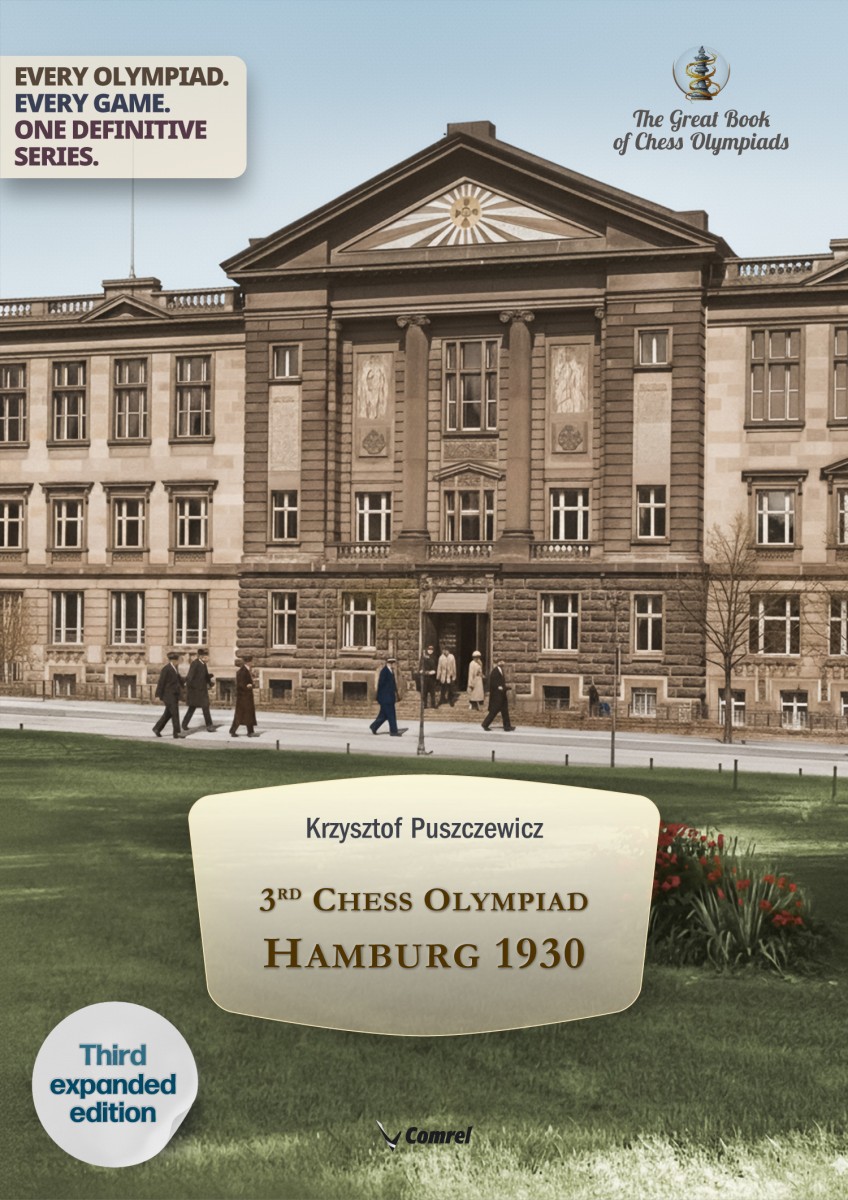
July 1930. The world is gripped by the Great Depression, but in Hamburg, Germany, history is being made on 64 squares. For the first time ever, FIDE abolishes the amateur-professional divide, allowing the greatest chess players on Earth to compete at the Olympiad. World champion Alexander Alekhine, the legendary Akiba Rubinstein, tactical genius Savielly Tartakower — all under one roof. The German press has already picked their favorite, dubbing the Polish team the "Bombenmannschaft" — the bomb squad. They will not be disappointed.
The complete monograph of the 3rd Chess Olympiad, with 424 pages of analysis, all recovered games with original commentary, and unique archival photographs, is available in the Great Book of Chess Olympiads series by Krzysztof Puszczewicz — browse our catalogue.
Table of Contents
- Historical Context – The World in 1930
- FIDE's Landmark Decision – End of the Amateur Era
- Hamburg as Host – The Provinzialloge von Niedersachsen
- Participants – 18 Teams and a Parade of Stars
- Poland's Dream Team – The "Bombenmannschaft"
- Tournament Progress – Round by Round
- Alekhine's Controversial Strategy
- Sultan Khan – The Most Colorful Figure
- Final Standings
- Top Individual Performers
- Poland's Road to Gold
- Records, Curiosities, and Marcel Duchamp
- Legacy of the 3rd Chess Olympiad
- Frequently Asked Questions
Historical Context – The World in 1930
The 1930s began under the shadow of the worst economic crisis in modern history. The 3rd Chess Olympiad took place right in the middle of the Great Depression — bankruptcies, mass unemployment, and rising political extremism dominated headlines across the globe.
Yet the world kept turning. In astronomy, the American Clyde Tombaugh discovered the mythical "Planet X" — Pluto. In telecommunications, Poland established its first direct telephone connection to the United States. Automotive technology was advancing rapidly.
A remarkable coincidence: on the exact day of Round 1, July 13, 1930, the referee's whistle blew in Montevideo for the very first FIFA World Cup, featuring 13 national teams. Both organizations — FIDE and FIFA — had made the same groundbreaking decision: professionalize their sport and let the best compete. Until then, Olympic-style competition had been synonymous with amateur sport. The end of the Chess Olympiad coincided with the finish of the Tour de France. It was a transformative moment for international competitive sport.
The chess world was still mourning the loss of Richard Réti, one of its greatest thinkers, who had died of scarlet fever in Prague in 1929, aged just 40. Réti enriched opening theory with many variations, including the opening bearing his name. Alekhine wrote of him: "Réti is the only chess player in the world whose moves I cannot predict." His absence was felt in Hamburg — many participants had faced him across the board numerous times.
Pre-Olympiad Form Guide
Several major tournaments in 1929–1930 provided insight into the form of future Olympiad participants. The magnificently fielded San Remo tournament (January–February 1930) was won by Alekhine, who finished a staggering 3.5 points ahead of runner-up Nimzowitsch. Rubinstein took an honorable third place. Tartakower won the Nice tournament five months before the Olympiad.
The József Szén Memorial in Budapest (September 1929) was won by Capablanca with 10.5 out of 13. Rubinstein was second, one point behind. Tartakower was third. The tournament was notable for an exceptionally low number of draws — less than one-third of all games — foreshadowing the combative spirit of the upcoming Olympiad.
FIDE's Landmark Decision – End of the Amateur Era
The 5th FIDE Congress, held in The Hague during the previous Olympiad, made a decision of historic significance: all barriers between professionals and amateurs were abolished. For the first time, the world's strongest players could compete in the Chess Olympiad without restrictions.
This was a turning point. At the two previous Olympiads — London 1927 and The Hague 1928 — a controversial rule limited participation to amateurs only. This had excluded giants like Alekhine, Rubinstein, and Tartakower. In Hamburg, that barrier fell permanently, instantly elevating the tournament to an unprecedented level.
Hamburg 1930 also marked the last Olympiad where teams could freely arrange their players across boards. From subsequent editions, a fixed player hierarchy was required.
Hamburg as Host – The Provinzialloge von Niedersachsen
The 3rd Olympiad was organized to celebrate the 100th anniversary of the Hamburg Chess Club. The German Chess Federation ensured an occasion worthy of the centenary.
Games were played in the "Provinzialloge von Niedersachsen," an imposing building surrounded by a beautiful park. The main congress hall, named after Wolfgang Amadeus Mozart, was large enough to accommodate both the players and throngs of spectators.
Playing conditions:
- Dates: July 13–27, 1930
- Location: Provinzialloge von Niedersachsen, Hamburg, Germany
- Format: Round-robin (17 rounds)
- Teams: 18 (4 players + 1 reserve)
- Total players: 88
- Games played: 605
- Time control: 40 moves in 2 hours, then 20 moves per additional hour
- Clock checks: First at 4 hours, second at 6 hours
The head of the Organizing Committee was Walter Robinow, president of the German Chess Federation. Julius Drimer served as chief arbiter.
Organizers arranged sightseeing for the players during rest days — tours of Hamburg's transatlantic port, visits to ships, and the famous Hagenbeck Zoo. A banquet at the Hamburg City Hall, hosted by the Senate of the free city, concluded the event.
Participants – 18 Teams and a Parade of Stars
18 nations entered the competition — a new record, surpassing The Hague. The field included the very best of the chess world:
- Alexander Alekhine (France) — reigning World Champion, fresh from a dominating victory in San Remo
- Savielly Tartakower (Poland) — winner of the Nice tournament five months prior
- Akiba Rubinstein (Poland) — third at San Remo, widely considered one of the strongest players alive
- Dawid Przepiórka (Poland) — runner-up at the 1928 Amateur World Championship in The Hague
- Frank Marshall and Isaac Kashdan (USA) — Kashdan was the hero of the previous Olympiad
- Hans Kmoch (Austria) — Vienna tournament winner and Alekhine's second
- Sultan Khan (England) — the most colorful figure of the Olympiad, an Indian playing under the English flag
- Salo Flohr (Czechoslovakia) and Géza Maróczy (Hungary) — jewels of strong international tournaments
Three countries made their Olympiad debut: Lithuania, Iceland, and Norway.
Nearly all teams arrived with full five-player squads. Only Latvia and Iceland competed with just four players, without a reserve.
Poland's Dream Team – The "Bombenmannschaft"
The strongest lineup on paper belonged to Poland. German journalists immediately labeled them the "Bombenmannschaft" (bomb squad) and considered them clear favorites.
Akiba Rubinstein — the greatest chess player in Polish history, winner of twenty international tournaments. He learned chess late while studying at a yeshiva in Białystok and abandoned his rabbinical studies for the royal game. A Grandmaster from 1907–1910, Polish Champion in 1927, feared rival of Lasker and Capablanca, and the undisputed master of the endgame. World War I destroyed his chances of a world championship match against Lasker, scheduled for September 1914.
Savielly Tartakower — the second pillar of Polish strength, a versatile strategist known for his unconventional approach and legendary wit.
Dawid Przepiórka — an experienced master who had already proven his class at the 2nd Olympiad in The Hague.
Kazimierz Makarczyk and Paulin Frydman — strong players who provided excellent depth to the squad.
Stefan Rotmil served as team captain, handling all technical matters of the expedition.
Other teams considered as potential challengers included Hungary, Germany, USA, Austria, the Netherlands, and Czechoslovakia.
Tournament Progress – Round by Round
Round 1 — "Enter the Polish Dragon"
The very first round produced a blockbuster: Poland vs. Hungary, defending champions from both previous Olympiads. Poland crushed Hungary 3.5–0.5. The key game was Rubinstein vs. Maróczy — the Polish master employed an innovative 5.Nge2 in the Nimzo-Indian Defense, a move he had first used against Sämisch at the Moscow 1925 tournament. Maróczy overlooked a spectacular sacrifice and lost quickly. Rubinstein himself annotated the game for the press, noting its theoretical significance.
Tartakower exploited Takacs' uncertain play in a queen endgame with subtle maneuvering. Przepiórka defeated Vajda after a long endgame, and Makarczyk agreed to a draw with E. Steiner in an equal position. For context: at the previous Olympiad in The Hague, the Poland–Hungary match had ended 1–3 in Hungary's favor!
The biggest upset: USA lost to France 1.5–2.5. Andre Voisin scored the decisive point against debutant Harold Philips.
Round 3 — Tartakower's Only Loss and "Poland Has Not Yet Perished!"
Poland beat Latvia 2.5–1.5 but Tartakower suffered his only defeat of the entire tournament — against Latvia's Pietrow, who unleashed a beautiful queen sacrifice. After resigning, Tartakower declared to his astonished opponent: "Jeszcze Polska nie zginęła!" (Poland has not yet perished!) — quoting the opening line of the Polish national anthem.
Round 4 — The Netherlands Stun Czechoslovakia
Table-leading Czechoslovakia was demolished 0.5–3.5 by the Netherlands. Flohr lost to the young Daniel Noteboom through his own miscalculation. Poland drew with the USA 2–2 in four fiercely contested games.
Round 5 — Iceland Draws with Germany
Debutants Iceland pulled off a sensational 2–2 draw against the strong German team — one of the biggest surprises of the tournament.
Round 6 — Poland Demolishes Sweden 4–0
Arguably Poland's most impressive result alongside the Round 1 victory over Hungary. All four Polish representatives played flawlessly, securing their wins before time control.
Round 9 — Poland's First Loss
The Netherlands defeated Poland 2.5–1.5 — Poland's first and only loss in the tournament's regular course. Frydman's blunder just before adjournment against Noteboom decided the match.
Round 13 — "Austria Detonates the Bomb"
The biggest sensation: Austria destroyed the USA 4–0. Kashdan, after five consecutive wins, had to resign against Kmoch. Marshall fell to Lokvenc. Meanwhile, Poland lost its second and final match — to Czechoslovakia 1.5–2.5 — in particularly unlucky circumstances. Frydman captured a rook instead of recapturing a knight with a pawn and had to resign immediately, facing unstoppable checkmate.
Round 17 — The Dramatic Finale
Going into the final round, Hungary led Poland by half a point: 45.5 to 45.0. Everything would be decided in a single day.
Poland faced Finland, a clearly weaker team. Rubinstein won decisively (his opponent even overstepped the time limit). Tartakower ground down Krogius. Przepiórka won positionally.
As Makarczyk was signing a draw with Rasmusson — Poland already leading Finland 3–0 — the decisive news arrived from the adjacent table: Hungary had just lost to the Netherlands! The Hamilton-Russell Cup belonged to Poland.
Alekhine's Controversial Strategy
One of the most intriguing stories of Hamburg 1930 is World Champion Alexander Alekhine's deliberate avoidance of top opponents. Playing for France, Alekhine had announced his strategy before the tournament even began.
He played only 9 out of 17 possible games — and won every single one, achieving 100%. But he systematically avoided confrontation with the strongest players. He refused to face Kashdan in the USA match. He sat out many critical encounters.
His 9/9 record commands respect, but the context raises questions. If we exclude Alekhine's limited sample, the highest percentage in the tournament (88.2%) belongs to Rubinstein — who played all 17 games and lost none.
Sultan Khan – The Most Colorful Figure
The most colorful personality at the 3rd Chess Olympiad was undoubtedly Sultan Khan — an Indian servant of Sir Umar Hayat Khan, a Punjabi aristocrat, playing for England. Sultan Khan had learned chess in the Indian tradition, significantly different from European chess. Despite this, he achieved a 65% score — the best in the English team — winning 9 games, drawing 4, and losing 4.
His exotic background and unorthodox playing style captivated spectators and journalists alike. Just one year after Hamburg, Sultan Khan would win the British Chess Championship.
Final Standings
Place | Team | Points | Match Points
- 🥇 1. Poland 48.5 27
- 🥈 2. Hungary 47.0 24
- 🥉 3. Germany 44.5 26
- Austria 43.5 23
- Czechoslovakia 42.5 25
- USA 41.5 24
- Netherlands 41.0 22
- England 40.5 24
- Sweden 40.0 23
- Latvia 35.0 17
- Denmark 31.0 13
- France 28.5 14
- Romania 28.5 10
- Lithuania 22.5 9
- Iceland 22.0 9
- Spain 21.5 6
- Finland 18.0 5
- Norway 16.0 5
A total of 605 games were played (out of 612 possible — 7 were forfeited, 5 of them by Lithuania). 88 players from 18 countries competed from July 13 to 27, 1930.
Top Individual Performers
Special individual prizes:
- Akiba Rubinstein (Poland) — highest number of points scored
- Kornél Havasi (Hungary) — best percentage with minimum 12 games played
- Salo Flohr (Czechoslovakia) — second-highest number of points
Best performers (65%+):
- Alexander Alekhine – France – 9/9 – 100%
- Akiba Rubinstein – Poland – 15/17 – 88%
- Kornél Havasi – Hungary – 12/14 – 86%
- Salo Flohr – Czechoslovakia – 14.5/17 – 85%
- Isaac Kashdan – USA – 14/17 – 82%
- Daniel Noteboom – Netherlands – 11.5/15 – 77%
- William Winter – England – 11.5/15 – 77%
- Savielly Tartakower – Poland – 12/16 – 75%
- Heinrich Wagner – Germany – 10.5/14 – 75%
- Frank Marshall – USA – 12.5/17 – 74%
- Erich Eliskases – Austria – 11/15 – 73%
- Dawid Przepiórka – Poland – 9/13 – 69%
Brilliancy prizes:
- Alexander Alekhine (France) — 1st prize
- Kurt Richter (Germany) and Daniel Noteboom (Netherlands) — shared 2nd prize
- Isaac Kashdan (USA) — best endgame prize
Salo Flohr set a new all-time Olympiad record with 14 wins in a single tournament.
Poland's Road to Gold
Individual results of the Polish team:
- Akiba Rubinstein — 13 wins, 4 draws, 0 losses — 15/17 — 88%
- Savielly Tartakower — 9 wins, 6 draws, 1 loss — 12/16 — 75%
- Dawid Przepiórka — 7 wins, 4 draws, 2 losses — 9/13 — 69%
- Kazimierz Makarczyk — 5 wins, 5 draws, 3 losses — 7.5/13 — 58%
- Paulin Frydman — 3 wins, 4 draws, 2 losses — 5/9 — 56%
Rubinstein scored the most points of any player in the entire Olympiad. His 13 wins and 4 draws without a single loss is a result worthy of a world champion. Tartakower lost just once — to Latvia's Pietrow in Round 3.
Poland lost only 2 matches out of 17, won 12, and drew 3. The key was their devastating Round 1 victory over Hungary (3.5–0.5), which gave them a psychological edge that lasted the entire tournament.
Records, Curiosities, and Marcel Duchamp
- Only 3 players finished the Olympiad undefeated (among those who played 9+ games): Rubinstein (Poland, 17 games), Winter (England, 15), and Havasi (Hungary, 14).
- The "King of Draws" was Denmark's Arno Desler — 8 draws out of 16 games — which paradoxically proves how combatively the tournament was played.
- The youngest participant was 18-year-old Erich Eliskases of Austria, who achieved an excellent 73%. A great international career awaited him.
- Marcel Duchamp — yes, the famous avant-garde artist who created "Fountain" and revolutionized modern art — played fourth board for France. Duchamp was a passionate chess player who, at various points in his life, nearly abandoned art for chess entirely. His draw against Frank Marshall is one of the most fascinating intersections of art and chess history.
- The 2nd Women's World Championship was held alongside the Olympiad. Defending champion Vera Menchik retained her title with 6.5 points. Only five women competed.
- The Czechoslovaks and the Dutch played "Robin Hood" — stealing points from the strongest teams while dropping them to weaker ones. The Netherlands defeated Poland, Hungary, Germany, and Czechoslovakia, drew with Austria, and lost only to the USA.
- Havasi — the greatest reserve player performance in Olympiad history. Hungary's reserve, Kornél Havasi, won 10 out of 14 games without a single loss — the strongest individual contributor on the Hungarian team.
Legacy of the 3rd Chess Olympiad
The 3rd Chess Olympiad in Hamburg represents a milestone in the history of team chess:
End of the amateur-professional divide. The decision to admit professionals permanently transformed the Olympiad into the ultimate arena for the world's best players. This change, first implemented in Hamburg, remains in effect to this day.
Poland's greatest triumph. The Hamilton-Russell Cup, won by the Polish team led by Rubinstein, Tartakower, and Przepiórka, represents the pinnacle of Polish team chess achievement in the interwar period.
Record participation despite global crisis. 18 teams competed despite the Great Depression, proving that chess had genuine international appeal even in the darkest economic times.
Birth of future stars. Hamburg 1930 witnessed the debuts of players who would shape chess for decades — Erich Eliskases, Salo Flohr, and Gideon Stahlberg among them.
The 7th FIDE Congress
The tournament coincided with the 7th FIDE Congress — four meetings of delegates and the FIDE Board. Fifteen federations were represented. New members Lithuania and Iceland were admitted. A Czech project to standardize opening names was referred to a committee comprising Poland, Germany, the Netherlands, Sweden, and Czechoslovakia.
Frequently Asked Questions
Who won the 3rd Chess Olympiad in Hamburg 1930?
Poland won the 3rd Chess Olympiad with 48.5 points (27 match points), ahead of Hungary (47.0) and Germany (44.5). The Polish team consisted of Akiba Rubinstein, Savielly Tartakower, Dawid Przepiórka, Kazimierz Makarczyk, and Paulin Frydman, captained by Stefan Rotmil.
Who was the best individual player?
Alexander Alekhine scored a perfect 9/9 (100%) but played only 9 games. Among regular participants, Akiba Rubinstein was the best with 15/17 (88%). Salo Flohr set a new Olympiad record with 14 individual wins.
Why was the 3rd Chess Olympiad historically significant?
Hamburg 1930 was the first Chess Olympiad to allow professional players. This ended the amateur-only era of the previous two Olympiads and permanently transformed the tournament into a showcase for the world's strongest players.
Did Marcel Duchamp really play at the 1930 Chess Olympiad?
Yes. The renowned avant-garde artist Marcel Duchamp played fourth board for France. Duchamp was a serious and passionate chess player who at various times prioritized chess over art.
Who was Sultan Khan?
Sultan Khan was an Indian chess player who competed for England. A servant of the Punjabi aristocrat Sir Umar Hayat Khan, he learned chess in the Indian tradition. Despite his unconventional background, he scored 65% in Hamburg — the best result on the English team. He would win the British Championship the following year.
Why did Alekhine play only 9 games?
World Champion Alexander Alekhine announced his strategy before the tournament began. He systematically avoided the strongest opponents, choosing weaker rivals and sitting out key matches. He won all 9 games (100%), but his approach was controversial.
How many teams and players competed?
88 players from 18 countries played 605 games across 17 rounds, from July 13 to 27, 1930. Three nations made their debut: Lithuania, Iceland, and Norway.
How did the tournament end so dramatically?
Going into the final round, Hungary led Poland by half a point. Poland defeated Finland 3.5–0.5 as expected, but the decisive result came from the Netherlands, who upset Hungary — handing Poland the gold medal and the Hamilton-Russell Cup in the most dramatic fashion possible.
Source: Krzysztof Puszczewicz, "III Olimpiada Szachowa – Hamburg 1930" (3rd Chess Olympiad – Hamburg 1930), Great Book of Chess Olympiads, 3rd Edition (2025).
Want the full story? Browse our catalogue to discover 424 pages of round-by-round analysis, all recovered games with original commentary from 1930s chess periodicals, unique archival photographs, and statistics unavailable anywhere else!