






35th Chess Olympiad - Bled 2002
Kasparov's final Olympiad and a bronze medal for Poland's women
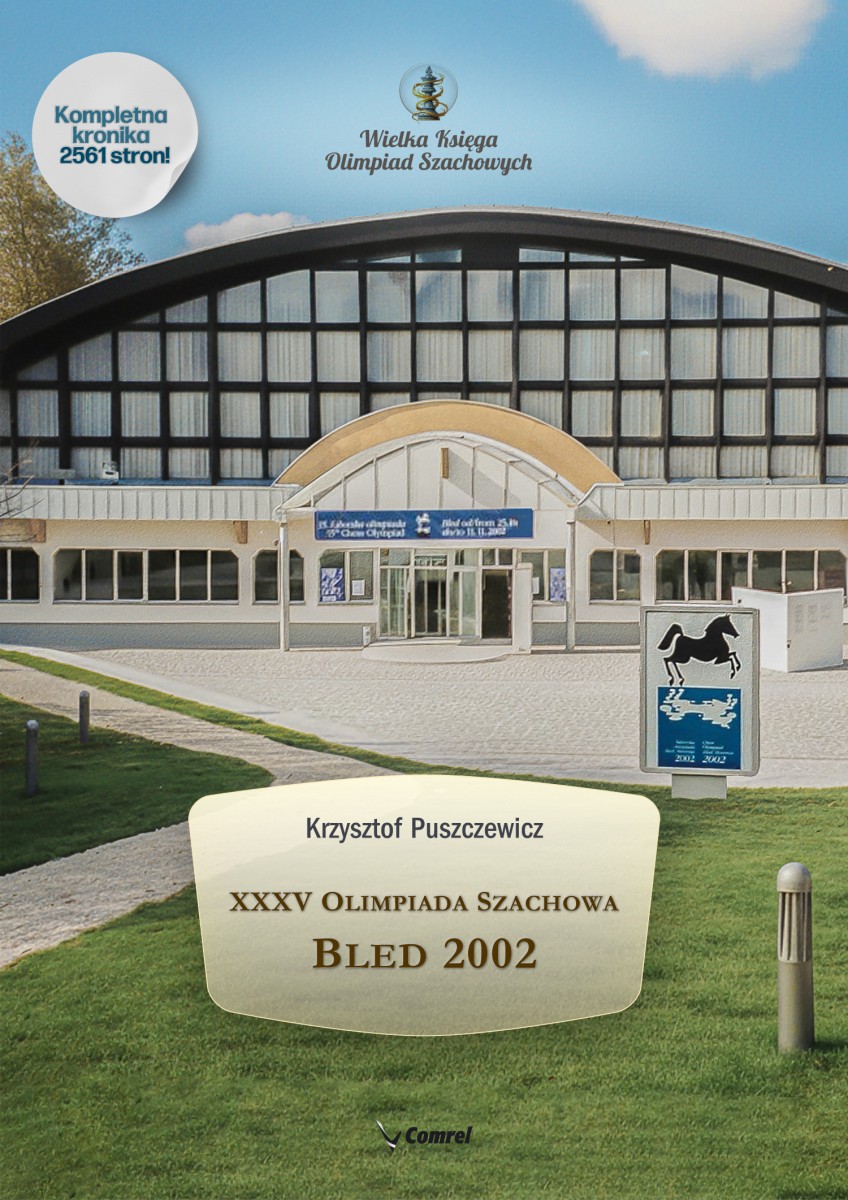
35th Chess Olympiad - Bled 2002: Kasparov's Final Olympiad and a Bronze Medal for Poland's Women
Autumn 2002. The Alpine resort of Bled in Slovenia, surrounded by mountains and set on the shores of a crystal-clear lake, becomes the chess capital of the world. A record 135 teams arrive for 14 rounds of competition. Garry Kasparov returns to the Russian squad - though no one yet knows this will be his farewell to the Olympiad. And the Polish team, written off by most pundits, begins playing as though channelling the spirit of their pre-war triumphs. What happened in Bled, and why has this Olympiad earned a permanent place in chess history?
The full story of the 35th Chess Olympiad - 2,561 pages of analysis, annotated games, and rare photographs - can be found in Krzysztof Puszczewicz's monograph from the Great Book of Chess Olympiads series, available in our shop.
Table of contents
- Slovenia welcomes the chess world - organising the Olympiad in Bled
- Record turnout and stars at the start
- Anti-doping tests - revolution and controversy
- Garry Kasparov - the king's last Olympic dance
- Men's tournament, round by round
- Russia, Hungary, Armenia - the battle for medals
- Poland at the Bled Olympiad - so close to the top!
- Women's tournament - bronze for Poland!
- Heroes and surprises of the 35th Olympiad
- Final standings and classification
- Trivia and records from Bled 2002
- The historical significance of Bled 2002
- FAQ - Frequently asked questions
Slovenia welcomes the chess world - organising the Olympiad in Bled
The Republic of Slovenia, which had broken away from Yugoslavia in 1991 and joined FIDE just a year later, staked enormous prestige on hosting the event. The venue chosen for the world's largest chess competition was Bled - a spa town of barely six thousand inhabitants, nestled between the Sava Dolinka and Sava Bohinjka rivers amid the forested plateaux of Jelovica and Pokljuka.
As Krzysztof Puszczewicz recounts in his monograph, the Olympiad's importance to Slovenia was underlined by the presence of top officials, led by President Milan Kučan, who performed the opening ceremony. Boris Kutin was appointed Tournament Director, and the role of Chief Arbiter went to the experienced Dutchman Geurt Gijssen.
Players were housed in the three-star Hotel Kaprys, just 200 metres from the lake. Games were played in a large sports hall. The press centre was impressive - 35 computer workstations, 24 laptops with internet access, three fax machines and 10 international phone lines. The Olympiad's main website attracted over one million visitors - an astonishing figure for 2002.
Garry Kasparov himself said at the closing press conference: "This was the best Olympiad!" The world's strongest player, never one to mince words, meant every syllable.
Chief Arbiter Geurt Gijssen recalled that Slovenia had a rich chess heritage - Bled had hosted major tournaments in 1931 and 1961, and nearby Portorož in 1958. A stage of the 1959 Candidates Tournament had also been held here. Legends such as Alexander Alekhine, Mikhail Tal, and Bobby Fischer had stayed at the Grand Hotel Toplice. It was against this historical backdrop - among the ghosts of great chess events - that the next Olympiad was taking place.
The opening and closing ceremonies were staged with flair: folk dances, a "living chess" display, fireworks, and even a scene in which a real white horse trotted onto a giant outdoor chessboard. The organisers gave the players two rest days - after rounds eight and thirteen - allowing time to visit the 12th-century Bled Castle or the Triglav National Park, home to Slovenia's highest peak, Triglav (2,863 m).
Record turnout and stars at the start
Bled set a new participation record - 135 teams took part (up from 126 in Istanbul 2000). Even more had been expected - the last starting number was 141 - but Morocco, Syria, Seychelles, Sudan, Ivory Coast, and Malawi ultimately did not travel. Nigeria arrived late (joining from Round 3) and Rwanda even later (from Round 5).
The top seeds were as follows:
Seed Team Average rating
- 🇷🇺 Russia 2734
- 🇭🇺 Hungary 2674
- 🇺🇦 Ukraine 2665
- 🇮🇱 Israel 2660
- 🇳🇱 Netherlands 2648
- 🏴 England 2640
- 🇨🇳 China 2633
- 🇩🇪 Germany 2626
- 🇦🇲 Armenia 2620
- 🇺🇸 USA 2620
- 🇵🇱 Poland 2600
The vast majority of teams arrived at full strength. Garry Kasparov (rated 2838!) returned to lead Russia after a break, pushing the Russian average to a staggering 2734.
Notable absentees included Viswanathan Anand (India), Vladimir Kramnik (Russia), Robert Hübner (Germany), Jan Timman (Netherlands), and - as usual - Anatoly Karpov (Russia), Joël Lautier (France), and Lajos Portisch (Hungary).
There was no shortage of colourful stories. Legendary Henrique Mecking, one of the world's top players in the 1970s who had returned after a serious illness, appeared on Board 3 for Brazil. Eugenio Torre played his 17th (!) Olympiad for the Philippines. Unexpectedly, the 15-year-old Teimour Radjabov (rated 2628) led Azerbaijan. Three women competed in the open section: Judit Polgar (Hungary, on Board 2!), Julia Lebel-Arias (Monaco), and Lee Wing Yan (Macau).
Anti-doping tests - revolution and controversy
The Bled Olympiad saw anti-doping testing introduced in chess for the first time ever. Urine samples were collected in accordance with WADA/IOC standards as part of FIDE's drive to gain recognition of chess as an Olympic discipline.
The move triggered a wave of protests. Several prominent players - among them Jan Timman, Artur Yusupov, and Robert Hübner - objected and withdrew from the Olympiad precisely because of the tests. As Puszczewicz notes, most available sources indicate that not a single positive result was returned.
The decision had far-reaching consequences for chess as a sport and opened a debate that continues to this day: should chess be subject to the same anti-doping procedures as physical sports?
Garry Kasparov - the king's last Olympic dance
Garry Kasparov, rated 2838 - the highest among all participants - led the Russian team. His comeback after a break was an event in itself. Alongside him played Alexander Grischuk (promoted from the reserve board, his rating climbing from 2601 to 2702), Alexander Khalifman (shifted from first board to third), Alexander Morozevich (who asked to play on Board 4, saying he felt low on confidence after a poor season), and reserves Peter Svidler and Sergei Rublevsky.
Kasparov played nine games in Bled, scoring a phenomenal +6 =3 -0 for a performance rating of 2933 - the highest at the entire Olympiad. He was ruthless on first board, not losing a single game.
As it turned out, Bled 2002 was the last Olympiad in which Garry Kasparov competed, even though he remained an active player until 2005. He bade farewell to the Olympic stage in grand style.
Men's tournament, round by round
The event comprised 14 Swiss-system rounds. For the first time, the new official FIDE time control was used - 90 minutes for the entire game plus an additional 30 seconds per move. The idea, long championed by former World Champion Bobby Fischer, had finally found its way into official competition.
Rounds were scheduled for 2:30 p.m. (the final round started at 10:00 a.m. so that the closing ceremony could take place the same day).
Puszczewicz stresses that the tournament was highly entertaining, contrary to some negative commentaries in the Polish chess press. Drama was never in short supply - household names suffered shock defeats at the hands of little-known opponents, much to the spectators' delight.
Opening rounds - upsets and rising hopes
The very first round produced a sensation: Alejandro Ramirez of Costa Rica (just 14 years old!) drew with Grandmaster Morozevich on Board 4. Luxembourg crushed Brazil 3-1! Poland, meanwhile, cruised past Bolivia 4-0, opening the tournament on the highest possible note.
Russia set a steady pace from the start, though not without hiccups. Hungary, led by the remarkable Judit Polgar on Board 2 (performance 2741!), kept the pressure on the leaders. Armenia, captained by Akopian, proved to be the dark horse.
Middle rounds - intensifying rivalry
A tight leading group emerged in the middle phase. Russia faced no fewer than 10 matches against top-16 opponents - more than anyone else. China (8 matches against the leading pack), Hungary, Georgia, and Poland (7 each) were also in constant combat with the best.
The Polish team found rounds five through ten the toughest, managing just four wins during that stretch. Fatigue took its toll, and the early enthusiasm gradually gave way to frustration over squandered chances down the final stretch.
The final showdown
In the last round, Macedonia and Switzerland gatecrashed the leading group with late 3-1 victories. Russia sealed gold comfortably, while the fight for silver and bronze went down to the last move. Hungary held on to second place, trailing Russia by just one point - a measure of how tight the battle at the top had been.
Russia, Hungary, Armenia - the battle for medals
The fight for the podium in the men's event was fierce to the very end.
🥇 Russia - 38.5 points. A sixth Olympic gold. Kasparov (2933), Khalifman (2797), and Morozevich (11 games without a loss!) formed the backbone. Russia faced 10 matches against leading teams - more than anyone else.
🥈 Hungary - 37.5 points. Just one point behind Russia! Peter Leko on Board 1 played 11 games, scoring +1 =10 -0 - remarkable solidity. Judit Polgar on Board 2 scored 8.5/12 without a loss. Zoltan Almasi on Board 3 managed 9/13, also unbeaten. Debutant Peter Acs (21, Junior World Champion 2001) scored 7/9 on the second reserve board without a loss - a revelation!
🥉 Armenia - 35.0 points. A solid team with no weak links. Vladimir Akopian on Board 1 achieved a performance of 2827 (the second-best at the Olympiad!), scoring +5 =7 -0. Lputian, Asrian (12 games without a loss!), and the rest gave Armenia their third Olympic medal.
In head-to-head encounters among the top four, Hungary and Armenia each scored 7 points, Russia 6.5, and Georgia only 3.5 - showing that Russia's results against the immediate elite were less dominant than usual.
Poland at the Bled Olympiad - so close to the top!
Poland's men's team, seeded 12th, lined up as follows:
Board Player Rating
- I GM Michał Krasenkow 2651
- II GM Bartłomiej Macieja 2615
- III GM Bartosz Soćko 2569
- IV IM Kamil Mitoń 2564
- Reserve 1 GM Tomasz Markowski 2549
- Reserve 2 GM Robert Kempiński 2532
The squad closely resembled the one from Istanbul 2000, with one change - Blehm was replaced by Mitoń. All Polish players except Mitoń held the Grandmaster title. It is worth noting that Bartłomiej Macieja was the reigning European Individual Champion at the time, and many experts felt he should have been on Board 1 instead of Krasenkow, whose recent Olympiad form had been poor.
Controversy over team management
The team captain was Grandmaster Włodzimierz Schmidt, a veteran Olympiad representative - a choice fully supported by the squad. However, the team manager role was given to the President of the Polish Chess Federation, Stanisław Łobaziewicz, despite objections from nearly all the players.
Puszczewicz reports that the players filed a formal request for a change of manager, proposing Maria Macieja or simply entrusting both functions to Captain Schmidt. The complaints cited Łobaziewicz's lack of competence, his disruptive behaviour at the previous Olympiad, and his inability to speak foreign languages. The Federation board never even considered the request. These behind-the-scenes details, unavailable in any other source, illustrate the off-the-board difficulties the Polish team had to contend with.
Final result: 13th place, 32.5 points
That may sound unremarkable, but it conceals an extraordinary story. For the first time since the war, the Polish team fought among the world's elite virtually throughout the entire tournament!
Key match results:
- 🏆 Poland 3-1 Croatia
- 🏆 Poland 3-1 Cuba
- 🏆 Poland 3-1 Switzerland
- 🏆 Poland 3-1 Denmark
- 🏆 Poland 2.5-1.5 Israel
- ❌ Poland 1-3 Bosnia and Herzegovina
- ➖ Poland 2-2 Canada
Poland faced 7 matches against the tournament's leading teams (the same number as Hungary and Georgia), proof of how high the team sat in the standings for most of the event.
Hero and anti-hero
The undisputed pillar of the Polish team was Tomasz Markowski, playing on reserve Board 1. His score of 8.5/10 (85%) gave him the sixth-best performance rating of the entire Olympiad. Markowski was among the 61 players who went through Bled without losing a single game.
Puszczewicz makes no attempt to conceal his disappointment with the team's nominal leader - Michał Krasenkow once again underperformed at the Olympiad. On Board 1 he managed just one win against three losses. The author suggests plainly that, over the previous two Olympiads, Krasenkow should have been moved to a lower board, with first-board duties entrusted to Macieja - the reigning European Individual Champion in 2002.
Bartłomiej Macieja, for his part, drew 10 of his 11 games, making him the joint "draw king" of the Olympiad (tied with Leko, Rychagov, Tiviakov, Ivanchuk, and Movsesian).
Bartosz Soćko, Kamil Mitoń, and Robert Kempiński fell short of expectations. The toughest stretch came between rounds five and ten, when Poland managed just four wins. Kempiński's lack of progress was often attributed to a narrow opening repertoire.
Author Krzysztof Puszczewicz stresses, however, that the positives should not be overlooked. The Polish players won a total of 19 games over the demanding 14-round distance and lost only 9 - a solid balance. The entire team was meticulously prepared for every match, and a superb start gave them the belief that Poland could beat even the very best.
It is worth noting, finally, that the "magic barrier" of 32.5 points remained unbroken - despite excellent play, the point tally was identical to that of the previous Olympiad in Istanbul.
"What matters is that the entire Polish team was meticulously prepared for every match. This was primarily the result of a superb opening - which made the players believe they could beat even the very best. It was precisely this lack of self-belief that had so often led to poor results in previous years."
Women's tournament - bronze for Poland!
One of the greatest achievements in Polish chess at this Olympiad was the bronze medal in the women's event!
Final standings - women's tournament:
Place Team Points
- 🥇 China 29.5
- 🥈 Russia 29.0
- 🥉 Poland 28.0
- Georgia 27.5
- Hungary 25.5
Poland's women - WGM Iweta Rajlich (née Radziewicz), WGM Jolanta Zawadzka (née Dworakowska), and IM Monika Soćko - fought courageously throughout. In the final round, Poland beat Vietnam 3-0 and then waited nervously for other results. The Polish women's captain had rejected Vietnam's offer of three agreed draws before the round - even though that would have secured a very high fourth place - and chose instead to go all-in.
Puszczewicz describes the decision with palpable emotion: the team needed a 3-0 win and then had to wait patiently for rivals to slip up. They were banking in particular on Yugoslavia defeating the exhausted and demoralised Georgians, who were watching the gold slip away. Vietnam fielded their team without top board Hoang Thanh Trang, who secured the individual gold medal on Board 1 by sitting out the final round.
Radziewicz won her game convincingly; Dworakowska and Soćko added further points, and the Polish women could raise their arms in triumph.
The gamble paid off - Poland claimed bronze with 28 points, edging past Georgia by just half a point. That bronze medal remains one of the proudest moments in the history of Polish women's chess at the Olympiad.
Heroes and surprises of the 35th Olympiad
Robert Gwaze - the Zimbabwean phenomenon
The biggest individual sensation was Robert Gwaze of Zimbabwe, who achieved a perfect 9/9 on Board 1 - a 100% score! The young African player won every single game without conceding a draw, earning the gold medal for the best percentage on first board.
Thomas Luther - Luxembourg's sharpshooter
Thomas Luther of Luxembourg scored 11/13 on Board 1, winning 10 games - more than anyone else at the tournament. He was one of the most prolific scorers of the Olympiad.
Judit Polgar - the strongest female player in history among men
Judit Polgar, playing on Board 2 for Hungary in the men's event, scored 8.5/12 without a loss (performance 2741). In Bled she swapped boards with Almasi - moving from Board 3 to Board 2 to become the team's de facto vice-leader.
14-year-old Ramirez and 15-year-old Radjabov
Alejandro Ramirez of Costa Rica (14) finished +7 -3 =4, including a sensational draw against Morozevich in Round 1. Teimour Radjabov of Azerbaijan (15) scraped through on Board 1 (+3 -3 =5), but the mere fact that such a young player led his country's team commanded respect.
Viktor Korchnoi - forever young
The 64-year-old (!) Viktor Korchnoi, leading Switzerland on top board, lost only one game while winning six. The chess legend could still hold his own against far younger opponents. As Puszczewicz notes, Switzerland with Korchnoi at the helm surged into the leading group with a late 3-1 victory in the final round, ultimately finishing 12th with 33 points.
Final standings and classification
Men's tournament - Top 20
Place Team Points
- 🥇 Russia 38.5
- 🥈 Hungary 37.5
- 🥉 Armenia 35.0
- Georgia 34.0
- China 33.5
- Netherlands 33.5
- England 33.5
- Slovakia 33.0
- Israel 33.0
- Yugoslavia 33.0
- Macedonia 33.0
- Switzerland 33.0
- Poland 32.5
- Ukraine 32.5
- Bosnia and Herzegovina 32.5
- Germany 32.5
- Belarus 32.5
- Czech Republic 32.5
- Spain 32.5
- Uzbekistan 32.5
Individual medals by performance rating
- 🥇 Garry Kasparov (Russia) - 2933
- 🥈 Vladimir Akopian (Armenia) - 2827
- 🥉 Alexander Khalifman (Russia) - 2797
Individual results for the top three teams
Russia: Kasparov +6-0=3, Grischuk +4-1=6, Khalifman +5-0=4, Morozevich +3-0=8, Svidler +5-2=2, Rublevsky +2-1=4.
Hungary: Leko +1-0=10, Polgar J. +5-0=7, Almasi +5-0=8, Gyimesi +3-1=3, Ruck +1-0=4, Acs +5-0=3.
Armenia: Akopian +5-0=7, Lputian +4-0=6, Asrian +3-0=9, Sargissian +3-2=5, Minasian +2-2=2, Anastasian +3-2=1.
Trivia and records from Bled 2002
- Record turnout - 135 teams, an all-time Chess Olympiad record at the time.
- First-ever anti-doping tests in Olympic chess history.
- New time control - the official FIDE rate of play (90 minutes + 30 seconds per move) was used for the first time.
- Kasparov's final Olympiad - although he continued playing actively until 2005, he never returned to the Russian squad.
- 61 players went unbeaten, including two Poles - Macieja (11 games) and Markowski (10 games).
- Draw king - Matamoros of Ecuador drew 11 of his 14 games.
- Most wins - Luther of Luxembourg won 10 games.
- Three women in the open section - Judit Polgar, Julia Lebel-Arias, and Lee Wing Yan.
- One million visits to the Olympiad website - a record in the early internet era.
- Polish players in other teams - Piotr Dukaczewski moved up to Board 1 for IBCA (the blind players' team), while Bogdan Bieluczyk competed on Board 3 for IPCA (the physically disabled team).
- From the Bled Olympiad onwards, FIDE rating lists began to be published quarterly instead of twice a year. The minimum rating floor was also lowered to 1800 Elo.
The historical significance of Bled 2002
The 35th Chess Olympiad in Bled marks a turning point in several respects.
The end of an era. Bled 2002 was the last Olympiad appearance by Garry Kasparov - the player who had dominated world chess for two decades - in national team colours. He closed his Olympic chapter with a result befitting a king: the highest performance rating of the tournament.
The dawn of a new regulatory era. The introduction of anti-doping tests and the new FIDE time control launched a series of reforms that shaped modern tournament chess. The testing decision, though controversial, was a step towards recognition of chess as a fully-fledged sport.
A generational changing of the guard. Bled saw the debuts of future world-class players - 15-year-old Radjabov as Azerbaijan's leader, 18-year-old Luke McShane (later a top English player), and 17-year-old Bu Xiangzhi on Board 4 for China. At the same time, veterans such as the 64-year-old Korchnoi and the returning Mecking were still in action.
Polish chess at a crossroads. Bled 2002 showed that the Polish team had the potential to compete at the highest level, yet it also exposed systemic problems - controversy over team management, questionable board order (Krasenkow on Board 1 instead of Macieja), and the psychological barrier of 32.5 points. On the other hand, the women's bronze proved that Poland was a force to be reckoned with in the women's event.
The technological revolution. Bled 2002 was one of the first Olympiads where the internet played such a prominent role. Over a million website visits, electronic bulletins, live online coverage - all of this heralded the revolution in how chess is followed and documented. As Puszczewicz observes, results and pairings were already being distributed via electronic bulletins - in 2002, that was still a novelty.
FAQ - Frequently asked questions
Who won the 35th Chess Olympiad in Bled 2002?
Russia won the 35th Chess Olympiad in Bled 2002 with 38.5 points. Hungary finished second (37.5) and Armenia third (35.0). Garry Kasparov posted the highest performance rating of the tournament - 2933. In the women's event, China triumphed (29.5) ahead of Russia and Poland.
How did Poland perform at the 2002 Olympiad in Bled?
Poland's men's team finished 13th with 32.5 points - for the first time since the war, competing among the world's elite throughout the tournament. The team's standout player was Tomasz Markowski (8.5/10, sixth-best performance rating). Poland's women won the bronze medal (28 points), behind China and Russia.
How many teams took part in the 35th Chess Olympiad?
135 teams competed in the men's event in Bled - a Chess Olympiad record at the time. In total, several hundred players from across the globe took part, ranging from top grandmasters to amateurs from far-flung nations.
Why was the 35th Chess Olympiad in Bled special?
Bled 2002 was groundbreaking for several reasons: anti-doping tests were conducted in chess for the first time (prompting a boycott by Timman, Yusupov, and Hübner); the new FIDE time control (90 min + 30 s/move) was introduced; a participation record was set (135 teams); and for Kasparov it was his final Olympiad appearance.
Who was the best player at the 2002 Olympiad in Bled?
By performance rating, the best player was Garry Kasparov (2933). The highest percentage score on Board 1 belonged to Robert Gwaze of Zimbabwe - a perfect 9/9 (100%). The most points overall were scored by Thomas Luther of Luxembourg (11/13). The top Board 2 performance was achieved by Judit Polgar (2741).
What were the most memorable moments of the 35th Olympiad?
Highlights included: the draw by 14-year-old Ramirez of Costa Rica against Morozevich in Round 1; Gwaze's perfect 9/9 for Zimbabwe; the Polish women's bronze after a dramatic fight for the podium; the anti-doping controversy; and first-round upsets (Luxembourg 3-1 Brazil).
Why did Timman, Yusupov, and Hübner not play in Bled?
Jan Timman, Artur Yusupov, and Robert Hübner boycotted the Bled Olympiad in protest at the introduction of mandatory anti-doping testing. They objected to subjecting chess players to procedures designed for physical sports.
Did Judit Polgar play in the men's tournament?
Yes - Judit Polgar played on Board 2 for Hungary in the open (men's) event. She scored 8.5/12 without a loss, with a performance rating of 2741. She was one of three women competing in the men's tournament.
What new rules were introduced at the Bled Olympiad?
Two key innovations were introduced: anti-doping tests (for the first time in chess, in line with WADA/IOC standards) and the new FIDE time control (90 minutes per game + 30 seconds per move, replacing earlier systems). In addition, from 2002 onwards FIDE rating lists began to be published quarterly.
Who captained the Polish team at the Bled Olympiad?
The captain of Poland's men's team was Grandmaster Włodzimierz Schmidt, a long-standing national Olympiad representative. The team manager role was given (against the players' wishes) to the Polish Chess Federation president, Stanisław Łobaziewicz.
Source: Krzysztof Puszczewicz, "35th Chess Olympiad - Bled 2002", Great Book of Chess Olympiads, 1st edition (2026)
Want the full story of the 35th Chess Olympiad? Buy the book in our shop and discover 2,561 pages of detailed analysis, annotated games from all 14 rounds (men's and women's events), rare period photographs, and statistics unavailable anywhere else. This is the most comprehensive account of the Bled 2002 Olympiad ever published!
Tags: 35th Chess Olympiad, Bled 2002, Kasparov, Judit Polgar, chess olympiad, Russia chess, Poland chess olympiad 2002, Armenia chess, Hungary chess, Tomasz Markowski, anti-doping chess, chess olympiad results, chess history