






Women's World Championship 1949–1950
World champion Vera Menchik, along with her mother and sister (also a chess player), perished during the bombing of London in 1944, and the women no longer had their queen. Therefore, at the initiative of FIDE, after the Soviet Union was registered as a member of the International Chess Federation, a tournament was organized in Moscow at the turn of 1949 and 1950 to determine a new women's world champion.
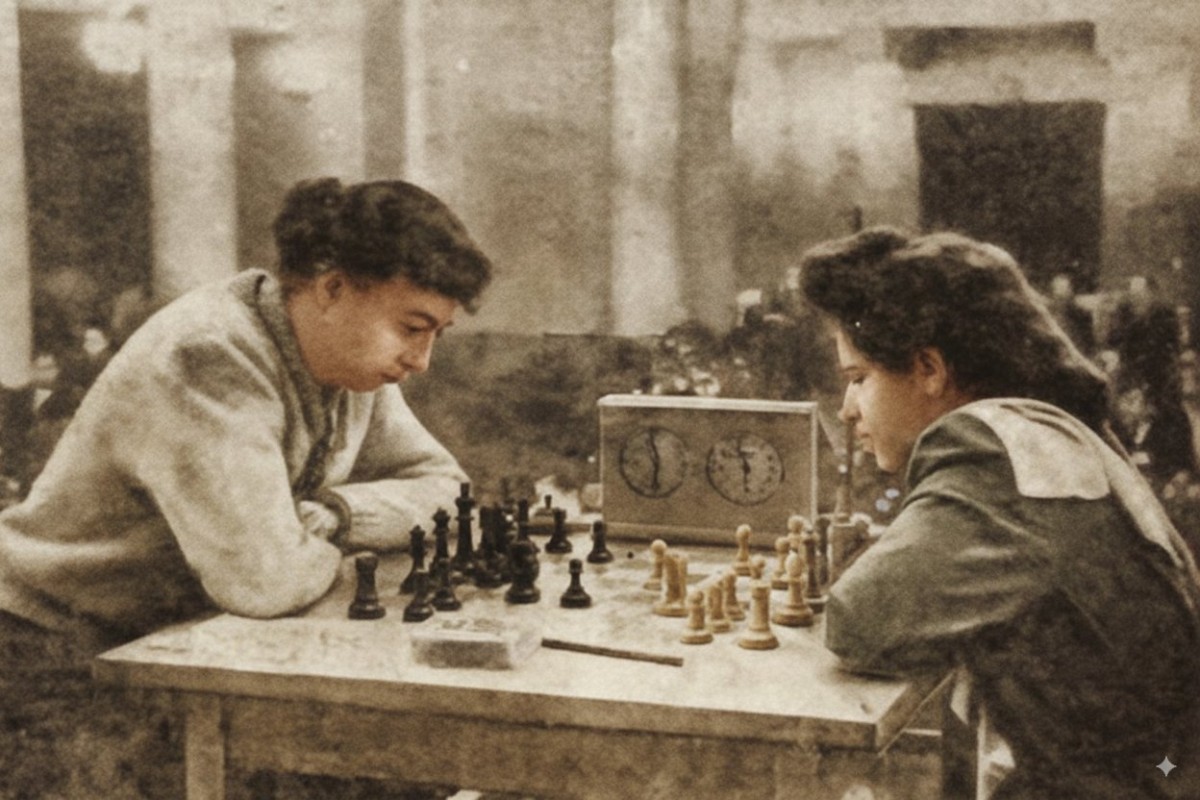
Opening of the Women's World Championship
The opening of the Women's World Championship took place on the evening of December 19, 1949, in the enormous hall of the Red Army House (photo). Guests arrived long before the official start of the tournament. Among them were representatives of sports organizations, chess enthusiasts from around the world, and great authorities in the field of chess at the time, such as Smyslov, Levenfish, and Lilienthal (a Hungarian Olympian who had settled permanently in the USSR). The large number of women interested in chess was particularly striking, which was a rarity in those times.

Opening of the Women's World Championship (photo by Jablonowski, December 29, 1949)
The hall gradually filled up. At the top, on the raised stage, emblems depicting chess rooks against a chessboard background were displayed. Around them, flags of the twelve countries represented by the world's best female players were arranged. In the most prominent seats sat, among others, A. H. Apolloinov, representative of the Committee for Physical Culture and Sports under the Council of Ministers (!) of the USSR, Committee representatives Postnikov and Romanov, men's world champion Mikhail Botvinnik, and others. Greeted by applause, the heroines of the battle for the women's crown gradually appeared on stage. They entered in order: USSR champion of 1945, Leningrad (today St. Petersburg) resident Valentina Belova, Italy's strongest female chess player Clarissa Benini, USSR champion of 1947 and 1948, Moscow resident Elisaveta Bykova, Polish champion Roza Hermanowa, US champion of 1944 and 1948 Gisela Gresser, four-time Czechoslovak champion Nina Hruskova – Belska, France's strongest female chess player Chantal Chaude de Silans, US champion of 1942, 1946, and 1948 Maya Karff, the young representative of the German Democratic Republic Edith Keller, Danish champion Ingrid Larsen, Cuba's strongest female chess player Maria Teresa Mora (due to the small number of Cuban women playing chess, no national championship was organized), multiple USSR champion and current national champion, Moscow resident Olga Rubtsova, leading Leningrad chess player Ludmila Rudenko, England's strongest representative Eileen Tranmer, and the leading Dutch player Fenny Heemskerk. Three-time Hungarian champion Jozsa Langos had not arrived in time, but her train was already approaching Moscow.
The ceremonial opening of the Women's World Championship was performed by Postnikov, and a beautiful concert by the Central Orchestra of the USSR began (such were the times!).
Chief arbiter Vera Tiudova acquainted everyone with the tournament regulations and conducted the drawing of lots, which produced the following results:
- Benini (Italy)
- Hermanowa (Poland)
- Chaude de Silans (France)
- Gresser (USA)
- Bykova (USSR)
- Keller (GDR)
- Heemskerk (Netherlands)
- Larsen (Denmark)
- Langos (Hungary)
- Karff (USA)
- Belova (USSR)
- Tranmer (England)
- Rudenko (USSR)
- Rubtsova (USSR)
- Hruskova – Belska (Czechoslovakia)
- Mora (Cuba)
At the conclusion of the opening ceremony of this exceptional tournament, Postnikov took the floor: Today we open the tournament for the Women's World Chess Championship. The International Chess Federation has entrusted the organization of this tournament to its new member, the Soviet Union. The world's strongest female chess players have come to participate from Great Britain, the German Democratic Republic, the Netherlands, Denmark, Italy, Cuba, Poland, the USA, France, and Czechoslovakia. A representative of Hungary is on her way to Moscow. The chess players of these countries will compete for the honorable title of women's world champion! Millions of Russian chess enthusiasts, as well as the global community, will follow the course of battle in this tournament of the strongest with enormous interest!
After wishing the players success, thunderous applause erupted, after which the famous chess player Ragozin took the floor (today we have the Ragozin Variation in the Queen's Gambit, which involves the early journey of the black Bishop to the square "b4"). Ragozin recalled the history of matches for the women's crown:
- 1927 – in a tournament with 12 participants, first place and the title of chess queen was won by the talented Czech chess player Vera Menchik.
- Subsequent championships were held in 1930, 1931, 1933, 1935, 1937, and finally the seventh in Buenos Aires in 1939. Vera Menchik won all of these tournaments without fail (later as a citizen of England).
- It was not until 1948, at the initiative of the Soviet Chess Organization, that the 19th FIDE Congress decided to resume the Women's World Championship tournaments.
- For the first time, Soviet female chess players were participating in this type of competition!
- Then N. Blukiet, M. Botvinnik, and Kislova spoke, but their addresses did not contribute anything new.
Round 1 – December 20, 1949
Round 1 results:
- Benini 0 : 1 Mora
- Hermanowa ½ : ½ Hruskova – Belska
- Chaude de Silans ½ : ½ Rubtsova
- Gresser 1 : 0 Rudenko
- Bykova 1 : 0 Tranmer
- Keller 0 : 1 Belova
- Heemskerk ½ : ½ Karff
- Larsen (postponed) Langos
Standings after Round 1:
- 1 – 4 Mora, Gresser, Bykova, and Belova 1 pt
- 5 – 10 Hermanowa, Hruskova – Belska, Chaude de Silans, Rubtsova, Heemskerk, and Karff 0.5 pts
- 11 – 16 Benini, Rudenko, Tranmer, Keller, Larsen (1), and Langos (1) 0 pts
The course of Round 1 as described by chief arbiter Vera Tiudova.
The Women's World Championship opened in the concert hall of the Red Army House, decorated with the flags of 12 nations. At precisely 5:30 PM on December 20, the clocks were started.
The first round had begun.
Seven games are in progress. Hungarian chess player Jozsa Langos has not yet arrived, and her game against Larsen has been postponed.
The first game to finish was Benini – Mora. In the Queen's Gambit, Black unsuccessfully maneuvered the kingside Knight to "b6" and then weakened the position of the advanced "e" and "f" Pawns. White's pieces seized the center and the "c" file. However, the intrusion of the white Rook to the seventh rank and immediately afterward playing the Rook to "c1" proved to be a mistake. By means of a simple combination, Mora put White in a position of either losing the Queen or being checkmated. After move 23, Benini resigned.
The second game to finish was Keller – Belova. In a complex variation of the Queen's Gambit, Belova (Black) managed to equalize the game. As a result of strong pressure from White, attacking the opponent's King, Black had to give up a Pawn. Mutual severe time trouble followed, in which Belova kept a cool head and constructed a mating net! Toward the end of the game, Keller could not withstand the tension of the struggle and incorrectly sacrificed a Rook. On move 41, Belova achieved victory.
The game Chaude de Silans – Rubtsova was sharply contested. White sacrificed a Pawn and gained a lead in piece development. Rubtsova repelled the first attack, and when White carried out a combination involving a Rook sacrifice, she won the exchange and a Pawn with an unexpected counter-blow (Bg4). However, two Bishops and a Pawn advantage on the queenside gave White the opportunity to fight for a draw. Chaude de Silans defended tenaciously and forced a draw by perpetual check.
The closed variation of the Sicilian Defense was beautifully played in the game Bykova – Tranmer. Black's position up to the twentieth move was very cramped, and their pieces could only move along the seventh and eighth ranks. White, on the other hand, had the entire chessboard at their disposal. The game was adjourned in a clearly better position for White, and on the day of the continuation, Tranmer resigned on move 48.
In a rare variation of the Ruy Lopez (Spanish Game) with the move 3...Bc5, in the game Gresser – Rudenko, a very complex position arose in which Black managed to organize an attack on the kingside. But in the later stage of the game, Rudenko conducted the attack inaccurately, lost several tempi, which led to a deterioration of her position. Black lost a Pawn and the exchange, and on the day of the continuation resigned.
In the game Hermanowa – Hruskova-Belska, Black lost an important tempo in the King's Indian Defense and obtained an inferior position. In the subsequent fight, White somewhat prematurely launched an attack on the kingside, but still with complete success. The game was adjourned in a position where Hermanowa had a Pawn advantage. But on the day of the continuation, she played the endgame inaccurately and the game ended in a draw.
The game Heemskerk – Karff proceeded in an atmosphere of great tension. In the Queen's Gambit, Karff obtained a cramped position with a weak Pawn on the "c" file. Unexpectedly, with the move e6–e5, Black obtained strong counterplay. White won a Pawn, but their Bishop was excluded from the game. At the same time, Black's Knight occupied a strong position on "c4". White's situation became difficult. In time trouble, Karff overlooked a strong defensive continuation by her opponent and was forced to transition to a only slightly better endgame. On the day of the continuation, the game ended in a draw.
We present the complete set of games played in the first round of the Women's World Championship, Moscow 1949–1950
Abbreviations used below:
- GDR – German Democratic Republic
- USSR – Union of Soviet Socialist Republics
Sicilian Defense [B25]
Women's World Championship, Moscow 1949–1950
Bykova – Tranmer
1.e4 c5 2.Nc3 Nc6 3.g3 g6 4.Bg2 Bg7 5.d3 d6 6.Nge2 Bd7 7.Be3 Nd4 8.h3 Qc8 9.Qd2 Rb8 10.g4 b5 11.Ng3 b4 12.Nd1 Bc6 13.c3 bc3 14.bc3 Nb5 15.f4 e5? (The cause of Black's further troubles. Correct was 15...Na3!)

16.f5! Nf6 17.g5 Nd7 18.0–0 Nb6 19.Qf2 Qd7 20.a4! Nc7 21.a5 Nc8 22.c4 Na6 23.Qd2?! (Mutual time trouble had begun! After 23.Bf3 followed by 24.Bg4, White would have had a winning position) 23...Bf8 24.f6 Rb3 25.Nc3 Qc7 26.Rfb1 Rb1 27.Nb1 Nb4 28.Nc3 a6 29.Nge2 Qd8 30.Ng3 h6 31.Nd5 Bd5 32.ed5 Na7 33.Kh2 hg5 34.Bg5 Qc8 35.Bf1 Qg4 36.Ne4 Qf3 37.Qg2 Qg2 38.Kg2 Kd7 39.Be2 Bh6 40.Kg3 Bg5 41.Ng5 (Time trouble was over. White has a winning position) 41...Kc7 42.Rb1 Kd7 43.Bg4 Kc7 44.Nf7 Rf8 45.Be6 Nc8 46.Rd1 Nc2 47.Rb1 Nb4 48.Rb3 and Black resigned. After the game, Tranmer explained that she had seen that after 48...Nc2, there could follow 49.Bc8! Rc8 (If 49...Rf7, then 50.Rb7) 50.Rb6 and White wins.

The game Bykova (right) – Tranmer in progress (photo by Jablonowski)
Queen's Gambit [D45]
Women's World Championship, Moscow 1949–1950
Chaude de Silans – Rubtsova
1.d4 Nf6 2.c4 e6 3.Nc3 d5 4.Nf3 c6 5.e3 a6 6.c5 Nbd7 7.Bd3 Qc7 8.0–0 e5 9.de5 Ne5 10.Ne5 Qe5 11.e4 de4 12.Ne4 Ne4 13.Be4 Be6 14.Qf3 Qc5 15.Be3 Qd6 16.Bf4 Qd7 17.Rfd1 Qc8 18.Rac1 Be7 19.Rc6 bc6 20.Bc6 Kf8 21.Ba8 Bg4 22.Rc1 Qc1 23.Bc1 Bf3 24.Bf3 Bf6 25.b3 g6 26.Kf1 Kg7 27.Ke2 Rc8 28.Kd1 Bd4 29.Be3 Be5 30.g3 f5 31.Be2 Rd8 32.Kc2 Rd6 33.Bc4 h6 34.f4 Bf6 35.b4 g5 36.Kb3 g4 37.Kc2 h5 38.a4 h4 39.Bc5 Rc6 40.Bd5 Rc7 41.Kd3 a5 42.Kc4 ab4 43.Kb4 h3 44.Kb5 Bc3 45.Bb6 Rd7 46.Kc6 Re7 47.a5 Ba5 48.Ba5 Re2 49.Kd6 Rh2 50.Bc3 Kg6 51.Ke7 Re2 52.Kf8 Rc2 53.Bf7 Kh7 54.Bg8 and drawn.

The game Chaude de Silans (right) – Rubtsova in progress (photo by Jablonowski)
Ruy Lopez (Spanish Game) [C64]
Women's World Championship, Moscow 1949–1950
Gresser (USA) – Rudenko (USSR)
1.e4 e5 2.Nf3 Nc6 3.Bb5 Bc5 4.c3 f5 5.d4 fe4 6.dc5 ef3 7.Qf3 Nf6 8.Bg5 0–0 9.0–0 Qe7 10.Bc4 Kh8 11.b4 a5 12.Bf6 Rf6 13.Qd5 Rf8 14.b5 Nd8 15.Nd2 c6 16.Qd6 Qd6 17.cd6 b6 18.Rfe1 cb5 19.Bb5 Nf7 20.Nc4 Ba6 21.Ba6 Ra6 22.Ne5 Nd6 23.Nd7 Rc8 24.Rad1 b5 25.h3 Nf7 26.Re7 Kg8 27.Rde1 Nd6 28.R1e6 Rc3 29.Ne5 h6 30.Rd7 Rc5 31.Nf7 Nf7 32.Ra6 Ne5 33.Rb7 b4 34.Raa7 Nc6 35.Rg7 Kf8 36.Raf7 Ke8 37.Rb7 Rf5 38.Rg8 Rf8 39.Rf8 Kf8 40.Rb6 Ne5 41.Rh6 and Black resigned.
Queen's Gambit [D63]
Women's World Championship, Moscow 1949–1950
Benini (Italy) – Mora (Cuba)
1.d4 Nf6 2.Nf3 e6 3.c4 d5 4.Nc3 Nbd7 5.Bg5 Be7 6.e3 0–0 7.Rc1 c6 8.a3 Re8 9.Bd3 dc4 10.Bc4 Nd5 11.Be7 Qe7 12.0–0 Nc3 13.Rc3 e5 14.d5 cd5 15.Bd5 Nb6 16.Be4 f5 17.Bb1 e4 18.Nd4 Kh8 19.Qc2 Bd7 20.Ba2 Rac8 21.Rc7 Qd6 22.Rc1 Rc7 23.Qc7 Rc8 and White resigned.
Queen's Gambit [D66]
Women's World Championship, Moscow 1949–1950
Keller (GDR) – Belova (USSR)
1.d4 d5 2.c4 e6 3.Nc3 Nf6 4.Bg5 Be7 5.e3 Nbd7 6.Nf3 0–0 7.Rc1 h6 8.Bh4 c6 9.Bd3 dc4 10.Bc4 b5 11.Bd3 a6 12.a4 ba4 13.Na4 Bb4 14.Nd2 Qa5 15.Nc3 c5 16.Nb3 Qb6 17.dc5 Bc5 18.0–0 Be7 19.Na4 Qd8 20.Bg3 Ra7 21.Qe2 Nd5 22.Rfd1 Qe8 23.Nd4 Nb4 24.Bb1 Nf6 25.Nc5 Nd7 26.Ne4 e5 27.Nf5 Nb6 28.Ned6 Bd6 29.Nd6 Qe7 30.Qh5 f5 31.Nf5 Bf5 32.Bf5 Qf6 33.Bb1 Re7 34.Rc5 Nd7 35.Rc4 a5 36.Rg4 Qe6 37.Rg6 Nf6 38.Qh6 Qb3 39.Rd2 Rc8 40.Rg7 Rg7 and White resigned.

The game Chaude de Silans (right) – Rubtsova in progress (photo by Jablonowski)
Nimzo-Indian Defense [E51]
Women's World Championship, Moscow 1949–1950
Heemskerk (Netherlands) – Karff (USA)
1.d4 Nf6 2.c4 e6 3.Nc3 Bb4 4.e3 d5 5.Bd2 0–0 6.Nf3 Nc6 7.Bd3 dc4 8.Bc4 a6 9.0–0 b5 10.Bd3 Bb7 11.a3 Ba5 12.Rc1 Re8 13.Ne4 Bd2 14.Nfd2 Ne4 15.Ne4 Ra7 16.Nc5 Ne7 17.Nb7 Rb7 18.Qc2 h6 19.Be4 Nd5 20.Qc5 Re7 21.b4 Rb8 22.Qc2 Nb6 23.Bd3 Rc8 24.Qb1 Rd7 25.Rfd1 c6 26.Rd2 Rd6 27.Rdc2 e5 28.Bf5 Rc7 29.de5 Rd5 30.e4 Rd3 31.e6 Nc4 32.ef7 Kf8 33.Rc3 Rd2 34.Rg3 Qd4 35.Rf1 Rf7 36.Be6 Rff2 37.Rf2 Rf2 38.Kh1 Nd2 39.Qg1 Rf1 40.Rf3 Rf3 
41.Qd4 Rf1 42.Qg1 Rg1 43.Kg1 Ne4 44.Bd7 c5 45.Bc6 cb4 46.ab4 Nc3 47.Bb7 Ke7 48.Kf2 Kd6 49.Ba6 Kd5 50.Ke3 Kc4 51.Kf4 Nd5 52.Kf5 Ne3 53.Kg6 Ng2 54.Kg7 Kb4 and drawn.
Fenny Heemskerk participated in the first four Women's Chess Olympiads (Emmen 1957, Split 1963, Oberhausen 1966, and Lublin 1969). In those times, the Netherlands was one of the chess powerhouses in the women's category.
At the time of the Women's World Championship discussed here, she was 30 years old. She won the Dutch Championship in 1937, 1939, 1946, and 1949. After the World Championship in Moscow, she was Dutch champion again in 1950, 1952, 1954, 1956, 1958, and 1961.
Nimzo-Indian Defense [E21]
Women's World Championship, Moscow 1949–1950
Hermanowa (Poland) – Hruskova-Belska (Czechoslovakia)
1.d4 Nf6 2.Nf3 b6 3.g3 Bb7 4.Bg2 e6 5.c4 Bb4 6.Nc3 d6 7.0–0 Bc3 8.bc3 Nc6 9.Nd2 d5 10.cd5 ed5 11.e4 Ne7 12.e5 Nd7 13.Qg4 0–0 14.Nf3 Bc8 15.Bh6 Ng6 16.Bg5 f6 17.Qe6 Kh8 18.Qd5 Ba6 19.ef6 Nf6 20.Qd8 Rad8 21.Rfe1 Rde8 22.Bf6 gf6 23.Re3 Kg7 24.Rae1 Kf7 25.Nd2 Re3 26.Bd5 Ke7 27.Re3 Kd8 28.Bg2 Ne7 29.c4 Bc8 30.Kf1 Nf5 31.Rd3 a5 32.Be4 Nd6 33.Bc6 Ba6 34.Rc3 Rf7 35.Ke1 Re7 36.Kd1 Bb7 37.Bb7 Nb7 38.Re3 Rf7 39.Nf3 Kd7 40.Kd2 Kd8 
41.Kd3 Kd7 42.Nd2 f5 43.Nf3 Rf6 44.Ne5 Kd6 45.f4 h6 46.h3 c6 47.a4 Kc7 48.Nf3 Kd7 49.Re5 c5 50.Nh4 cd4 51.Nf5 Nc5 52.Kd4 Na4 53.Rd5 Kc7 54.Re5 Nc5 55.Ne3 Kd6 56.Nf5 Kc7 57.Ne3 Kd6 58.Nd5 Rg6 59.g4 Nd7 60.Re3 Re6 61.Re6 Ke6 62.f5 Kf7 63.Kc3 Kg7 64.Kb2 Ne5 65.Nb6 Kf6 66.Nd5 Kg5 67.Kc3 Kh4 68.Nf4 Kg3 69.Ng6 Nd7 70.Ne7 Kh3 71.Ng8 Kg4 72.Nh6 Kg5 73.Nf7 Kf5 74.Nd6 Ke5 75.Nb7 Nb6 76.Na5 Nc4 and drawn.
Roza Hermanowa was 48 years old during the Moscow tournament. In 1949 and 1950 she triumphed in the Polish Championship. Like all participants of the World Championship, upon the conclusion of the event she received the title of Woman International Master. While the titles of International Master and Grandmaster for men were introduced in 1950, the women had to wait until 1976, when the title of Woman Grandmaster was introduced.

A moment of rest for the World Championship participants. From left: Chaude de Silans, Belova, Tranmer, Hermanowa, Benini, and Bykova; (photo by K. Vdovin)
English Opening [A34]
Women's World Championship, Moscow 1949–1950
Larsen (Denmark) – Langos (Hungary)
1.c4 c5 2.Nc3 Nc6 3.Nf3 e5 4.e3 Nf6 5.d4 ed4 6.ed4 cd4 7.Nd4 Be7 8.Nc6 dc6 9.Be2 Qd1 10.Bd1 Bf5 11.Be2 0–0 12.0–0 Rfe8 13.a3 Bc5 14.Bf4 Bd4 15.Rfe1 Ne4 16.Nd1 Nc5 17.Be3 Nb3 18.Bd4 Na1 19.Ne3 Nc2 20.Nc2 Bc2 21.Be3 f6 22.Bf3 Be4 23.Be2 Rad8 24.Rc1 Re7 25.c5 b5 26.b4 a6 27.Kf1 h6 28.h4 Bd3 29.Ra1 f5 30.g3 Be2 31.Ke2 Re4 32.Rd1 Rd1 33.Kd1 Kf7 34.Kd2 Ke6 35.Kd3 Kd5 36.f3 Re7 37.h5 Rd7 38.Bf4 a5 39.Bd6 ab4 40.ab4 Ra7 41.Bf8 Rf7 42.Bd6 g6 43.hg6 Rg7 44.Ke3 Rg6 45.Kf4 Ke6 46.Bc7 Rg5 47.Bd8 Rg7 48.Bb6 Rd7 49.Ba5 Rd4 50.Ke3 Kd5 51.f4 h5 52.Kf3 Rd3 53.Kg2 Ke4 54.Kh3 Rb3 55.Kh4 Rd3 56.Bb6 Kf3 57.Kh5 Kg3 58.Kg5 Rd5 59.Bc7 Kf3 60.Kf6 Ke4 61.Be5 Kd3 62.Kf5 Kc4 63.Ke6 Kb4 64.f5 Kc5 65.f6 Rd8 66.f7 Kc4 67.Ke7 Ra8 68.f8Q Rf8 69.Kf8 Kd5 70.Bg7 c5 71.Ke7 b4 72.Kd7 c4 73.Kc7 c3 74.Kb6 Kc4 and White resigned. The game was played on December 21, 1949, because, as we recall, Langos arrived in Moscow late.
After the first round, the organizers conducted short interviews with two tournament participants. We present them below.
1. Roza Hermanowa (Poland)
I am a doctor by profession. I work at one of the outpatient clinics in the Polish city of Lodz.
I became interested in chess as a teenager. Years have passed, and I am still a devotee of this wonderful game.
I have repeatedly participated in the Polish Championship and won it. In 1935 in Warsaw and in 1937 in Stockholm, I played in the World Championship.
The Moscow tournament, in my opinion, stands out for its strong field. I think the title of women's world champion will be won by one of the Soviet chess players.
2. Ingrid Larsen (Denmark)
I have been playing chess since childhood, but I took it up seriously twelve years ago. I have successfully competed in the Danish Championship on multiple occasions, winning the national title.
I have participated in the World Championship twice – in 1937 in Stockholm and in 1939 in Buenos Aires. The Moscow tournament, in my opinion, is stronger than all previous World Championships. That is, of course, if we disregard the fact that Vera Menchik competed in those.
As for the favorites, at this point it is difficult for me to name them. That will be possible after the halfway point of the tournament.
In Moscow, we participants have seen many interesting things. What I liked most was the ballet performance of "Swan Lake" that took place at the Bolshoi Theatre.

The playing hall (photo by G. Jablonowski)
Round 2 – December 22, 1949
Round 2 results:
- Langos ½ : ½ Mora
- Karff 1 : 0 Larsen
- Belova 0 : 1 Heemskerk
- Tranmer 0 : 1 Keller
- Rudenko 1 : 0 Bykova
- Rubtsova 1 : 0 Gresser
- Hruskova – Belska 0 :1 Chaude de Silans
- Benini 1 : 0 Hermanowa
Standings after Round 2:
- 1 – 6 Chaude de Silans, Heemskerk, Langos, Karff, Rubtsova, and Mora 1.5 pts
- 7 – 12 Benini, Gresser, Bykova, Keller, Belova, and Rudenko 1 pt
- 13 – 14 Hermanowa and Hruskova – Belska 0.5 pts
- 15 – 16 Larsen and Tranmer 0 pts
The course of the second round as told by grandmaster Ragozin.
Ten years had passed since the previous Women's World Championship. Which of the ladies was now the strongest chess player? Who was a contender for first place in the World Championship?
Despite knowing the results of the first two rounds, even the greatest experts could not venture to attempt an answer to these questions. One thing, however, was certain: over the last ten years, female chess players had taken a great step forward.
In the first two rounds, the participants demonstrated not only a good knowledge of theory but also the ability to handle complex positions. Every game featured bold fighting, and the chess players did not shy away from sacrificing material.
Playing White, Rudenko already in the opening (Catalan Opening) sacrificed a Pawn to Bykova. Having seized the center of the chessboard, Rudenko launched a powerful attack on the kingside. After 17 moves, five white Pawns were menacingly positioned on the fourth rank, and then a storm on the black King's position followed. Bykova could not respond with a counter-blow on the queenside, where she had an extra Pawn, and had to resort to passive defense. After 31 moves, White's attack concluded successfully – Rudenko won a Knight, which decided the outcome of the game. On the day of the continuation, despite heroic defense, Bykova had to sign her capitulation.
In the game Rubtsova – Gresser, the Moscow chess player obtained a better position and had two active Bishops. Gresser managed to exchange one of them, but in seeking simplifications, the American allowed the enemy Queen to penetrate into her camp. The USSR champion, thanks to this maneuver, won the "a" Pawn. The resulting position, however, was still unclear. White correctly did not allow the exchange of Queens, since with opposite-colored Bishops, Black had enormous chances for a draw. Rubtsova accurately assessed the position, steered the game into a Queen endgame, and her passed "a" Pawn advanced all the way to the promotion square. Gresser lost.
Chaude de Silans played the game against Hruskova – Belska very well. Obtaining a strong pawn center in the opening (Sicilian Defense), Hruskova – Belska wasted a lot of time maneuvering the dark-squared Bishop to the long diagonal and then weakened her own King's position. By means of a central breakthrough d6–d5, Chaude de Silans opened the position and pinned White's pieces. On move 27, she won a piece, and after two more moves she triumphed.
In the games Tranmer – Keller and Mora – Langos, the Sicilian Defense was also played.
Tranmer launched a pawn storm on the kingside and Black's position looked difficult. Keller kept a cool head and defended patiently. In severe time trouble, Tranmer overestimated her position and sacrificed three Pawns without receiving compensation. In the continuation, Keller had no problems converting her advantage.
The game Mora – Langos had a quiet course. White maneuvered in the center and on the queenside. As a result, she managed to create a weak "b5" Pawn in Black's camp. In return, Langos had the bishop pair. The game was adjourned.
In the game Karff – Larsen, the fight was conducted in positional style. After the opening, Larsen stood better. The Danish player seized the open "d" file and forced White's pieces to defend the weak "d3" Pawn. However, Larsen did not find the correct plan, and in time trouble she lost all her positional advantage. Karff played the second phase of the game perfectly and won the exchange. The game was adjourned, and in the continuation the American converted her advantage.
The game Benini – Hermanowa proceeded under the sign of White's domination. Hermanowa played the opening poorly. White conducted a precise attack on the queenside and won the exchange. In the endgame, Benini precisely converted her advantage and on move 33 was victorious.
The greatest interest among spectators was drawn by the game of the Leningrad resident Belova against Heemskerk. After the opening (Nimzo-Indian Defense), Belova obtained an active position. Black managed to construct a counter-blow on the queenside, where they had a Bishop excellently placed on the square "a6". Belova could have exchanged it, but did not want to part with her bishop pair. She also willingly agreed to a mutual sharpening of the position. However, the Leningrad player lost a great deal of time and found herself in severe time trouble. For the next 13 moves she had only eight minutes. Heemskerk exploited her opponent's time shortage, won two Pawns, and achieved victory in the game.
English Opening [A28]
Women's World Championship, Moscow 1949–1950
Rubtsova (USSR) – Gresser (USA)
1.c4 e5 2.Nc3 Nf6 3.Nf3 Nc6 4.d4 e4 5.Ne5 (More commonly played is 5...Nd2, as Botvinnik played in the fifth game of his match against Flohr. The text move gives White only an equal game) 5...Bb4 6.Bg5 h6 7.Bh4 (This is stronger than 7.Bf6 Qf6 8.Nc6 e3! with a strong attack for Black) 7...Qe7 8.Nc6 bc6 (Better was 8.dc6. Now White stands better) 9.e3 0–0 10.Be2 d6 11.0–0 Bc3 12.bc3 Bd7 13.Rb1 Rfb8 14.Qd2 (Preparing for the move f3, but in the next move White abandons this plan. Better was 14.Qc2 right away) 14...Qe6 15.Qc2 (Threatening 16.Bf6 and forcing Black's next move) 15...g5 16.Bg3 Ne8 (Black defends the points "d6" and "c7" preparing for White's move c4–c5. But now the Knight does not control the square "e4" and the threat of opening the position for White's Bishops by means of the Pawn advance f2–f3 appears) 17.Kh1 Ng7 (White threatened the maneuver 18.f3 ef3 19.Bf3 Qe3? 20.Rbe1 and Black's Queen is trapped. Now after 18.f3, there follows 18...Nf5. White begins action on the queenside, where they have the advantage) 18.Rb8 Rb8 19.Rb1 Qe8 20.c5! (Bad was 20.Rb8 Qb8 21.Qe4 because of 21...Qb2!) 20...Nf5 21.cd6 cd6 22.c4 (Again threatening c4–c5) 22...c5? (This move eliminates the threat c4–c5 but gives White the "b" file, which will lead to the loss of a Pawn. Better was 22...Ng3 23.hg3 d5 and White had only a better game) 23.dc5 Rb1 24.Qb1 Ng3 25.hg3 dc5

26.Qb7 (This Queen intrusion decides the game) 26...Qe6 27.Qa7 Qc6 28.Qb8 Qc8 29.Qe5! Qc6 30.f4 ef3 31.Bf3 Qb6 32.Kh2 Qa6 33.Qe7 Be6 34.Bd5 Qc8 35.Be6 fe6 36.a4 e5 37.Qe5 Qg4 38.Qe8 Kg7 39.a5 Qc4 40.Qd7 Kg6 41.Qc6 Kg7 42.a6 Qe2 43.Qd7 (notes by USSR champion Olga Rubtsova) and Black resigned.

The game Rubtsova (right) – Gresser in progress (photo by Jablonowski)
Nimzo-Indian Defense [E47]
Women's World Championship, Moscow 1949–1950
Belova (USSR) – Heemskerk (Netherlands)
1.d4 Nf6 2.c4 e6 3.Nc3 Bb4 4.e3 0–0 5.Bd3 d6 6.Nge2 e5 7.0–0 Nc6 8.Nd5 ed4 9.ed4 h6 10.Nb4 Nb4 11.Bb1 d5 12.b3 a5 13.Nf4 Bg4 14.f3 Bc8 15.Re1 b6 16.c5 Ba6 17.a3 Nc6 18.Bb2 Qd7 19.Qd2 bc5 20.dc5 d4 21.Bc2 Rfe8 22.Rad1 Re1 23.Re1 Re8 24.Re8 Qe8 25.Kf2 Qe5 26.b4 ab4 27.ab4 g5 28.Nd3 Qh2 29.Ba4 g4 30.Qf4 Qh4 31.Qg3 Qg5 32.Bc1 Qf5 33.Bc6 Qd3 34.b5 Qc2 35.Kg1 Qc1 36.Kh2 Qc5 37.Qc7 Bb5 38.Qb8 Kg7 39.Bb5 Qh5 40.Kg3 gf3 41.gf3 Qg5 42.Kf2 Qe3 43.Kg2 Qd2 44.Kh3 Qg5 45.Qb6 h5 46.Bc4 Qf5 47.Kg3 Qe5 48.Kh3 h4 49.Kh4 Qf4 50.Kh3 Qf3 and White resigned.
Reti Opening [A13]
Women's World Championship, Moscow 1949–1950
Karff (USA) – Larsen (Denmark)
1.Nf3 d5 2.c4 e6 3.g3 Nf6 4.Bg2 dc4 5.Qa4 Nbd7 6.Qc4 c5 7.0–0 Be7 8.d3 0–0 9.b3 a6 10.Bb2 b5 11.Qc2 Bb7 12.Nbd2 Rc8 13.Rac1 Qb6 14.Qb1 Rfd8 15.a4 Bd6 16.Qa1 Ba8 17.e4 Be7 18.Rfd1 Nb8 19.Nf1 Nc6 20.Ne3 Nb4 21.Ne1 Rc7 22.h3 Rcd7 23.Bf1 Qb7 24.Qb1 Nh5 25.Be2 g6 26.Bf3 Qb6 27.Ng4 f6 28.Bc3 Nc6 29.Bg2 e5 30.Qa2 Kg7 31.Bd2 g5 32.Bc3 Nd4 33.Ne3 Qe6 34.Bd4 Rd4 35.Nf5 Kg6 36.Nd4 ed4 37.ab5 ab5 38.Ra1 Bc6 39.Nf3 Ra8 40.Qc2 Ra1 41.Ra1 Bd7 42.Rb1 h6 43.b4 Qd6 44.bc5 Qc5 45.Qb2 Qc3 46.Nd4 Qd3 47.Nb5 Qb5 48.Qb5 Bb5 49.Rb5 Bd6 50.Kf1 Ng7 51.Ke2 Be5 52.Ke3 Ne6 53.Rd5 h5 54.Bf1 h4 55.Kf3 hg3 56.fg3 Nd4 57.Kf2 Ne6 58.Be2 Nd4 59.Bg4 Nb3 60.Rd7 Nd4 61.Ke3 f5 62.ef5 Nf5 63.Ke4 and Black resigned.
Catalan Opening [E01]
Women's World Championship, Moscow 1949–1950
Rudenko (USSR) – Bykova (USSR)
1.d4 Nf6 2.c4 e6 3.g3 d5 4.Bg2 Nc6 5.Nc3 Bb4 6.a3 Bc3 7.bc3 0–0 8.Bg5 dc4 9.e4 h6 10.Bf6 Qf6 11.f4 Bd7 12.Nf3 Rab8 13.0–0 b5 14.Qe2 Qe7 15.g4 g6 16.h4 Kg7 17.h5 a6 18.g5 Rh8 19.hg6 fg6 20.gh6 Rh6 21.Ng5 e5 22.Qe3 ed4 23.cd4 Nd8 24.d5 Nf7 25.Qd4 Kg8 26.Nf3 Bh3 27.e5 Bg2 28.Kg2 Rd8 29.Rh1 Qf8 30.e6 Rh1 31.ef7 Qf7 32.Rh1 Qg7 33.Ne5 g5 34.f5 Re8 35.Re1 Qf6 36.Nf3 Qf7 37.Ng5 Qf8 38.Re8 Qe8 39.Ne6 Qf7 40.Qg4 Kh8 41.Kf3 Qh7 42.Qg6 Qh1 43.Kg4 Qg2 44.Kh5 Qh3 45.Kg5 Qg3 46.Kf6 Qh4 47.Kf7 Qh7 48.Kf8 and Black resigned.
Sicilian Defense [B85]
Women's World Championship, Moscow 1949–1950
Mora (Cuba) – Langos (Hungary)
1.e4 c5 2.Nf3 Nc6 3.d4 cd4 4.Nd4 Nf6 5.Nc3 d6 6.Be2 e6 7.Be3 a6 8.0–0 Qc7 9.Nb3 Be7 10.f4 0–0 11.Bf3 Na5 12.Na5 Qa5 13.Qe1 Qc7 14.Qf2 Bd7 15.Bb6 Qc8 16.Rad1 Bc6 17.Rd2 Nd7 18.Be3 Qc7 19.Rfd1 Rac8 20.a3 b5 21.Na2 Bb7 22.Nc1 Nc5 23.Bc5 Qc5 24.Qc5 Rc5 25.Nb3 Rc7 26.Kf2 Rd8 27.c3 Kf8 28.Rd4 Ke8 29.a4 e5 30.fe5 de5 31.Rd8 Bd8 32.ab5 ab5 33.Ke2 Be7 34.Nd2 h6 35.Kd3 Bg5 36.Nb1 Ba6 37.b4 Bf4 38.g3 Bg5 39.Kc2 Be7 40.Kb3 Bc8 41.Na3 Be6 42.Kb2 Bc4 43.Nc4 bc4 44.Rd5 f6 45.Bh5 Kf8 46.Be2 g6 47.Ra5 Bd6 48.Ka3 f5 49.Ka4 Ke7 50.ef5 gf5 51.Kb5 e4 52.Bc4 Kf6 53.Ra6 Ke5 54.Rc6 Ra7 55.Rc8 Kf6 56.Rh8 Kg7 57.Rg8 Kf6 and drawn.
Sicilian Defense [B80]
Women's World Championship, Moscow 1949–1950
Tranmer (England) – Keller (GDR)
1.e4 c5 2.Nf3 e6 3.d4 cd4 4.Nd4 Nf6 5.Nc3 d6 6.g3 a6 7.Bg2 Qc7 8.0–0 Bd7 9.Kh1 Nc6 10.f4 Rc8 11.Nb3 b5 12.Be3 Be7 13.a3 0–0 14.g4 Rfd8 15.g5 Ne8 16.h4 Na5 17.Na5 Qa5 18.f5 Qc7 19.Qf3 f6 20.Bh3 Qc4 21.Rad1 Nc7 22.Rd4 Qc6 23.Qh5 ef5 24.g6 hg6 25.Qg6 fe4 26.Rg1 Bf8 27.Bg2 d5 28.Bf1 Be8 29.Qg4 Bf7 30.Ne2 Qc2 31.h5 Ne6 32.h6 g6 33.Rd2 Qc7 34.h7 Kh8 35.Qh4 Bg7 36.Bh3 g5 37.Qf2 Qe5 38.Nd4 Rc7 39.Ne6 Be6 40.Bd4 Qd6 41.Be6 Qe6 42.Bb6 e3 43.Qe3 Qe3 44.Be3 Re7 45.Bd4 Kh7 46.Rgd1 Kg6 47.Bb6 Rdd7 and White resigned.
Queen's Pawn Game [D02]
Women's World Championship, Moscow 1949–1950
Benini (Italy) – Hermanowa (Poland)
1.d4 Nf6 2.Nf3 g6 3.g3 d5 4.Bg2 e6 5.c4 Bg7 6.Bg5 c5 7.0–0 Qb6 8.Nc3 cd4 9.Nd4 Ne4 10.Ne4 de4 11.c5 Qc7 12.Nb5 Qd7 13.Qd7 Kd7 14.Be4 f6 15.Rad1 Ke7 16.Bf6 Bf6 17.Nc7 Nd7 18.Na8 Nc5 19.Bg2 Bd7 20.b4 Na6 21.Bb7 Nb4 22.Bf3 Be5 23.a3 Nc6 24.Rc1 Nd4 25.Nc7 Rc8 26.Na6 Rc1 27.Rc1 Bb5 28.Nb4 Kf6 29.Kg2 Ne2 30.Be2 Be2 31.Nc6 Bb2 32.Rc2 Bb5 33.Na7 and Black resigned. 
The game Benini (right) – Hermanowa in progress (photo by Jablonowski)
Sicilian Defense [B51]
Women's World Championship, Moscow 1949–1950
Hruskova – Belska (Czechoslovakia) – Chaude de Silans (France)
1.e4 c5 2.Nf3 d6 3.Bb5 Nd7 4.c3 Ngf6 5.Qe2 e6 6.d4 cd4 7.cd4 Be7 8.0–0 0–0 9.Bd2 a6 10.Bd3 e5 11.Bc3 ed4 12.Nd4 Nc5 13.Bc2 Bd7 14.Nd2 Re8 15.Rae1 Rc8 16.f4 Na4 17.Ba4 Ba4 18.Kh1 Bd7 19.h3 b5 20.g4 d5 21.e5 Ne4 22.Ne4 de4 23.Qe4 
23...Rc4 24.Qd3 Bc6 25.Kh2 Qd5 26.Qd2 b4 27.f5 bc3 28.bc3 Rc3 29.Re2 Bb4 and White resigned.
Player profiles
Olga Nikolayevna Rubtsova was born in Moscow in 1910. Her father, a professor at the Bauman Moscow Technical Institute, was a chess enthusiast. He held the first category, which meant a great deal in the Soviet Union. In the 1920s he actively participated in tournaments. Her father taught Olga to play chess when she was still a small child.
Young Olga became seriously interested in chess in 1925 during an international tournament in Moscow. Together with her schoolmates, she visited the playing hall every day and followed the games of the world's leading chess players with great interest.
At the school where Rubtsova studied, a chess tournament was organized in 1926. To everyone's surprise, Olga defeated many of her classmates, and from that moment she represented the school in team competitions, playing on second board.
At the end of 1926, Rubtsova took part in an open tournament organized by the newspaper "Komsomolskaya Pravda" and in the women's section scored 7 points out of eight games, which gave her first place.
Soon Olga Rubtsova received a nomination to the team for the traditional Moscow – Leningrad matches. The event took place on May 1–2, 1927, in Leningrad. Playing on second board (Morachevskaya played on first board), she scored 1.5 points out of 2 games. As a reward, she was sent to Moscow for the first women's championship, where she faced experienced female chess players from Moscow and Leningrad. Once again she surprised everyone by scoring 8.5 points out of 10 games without a loss (three draws). She received the title of USSR champion and was awarded the second category.
In 1928, Rubtsova competed in the first Moscow championship. She took second place (10.5 points out of 12 games), losing her game to the winner Rudenko (12 points out of 12 games!).
Rubtsova was not successful in the next USSR championship in 1934. In the semifinal she took second place, and in the final she shared 6th–8th place. Semenova won. But already a year later, in a match against Semenova, she triumphed with the magnificent score of 8:2! This success gave her the USSR champion title once again.
In 1936, Rubtsova entered a "men's" tournament. The tournament proved too strong for her, but she defeated one master and drew with the famous grandmaster Lilienthal. That same year she finished third in the next women's national championship. But a year later she returned to the "throne" with a score of 12.5 points out of 15 games, finishing ahead of her nearest rivals, Semenova and Morachevskaya, by two points.
In 1940, Rubtsova was awarded the first category according to the men's classification! Five years later she finished 3rd–4th in the women's championship, and in 1946 she took second place in the Moscow championship. In 1947, again in the Moscow championship, she shared first place with Wojcik, but in the title match she crushed her 4:0.
The USSR championship in 1947 gave her fifth place, and in 1948 she won third prize. In the year of the Women's World Chess Championship that we are describing here, Rubtsova once again became champion.