






9th Chess Olympiad – Dubrovnik 1950
The first post-war Chess Olympiad without Poland – complete description
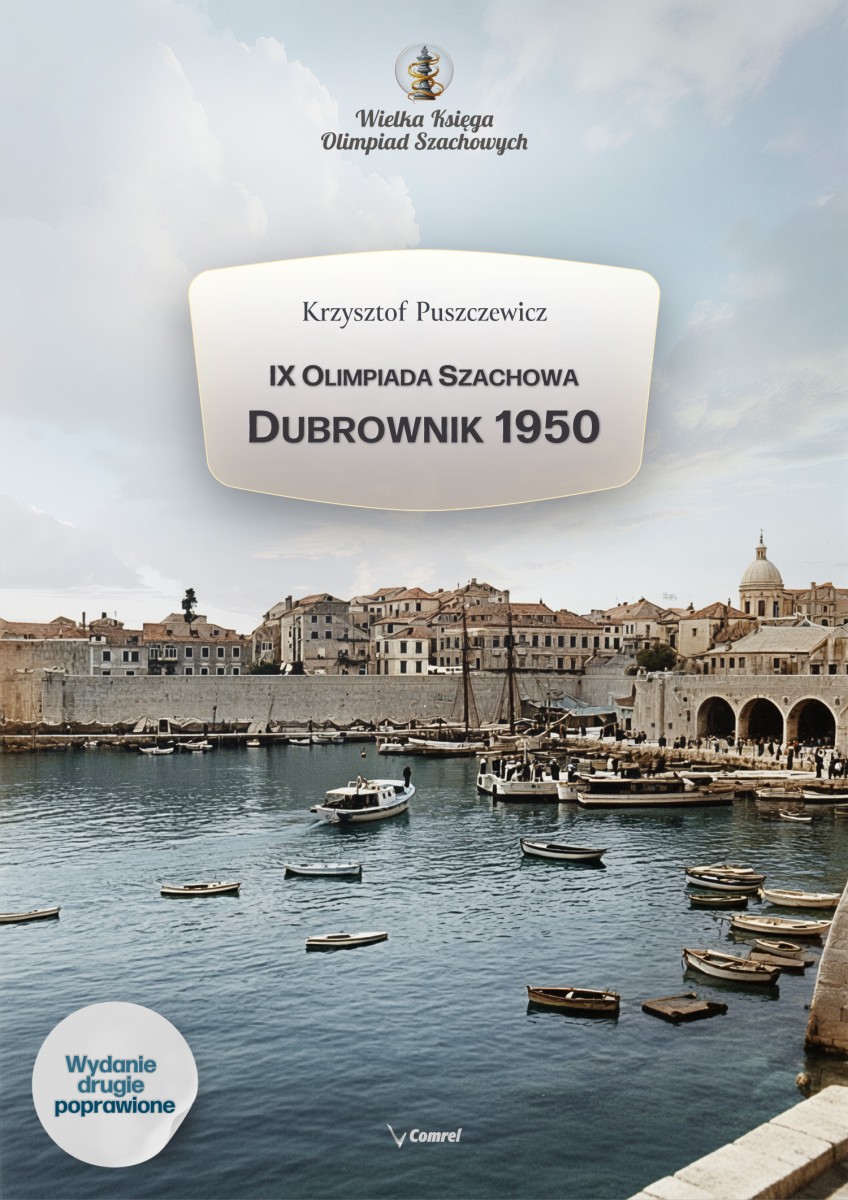
9th Chess Olympiad – Dubrovnik 1950
The year 1950. Five years after the end of World War II. Dubrovnik, the pearl of the Adriatic, under the patronage of Marshal Tito, hosts the first post-war Chess Olympiad. But something had changed – behind the Iron Curtain remained the strongest players in the world. Poland, a country that just 15 years earlier had won gold in Warsaw, would not come at all...
Table of Contents
- Historical context – Dubrovnik in the shadow of the Cold War
- Eastern Bloc boycott – where was Poland?
- Tournament organization – Tito, stamps, and heat waves
- Fight for gold – Yugoslavia versus Argentina
- Heroes of Dubrovnik – Gligorić, Najdorf, Unzicker
- Final results and statistics
- First introduction of grandmaster titles
- Polish chess players in Dubrovnik – the Olympic paradox
- Most interesting games of the tournament
- FAQ – Frequently asked questions
Historical context – Dubrovnik in the shadow of the Cold War
An 11-year break and a new geopolitical reality
It took 11 years since the previous Olympiad (Buenos Aires 1939) and 5 years after the end of World War II before a federation finally proposed continuing the Olympic tradition. Europe was gripped by the Cold War, and the world had split into two hostile camps.
The organization of this unique event was taken on by Yugoslavia – the only country in the world that surpassed even the USSR in the number of chess tournaments and festivals organized. The decision to entrust this prestigious event to Yugoslavia had already been made in 1948 at the FIDE Congress in the Swedish town of Saltsjöbaden.
Why Yugoslavia?
Yugoslavia found itself in a unique geopolitical position. After the Tito-Stalin split in 1948, the country became the first communist state to dare defy Moscow. It was precisely this conflict that led to the Olympiad boycott by the USSR and the People's Democracies.
Eastern Bloc boycott – where was Poland?
The list of absences that changed chess
The Olympiad was boycotted by:
- USSR (Soviet Union)
- Poland
- Hungary
- Czechoslovakia
- German Democratic Republic (East Germany)
- Bulgaria
- Romania
- Albania
What did this mean for the tournament? The absence of the world's strongest players. The USSR at that time had a team featuring Botvinnik, Smyslov, Keres, and Bronstein – a powerhouse that no other team could match.
Poland – from powerhouse to underdog
In 1935, Poland organized the 6th Chess Olympiad in Warsaw. In 1930 in Hamburg, it won the gold medal. But in 1950 in Dubrovnik, Poland was entirely absent.
As Krzysztof Puszczewicz wrote in "The Great Book of Chess Olympiads":
"Unlike other socialist countries, Poland completely neglected competitive chess. It was treated by sports federations as a burden, and from a great powerhouse, Poland became the weakest chess nation in Eastern Europe. The absence from Dubrovnik was in a sense symbolic: it opened a new, less glorious chapter in the history of Polish Olympic chess."
Poland did not produce its first grandmaster until 1976 – a full 41 years after the gold in Hamburg.
England also stayed away
Unfortunately, this was not the last Olympiad boycott. England did not come for a mundane reason – they had organized their national championship at the same time. For chess fans, this was a blow – the absence of one of the strongest pre-war teams.
Tournament organization – Tito, stamps, and heat waves
Dubrovnik – a city that lived and breathed chess
The 9th Chess Olympiad was held in an "intimate" setting in the beautiful seaside resort town. Games were played in the halls of an art gallery (Gallery Unietka).
For the Yugoslavs, for whom chess – alongside football – had always been a major sport, the battles on the 64 squares were the talk of the town. The press and radio reported daily on the tournament's progress, publishing interviews, games, and more.
First Olympic chess stamps in history
Yugoslavia issued the first-ever series of stamps themed around the Chess Olympiad. These unique stamps became a memento of the first post-war Olympiad.
Marshal Tito as patron
The excellent organization of the event was made possible by substantial state subsidies and... the honorary patronage of Marshal Josip Broz Tito. Tito personally attended the Opening Ceremony, spoke with the players, and followed the progress of the competition.
Hotels and playing conditions
Participants were housed in four quality hotels:
- "Moskva"
- "Beograd"
- "Dubrovnik"
- "Lapad"
The accommodation and playing conditions were excellent, with the only drawback being an enormous heat wave, the likes of which had not been seen there in a long time – temperatures exceeded 35°C in the shade.
Due to the extreme heat, rounds were scheduled from 5:00 PM to 10:00 PM, but even then it was still hot. The extreme weather conditions took a particular toll on the older players.
Technological innovations
During each round, the moves made by players were transmitted by telephone and immediately displayed on large demonstration boards in the main squares of Yugoslavia's biggest cities. This was a technological innovation for the 1950s!
Fight for gold – Yugoslavia versus Argentina
Tournament system
Due to the relatively small number of teams (only 16 countries), a round-robin system was used. 84 players contested a total of 480 games.
Teams were expanded to include a second reserve player – they could now field up to six players. Not all teams took advantage of this option – the Argentinians (!), Danes, Belgians, Germans, Italians, Austrians, Norwegians, and Greeks played with five, while Peru and Chile fielded only four.
Tournament progress
Yugoslavia led throughout the entire tournament, and their victory was never in jeopardy. However, Argentina's magnificent finish made the final stages very exciting.
The competition ran from August 20 to September 11, 1950 – a total of 15 rounds. Time control: 2.5 hours for 40 moves plus 1 hour for every subsequent 16 moves.
Arbiters
- Chief Arbiter: Milan Vidmar senior (participant in the Olympiads in Prague 1931 and Warsaw 1935)
- Round Arbiter: Hans Kmoch (participant in the Olympiads in London 1927, Hamburg 1930, and Prague 1931)
- Technical staff: Timet Dubravko (Yugoslavia)
Heroes of Dubrovnik – Gligorić, Najdorf, Unzicker
Svetozar Gligorić – the rising king of Yugoslav chess
Svetozar Gligorić was destined to become one of the strongest chess players in the history of Yugoslav and world chess. In Dubrovnik, he showed the first flashes of the brilliance that would take him to the very top of the world rankings.
Miguel Najdorf – a Polish wanderer in Argentine colors
Mieczysław Najdorf (competing as Miguel Najdorf) – the second "pre-war" Polish player – played for the Argentine team. A participant in the Olympiads in Warsaw 1935, Stockholm 1937, and Buenos Aires 1939, he belonged to the absolute world elite.
On first board, he scored 11 points out of 14 games – a result of approximately 80%, which is truly rare at the highest level. Najdorf and Bolbochan stood out on the most difficult top boards.
Julio Bolbochan – Argentina's hero on second board
30-year-old Julio Bolbochan (not to be confused with the pre-war player Jacobo Bolbochan) scored 11.5 points out of 14 games on second board – the best individual result of the entire Olympiad!
Wolfgang Unzicker – the German revelation
The biggest surprise of the tournament was 25-year-old German champion (1948 and 1950) Wolfgang Unzicker. His career was just beginning, but already in Dubrovnik he showed what he was capable of!
Unzicker matched Najdorf's percentage on first board – also scoring 11 points out of 14 games. It was thanks to him that West Germany finished in a surprising third place.
As reports noted: "Unzicker played in the style of a strong grandmaster," even though he did not yet formally hold the title.
Savielly Tartakower – a Polish heart in French colors
Savielly Tartakower – a member of the pre-war Polish team – made his debut in French colors. After the Olympiad, he stated that in his opinion the tournament in Dubrovnik surpassed previous Olympiads in three main respects:
- Publicity (daily bulletins, radio coverage, sports press, telegram organization, wonderful surroundings)
- A true spirit of sporting competition
- Excellent technical organization
Chantal Chaude de Silans – the first woman among men
A sensation was the participation of Chantal Chaude de Silans (1919-2001) in the French team, the first woman to compete on equal terms with men at a Chess Olympiad. She played on the first reserve board and collected a modest 1.5 points from 6 games.
Final results and statistics
Final team standings
- 🥇 Yugoslavia – 45.5 pts
- 🥈 Argentina – 43.5 pts
- 🥉 West Germany – 40.5 pts
- USA – 40.0 pts
- Netherlands – 37.0 pts
- Belgium – 32.0 pts
- Austria – 31.5 pts
- Chile – 30.5 pts
- Denmark – 30.0 pts
- France – 29.0 pts
- Italy – 27.5 pts
- Finland – 26.0 pts
- Sweden – 25.5 pts
- Peru – 17.0 pts
- Norway – 11.5 pts
- Greece – 11.0 pts
Roster of the winning Yugoslav team
- Vasja Pirc (International Master)
- Petar Trifunović (International Master) – 10 points from 13 games
- Svetozar Gligorić (International Master)
- Milan Vidmar junior (International Master)
- Aleksandar Rabar (International Master)
- Stojan Puc (International Master)
Yugoslavia was one of only two teams (alongside Argentina) where all members held international titles.
Best players by board
- Board 1: Najdorf and Unzicker – 11/14 pts
- Board 2: Bolbochan – 11.5/14 pts
- Board 3: Trifunović – 10/13 pts
First introduction of grandmaster titles
FIDE Congress – a revolution in chess
The FIDE Congress convened in Dubrovnik introduced the International Grandmaster title (awarded to 27 players) and the International Master title (94 chess players received this title).
For the following 6 years, the International Master and Grandmaster titles were awarded on a discretionary basis, after which a formal system based on results achieved at international tournaments was introduced.
Only four grandmasters in the tournament
Only four grandmasters competed in this Olympiad:
- Savielly Tartakower (France, pre-war Polish player)
- Miguel (Mieczysław) Najdorf (Argentina, pre-war Polish player)
- Samuel Reshevsky (USA)
- Max Euwe (Netherlands, former world champion)
Polish chess players in Dubrovnik – the Olympic paradox
Poles competed... but not for Poland
Although Poland boycotted the Olympiad, Polish chess players did compete in Dubrovnik – just under different national colors.
Mieczysław Najdorf (Argentina) and Savielly Tartakower (France) – two pre-war Polish players – represented the countries that had become their new homeland after the outbreak of World War II.
As the author wrote in the foreword:
"We could still follow the brilliant careers of Mieczysław Najdorf and Savielly Tartakower, but now wearing the colors of Argentina and France respectively."
A symbol of Polish chess decline
Poland's absence from Dubrovnik was in a sense symbolic: it opened a new, less glorious chapter in the history of Polish Olympic chess, where defeats occurred more often than successes.
From a great pre-war powerhouse, Poland became the weakest chess nation in Eastern Europe. The country had to wait until 1976 for its first grandmaster.
What happened to Polish chess after the war?
Post-war Poland lacked grandmasters. The Olympic team had been shattered:
- Najdorf remained in Argentina (he was there when war broke out in 1939)
- Tartakower settled in France
- Rubinstein did not return to active play
- Many other chess players perished or emigrated
Competitive chess was treated by sports federations as a burden, and between 1950 and 1990, advancing into the top ten was considered a major achievement for the Polish national team.
Most interesting games of the tournament
The shortest game of the Olympiad
Pedersen (Denmark) – Zografakis (Greece)
1.e4 c5 2.Nf3 d6 3.d4 cxd4 4.Nxd4 Nf6 5.Nc3 g6 6.f4 Bg7 7.e5 dxe5
8.fxe5 Ng4 9.Bb5+ Kf8 10.Ne6+
Black resigned! This was the shortest game of the entire Olympiad – just 10 moves.
Dramatic tiebreaks
Many games were not decided within the regulation time and required lengthy adjournments. Some games stretched across two or even three adjournment sessions.
A characteristic feature of the tournament was that every point was earned with tremendous effort. The vast majority of matches ended with a minimal victory for one side or in a draw.
FAQ – Frequently asked questions
Who won the 9th Chess Olympiad in Dubrovnik 1950?
Yugoslavia won with a score of 45.5 points, ahead of Argentina (43.5 pts) and West Germany (40.5 pts). Yugoslavia led throughout the entire tournament, though Argentina's magnificent finish made the final stages very exciting.
Why didn't Poland participate in the Dubrovnik Olympiad?
Poland boycotted the Olympiad along with the entire Eastern Bloc (USSR, Hungary, Czechoslovakia, East Germany, Bulgaria, Romania, Albania) due to the political conflict between the Soviet Union and Yugoslavia. After the Tito-Stalin split in 1948, the USSR ordered its satellite states to boycott events organized in Yugoslavia.
How many players took part in the 9th Chess Olympiad?
The tournament featured 84 players from 16 countries, playing a total of 480 games. This was the smallest number of participants in the post-war history of Chess Olympiads.
Did Polish chess players compete in Dubrovnik 1950?
Yes, but not under the Polish flag. Mieczysław Najdorf played for Argentina (scoring 11 points from 14 games on first board), while Savielly Tartakower represented France. Both were pre-war Polish players who remained abroad after the outbreak of World War II.
What chess titles were introduced during the Dubrovnik Olympiad?
The FIDE Congress convened in Dubrovnik introduced for the first time the International Grandmaster title (awarded to 27 players) and the International Master title (94 chess players). For the next 6 years, titles were awarded on a discretionary basis, after which a formal system based on tournament results was introduced.
Who was the best player at the 9th Chess Olympiad?
On first board, Miguel Najdorf (Argentina) and Wolfgang Unzicker (West Germany) tied – both scoring 11 points from 14 games. However, the best individual result was achieved by Julio Bolbochan (Argentina) on second board: 11.5 points from 14 games.
How many years had passed since the previous Chess Olympiad?
From the previous Olympiad (Buenos Aires 1939) to Dubrovnik 1950, 11 years had elapsed – the longest gap in Chess Olympiad history, caused by World War II.
Was this the first post-war Chess Olympiad?
Yes, the 9th Chess Olympiad in Dubrovnik 1950 was the first Chess Olympiad after World War II. It took 5 years after the war's end before the Tournament of Nations could be organized.
Which countries participated in the Dubrovnik Olympiad?
Sixteen countries took part: Yugoslavia, Argentina, West Germany, USA, Netherlands, Belgium, Austria, Chile, Denmark, France, Italy, Finland, Sweden, Peru, Norway, and Greece (debut). The entire Eastern Bloc was absent, as was Great Britain.
Who was Chantal Chaude de Silans?
Chantal Chaude de Silans (1919-2001) was the first woman to participate in a Chess Olympiad among men. She represented France, playing on the first reserve board. She scored 1.5 points from 6 games.
Summary – the significance of Dubrovnik 1950 for chess history
The 9th Chess Olympiad in Dubrovnik was a landmark tournament for several reasons:
- The first post-war Olympiad – a symbolic return to normalcy after the war
- Introduction of titles – International Grandmaster and International Master
- Eastern Bloc boycott – the first major political boycott in Olympiad history (the next one not until 1976 in Haifa)
- The beginning of Polish chess decline – from powerhouse to underdog
- Superb organization – stamps, broadcasts, Tito's patronage
- The first woman – Chaude de Silans competing among men
For Poland, Dubrovnik 1950 was a painful symbol. A country that 15 years earlier had won gold in Hamburg and hosted the Olympiad in Warsaw could not send its national team. Polish chess players did compete – but under foreign flags.
As Krzysztof Puszczewicz prophetically wrote:
"The absence from Dubrovnik was in a sense symbolic: it opened a new, less glorious chapter in the history of Polish Olympic chess, where defeats occurred more often than successes."
It was only in subsequent decades that Poland began to rebuild its chess standing – but that is another story...
Source: Krzysztof Puszczewicz, "9th Chess Olympiad – Dubrovnik 1950", The Great Book of Chess Olympiads, Second Edition 2026
Want to discover the full story of the first post-war Chess Olympiad? Buy the book in our store and explore 338 pages of detailed analyses, annotated games, and unique period photographs!
Tags: 9th Chess Olympiad, Dubrovnik 1950, first post-war Chess Olympiad, Yugoslavia chess, Najdorf Olympiad, Polish chess 1950, Chess Olympiad boycott, Cold War chess, Marshal Tito chess, Wolfgang Unzicker, Svetozar Gligorić, chess history