






4th Women's Chess Olympiad – Lublin 1969
4th Women's Chess Olympiad in Lublin 1969 – discover the history, results, and behind-the-scenes stories of the world's best female chess players.
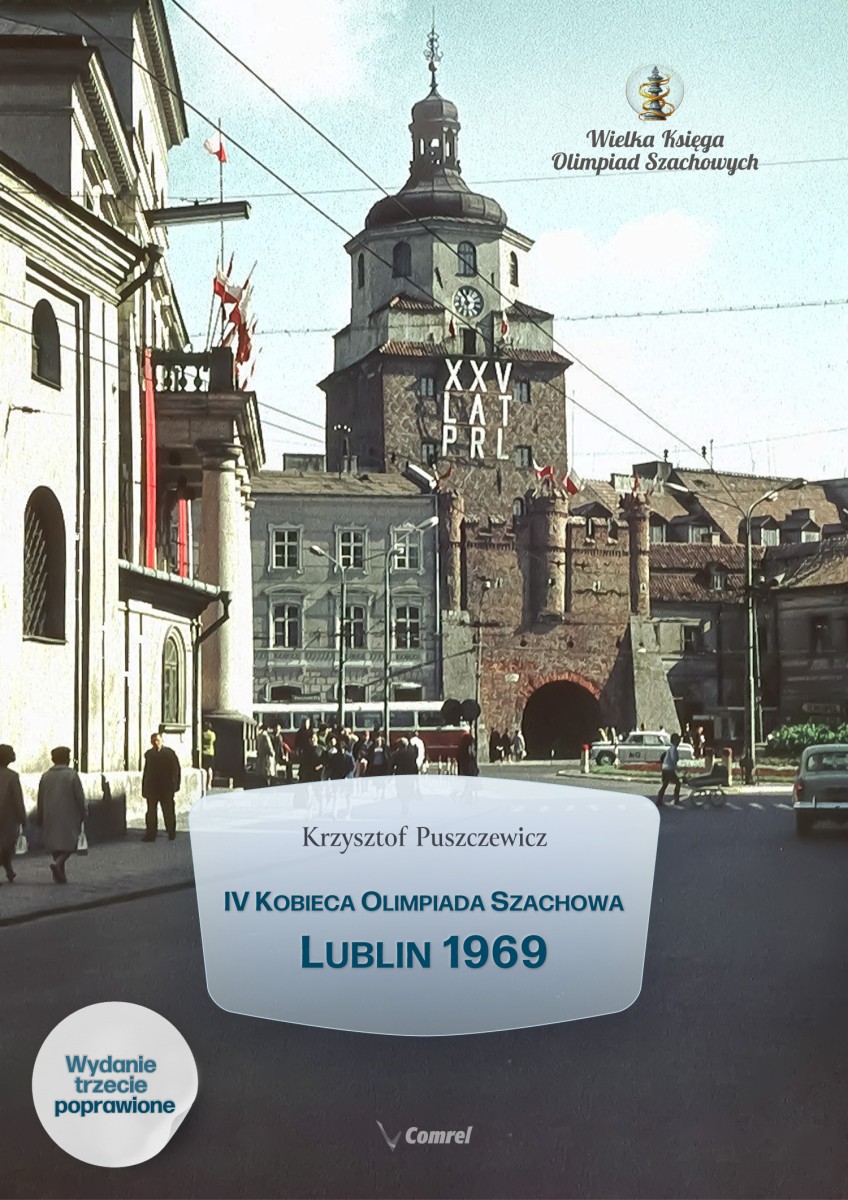
4th Women's Chess Olympiad – Lublin 1969: When Poland Hosted the World's Best Female Chess Players
A Historic Chess Olympiad on Polish Soil
Did you know that Poland hosted the Women's Chess Olympiad only once in history?The event took place inLublin in September 1969and to this day remains one of the most important chess tournaments ever played on Polish soil.
The 4th Women's Chess Olympiad in Lublin brought together43 top female chess players from 15 countries, who competed over 15 rounds for the team world championship title. Among the stars of the tournament wasworld champion Nona Gaprindashvili, who achieved a phenomenal score of95% of points.
In this article you will discover:
- How the Chess Olympiad in Lublin unfolded
- Who won and what were the most important games
- How the Polish team performed
- Fun facts and behind-the-scenes stories
- Where to find the complete documentation of the Olympiad
History of the Women's Chess Olympiad
The Women's Chess Olympiad(officially: Women's World Team Championship) is the most important team tournament in women's chess, organized byFIDE(the International Chess Federation). Historically, the first Women's World Team Championship was held in1957 in Emmen(the Netherlands). Since then, the tournament has been held every 2–3 years, bringing together the best female chess players from around the world.
4th Chess Olympiad Lublin 1969 – Key Facts
Tournament Organization
- Venue:Sports hall at Aleje Zygmuntowskie 6, Lublin
- Dates:September 7–23, 1969
- Number of teams:15
- Number of players:43
- Tournament system:round-robin
- Number of rounds:15
- Time control:2.5 hours for 40 moves
Olympiad motto
The tournament was organized under the official motto"On the occasion of the 25th anniversary of the People's Republic of Poland"– a typical move in the communist era that helped secure funding from the Main Committee of Physical Culture and Tourism.
Playing conditions
The Olympiad was held in anewly built sports hall seating 1,500 people, which was normally used for basketball. The hall was beautifully decorated with flags of all participating countries and equipped with:
- 8 magnetic demonstration boards
- Efficient air conditioning
- A café for participants
- A special room for game analysis
- A press office
Fun fact about the Lublin Olympiad:Despite high ticket prices, the hall was mostly empty – Polish fans did not show enough interest in the tournament...
Participants of the 4th Chess Olympiad in Lublin
List of participating countries
- USSR(Union of Soviet Socialist Republics)
- Hungary
- Czechoslovakia
- Yugoslavia
- Bulgaria
- GDR(German Democratic Republic)
- Poland
- Romania
- Netherlands
- England
- FRG(Federal Republic of Germany)
- Denmark
- Austria
- Belgium
- Ireland
Stars of the tournament
- Nona Gaprindashvili (USSR)– women's world champion since 1962, undisputedly the best female chess player of her time. In Lublin she achieved a phenomenal result:9.5 points out of 10 possible (95%).
- Alla Kushnir (USSR)– Women's World Championship challenger, also in outstanding form in Lublin:8.5 points out of 9 games (94%).
- Nana Alexandria (USSR)– the 20-year-old third-ranked Soviet player, three-time national champion, in Lublin:8 points out of 9 games (89%).
- Maria Ivanka (Hungary)– the 19-year-old sensation of the tournament, who the previous year had won the zonal tournament in Zinnowitz.
- Zsuzsa Veröci (Hungary)– a 20-year-old who in Lublindid not lose a single game(10 points out of 12 games = 83%).
- Stepanka Vokralova (Czechoslovakia)– the 20-year-old national champion, also unbeaten in Lublin.
Results of the 4th Women's Chess Olympiad – Lublin 1969
Final standings

Soviet dominance
TheSoviet Union team won by a margin of 5.5 pointsover the silver medalists from Hungary – this was thelargest margin in the history of Women's Olympiadsup to that point. All three Soviet players:
- Gaprindashvili: 9.5/10 (95%)
- Kushnir: 8.5/9 (94%)
- Alexandria: 8/9 (89%)
The USSR team won 26 matches out of 28 played, drawing only one (against Hungary).
Hungary's surprise silver medal
The young Hungarians(average age: 20) surprised everyone, finishing ahead of the favored Czechs and Romanians. The keys to their success were:
- Veröci unbeaten(10/12 = 83%)
- Ivanka's solid play (8/12 = 67%)
- A crucial 2:0 victory over Romania in the final round
How did the Polish team perform?
Polish team roster
Captain/coach:Stefan Witkowski
Players:
- Krystyna Radzikowska– 9-time Polish champion, first board
- Mirosława Litmanowicz– Polish vice-champion, second board
- Anna Jurczyńska– Olympiad debutante, reserve player
Polish team results
Final place: 7th (tied with Romania) – 16.5 points
Individual results:
- Radzikowska: 8.5/17 (50%)
- Litmanowicz: 7/11 (64%)
- Jurczyńska: 5/8 (62%)
Performance assessment
It was a success!After a disastrous performance at the previous Olympiad in Oberhausen (1966), the Polish team significantly improved their play:
- Radzikowska maintained 50% on the demanding first board
- Litmanowicz and Jurczyńska exceeded 60%
- Poland won matches against Belgium, Ireland, Austria, and the FRG
- Drew against the strong Romanians
Poland's most important matches
Great victories:
- Poland – Belgium 2:0
- Poland – Ireland 2:0
- Poland – GDR 1.5:0.5
- Poland – Austria 2:0
Painful defeats:
- Poland – Bulgaria 0:2
- Poland – Yugoslavia 0.5:1.5
- Poland – Hungary 0.5:1.5
Draws:
- Poland – Czechoslovakia 1:1
- Poland – Romania 1:1
Most Interesting Games from Lublin 1969
Games awarded brilliancy prizes
The jury comprisingAlexander Konstantinopolsky (USSR), Constant Orbaan (Netherlands), and Vladimir Sokolov (Yugoslavia)awardedtwo equal prizesfor the most beautiful games of the tournament.
1. Maria Ivanka – Hannelore Jörger (shared 1st–2nd prize)
Alekhine's Defense [B02]
Hungary – FRG, round 10
The game ended with asensational win by Jörgerafter a brilliant queen sacrifice!
Key moment: After the move 31.ef4 Sf4, Black sacrificed her queen with 31…fe3!! – a sacrifice that, if accepted, led to a forced win. Ivanka accepted the sacrifice, but after 32.He4 ef2 33.Kf1 Ge4, White was down a piece and soon lost.
Significance:This wasIvanka's only loss against a non-reserve playerin the entire tournament.
2. Mirosława Litmanowicz – Waltraud Nowarra (shared 1st–2nd prize)
Queen's Gambit [D24]
Poland – GDR, round 15
A beautiful checkmate in 36 moves!Litmanowicz executedan excellent positional attack, sacrificing pawns in succession for the initiative.
Key moment: The move 20.Wa3! launched a deadly maneuver with the Rook and dark-squared Bishop. The game ended with a spectacular checkmate: 36.Hg5 Kf4 37.Re5 Kf5 38.Re5 and checkmate!
Audience reaction:The game wasgreeted with a storm of applause– a rare sight at chess tournaments!
Other memorable games
- Sensational defeat of a champion:Zsuzsa Veröci (Hungary) checkmatedNana Alexandria(USSR) in round 9 – the only game lost by the Soviet player in the entire tournament.
- Shortest game:Krystyna Radzikowska – Hannelore Jörger ended after just13 moveswhen Jörger played the fatal13.c3?? Sc2losing a Rook.
- Longest game:Antonina Asenova (Bulgaria) – Nona Gaprindashvili (USSR) lasted85 movesin round 1.
Fun Facts from the 4th Chess Olympiad in Lublin
1. Two pregnant players
On theGDRteam, two players were pregnant:
- Waltraud Nowarra(age 29)
- Gabriele Just(age 33)
Despite this, both played full5-hour sessions in many roundsand contributed to their team's 6th-place finish!
2. The champion's striptease career
Ingrid Tuk(Netherlands), the reigning Dutch champion from 1968, disappeared from the chess world after the Olympiad. Dutch journalistMax Pamtracked her down in the 1970s at...a strip club in Amsterdam, where she was performing under the name Ingrid Jansen!
In an interview, she stated that"the new profession simply pays better". She returned to chess only in 2008.
3. The mystery of Litmanowicz's draws
Mirosława Litmanowicz twice agreed to a draw by repetition of positionin winning positions:
- Against Malypetrova (Czechoslovakia) – in an endgame with the exchange sacrifice advantage
- Against Honfi (Hungary) – in a winning position, where her sealed move gave the opponent a chance to repeat the position
As she herself admitted:"such a thing had happened to her for the first time in her career".
4. The Vera Menchik Cup
After the victory, Nona Gaprindashvilireceived the Vera Menchik Cup– named after the first women's world champion in chess (1927–1944). This was already thefourth consecutiveSoviet triumph at the Women's Olympiads.
5. Communist setting
The Olympiad was organized under the slogan of the"25th anniversary of the People's Republic of Poland". The Honorary Committee included, among others:
- The Chairman of the Voivodeship Committee of the Polish United Workers' Party
- The Voivodeship Commander of the Citizens' Militia
- Chairmen of voivodeship party committees
Such a framework wasnecessary to secure funding– initially 100,000 zlotys, later an additional 70,000.
6. An empty hall
Although the hall could accommodate1,500 people, it was usuallynearly empty. The organizers set ticket prices too high, and Poles lacked a tradition of spectating chess.
7. A special Olympiad stamp
A strikingcommemorative postage stampwas issued specially for the Olympiad. A postal stand with a special commemorative postmark was open only on theopening and closing daysof the tournament.
Organization of the 4th Chess Olympiad – Behind the Scenes
Organizing Committee
- Olympiad director:Mieczysław Niewiadomski
- Chief Arbiter:Tibor Florian (Hungary)
- Head of the press office:Władysław Litmanowicz
Fun fact:Władysław Litmanowicz was the husband of one of the Polish players –Mirosława Litmanowicz. It was he who later presented her with the special prize from the chess monthly "Szachy."
Accommodation
The participants stayed at the"Almatur" student hotel:
- ✅ Spacious single and double rooms
- ✅ Restaurant serving generous, fresh meals
- ❌ Hotel far from the playing hall
- ❌ Frequent lack of hot water
- ✅ Reliable bus transport
Activities for players
The organizers arranged:
- Tours of Lublin and its surroundings
- Visits to workplaces (each team was patronized by a Lublin factory)
- Access to an indoor swimming pool outside of playing hours
- A philatelic exhibition on a chess theme
- A performance by the Lublin Region Song and Dance Ensemble at the closing banquet
Why Learn About the History of the 4th Chess Olympiad?
1. The only Chess Olympiad in Poland
It was thefirst and last Women's Chess Olympiad played on Polish soil. A men's Olympiad has never been held in Poland (as of 2026).
2. Phenomenal sporting level
Despite the low turnout (15 teams), thelevel of play was very high:
- World champion Gaprindashvili – 95% of points
- 5 players unbeaten
- Two games awarded brilliancy prizes
- Records (shortest game: 13 moves, longest: 85)
3. A turning point for Polish chess
After the disastrous performance in Oberhausen (1966), thePolish women showed their best side, finishing 7th and scoring 16.5 points.
4. The beginning of a new era
The Olympiad in Lublin demonstrated thatyoung players(Hungarians, Czechs) could compete with experienced champions. It heralded changes in the world of women's chess.
5. Unique documentation
Krzysztof Puszczewiczcompiledcomplete documentationof the Olympiad:
- All 210 available games with commentary
- Over 130 photographs
- Full organizational rosters
- Press reports
- Master analyses
This is theonly complete monograph in the worlddedicated to this Olympiad!
Where to Find the Complete Documentation of the Olympiad?
"The Great Book of Chess Olympiads" – Volume IV
The complete history of the4th Women's Chess Olympiad in Lublincan be found in the volume byKrzysztof Puszczewicz, published as part of the series"The Great Book of Chess Olympiads".
What does the ebook contain?
✅ All 210 games with master commentary
✅ Over 130 photographs from the Olympiad
✅ Detailed descriptions of all 15 rounds
✅ Interviews and press reports
✅ Full team and organizer rosters
✅ Unique statistics
✅ 255 pages of valuable content
- Format:PDF (high quality)
- Language:Polish
- Edition:Third, revised and expanded (2026)
👉the ebook is available at the OlympChess.com store
Chess Olympiads – Questions and Answers (FAQ)
How many teams participated in Women's Olympiads?
At thefirst Women's Olympiad(Emmen 1957),21 teamsparticipated. AtLublin 1969there were only15 teams– one of the lowest numbers in history. From the next Olympiad (Skopje 1972), the number of participants grew steadily.
Are Chess Olympiads part of the Olympic Games?
NO.Despite the name, Chess Olympiads arenot part of the Olympic Games. They are separate competitions organized by FIDE. Chess is not an Olympic sport (although efforts to include it have been ongoing for years).
How often are Chess Olympiads held?
Currently,every 2 years, with the following details:
- The Open and Women's Olympiads take placeat the same venue and time
- Until 1976, Women's Olympiads were heldevery 2–3 years
- From 1957 to 1976, they wereseparate tournaments
Which female player has won the most Olympiads?
Nona Gaprindashvili(Georgia/USSR) won10 consecutive Olympiads(1957–1978) – an absolute record in chess! Together with her team, she won:
- 10 gold medals
- 25 individual medals
- 95% effectiveness in many tournaments
Where can one see games from the Olympiads?
Best sources:
- OlympChess.com– official website of "The Great Book of Chess Olympiads" series
- ChessBase– game database
- Chess.com/olympiads– history section
- FIDE– official results at fide.com
Chess Olympiads After Lublin – What Changed?
Growth in the number of participants
After Lublin (15 teams), the number of participants grew steadily:
- 1972 Skopje:24 teams
- 1984 Thessaloniki:52 teams
- 2024 Budapest:183 teams (record!)
Merging of the Open and Women's Olympiads
From1976(Haifa), the Open and Women's Olympiads have been heldat the same venue and time– this greatly increased the prestige of the women's tournament.
Increase in the number of players per team
- Until 1976:2-player teams (+ 1 reserve)
- 1976–1988:3-player teams (+ 1 reserve)
- From 1988:4-player teams (+ 1–2 reserves)
Introduction of the FIDE rating
The FIDE rating for womenwas introduced in1970– one year after the Lublin Olympiad. This greatly facilitated the assessment of players' strength.
End of Soviet dominance
After the dissolution of the USSR (1991),Soviet dominance came to an end. Currently, thegreatest power in women's chess is India(gold medals: 2024).
Summary of the 4th Chess Olympiad in Lublin
The 4th Women's Chess Olympiad in Lublin 1969was ahistoric eventfor Polish chess. For the first and last time, Poland hosted the world's best female chess players in a team championship.
Key facts:
✅26.0 points– record-breaking Soviet margin (5.5 pts ahead of 2nd place)
✅95%– Nona Gaprindashvili's phenomenal score
✅16.5 points– the Polish team's excellent performance (7th place)
✅210 games– all preserved and annotated
✅2 games awardedfor artistic value
✅15 teamsfrom around the world
Why does this Olympiad matter today?
- Historical documentation– the only complete monograph of the tournament
- Inspiration for the young– shows that Polish female chess players can compete with the world
- Educational value– 210 annotated games are a treasure trove of knowledge
- Sentiment– the only Women's Olympiad in Poland