






3rd Women's Chess Olympiad – Oberhausen 1966
3rd Women's Chess Olympiad – Oberhausen 1966: a complete guide to the historic tournament. The sensational defeat of the USSR, the dramatic chase of Romania, and Zatulovskaya's phenomenal result (94%). All 182 games, statistics, and trivia.
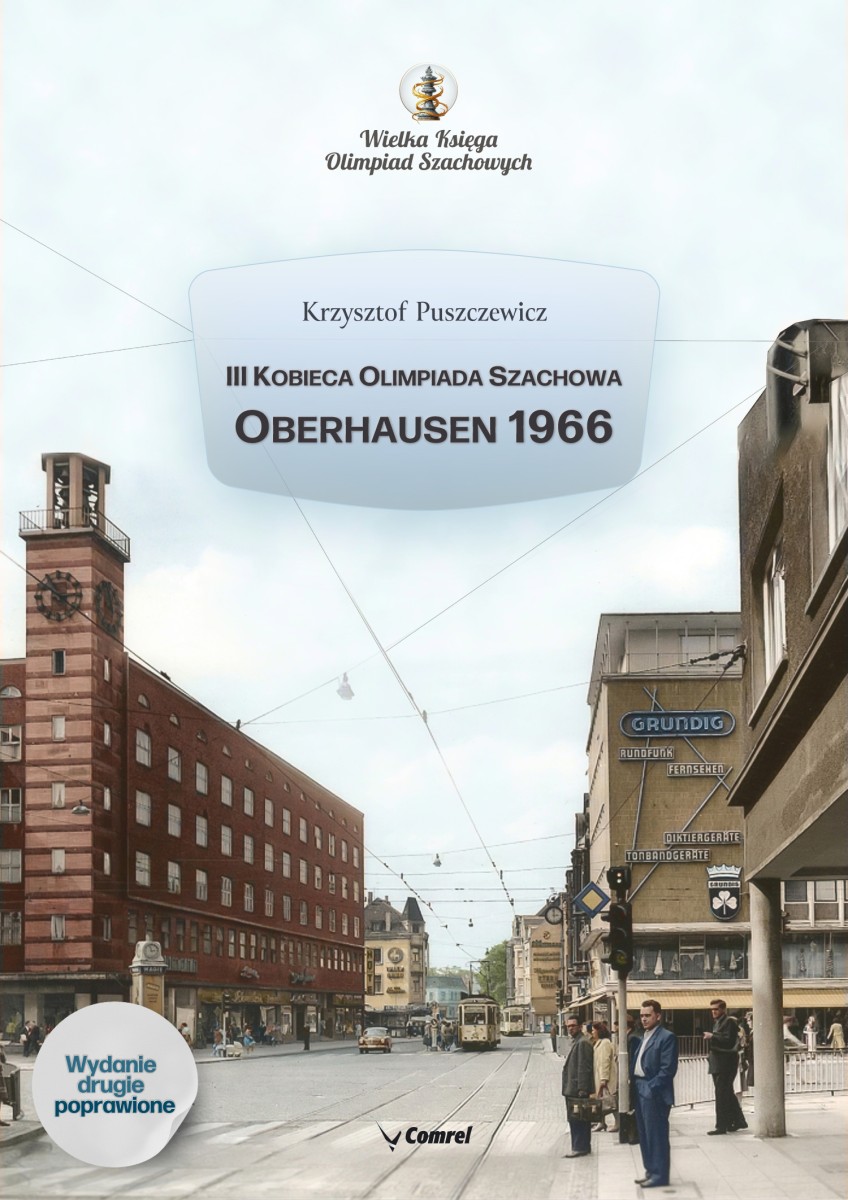
3rd Women's Chess Olympiad – Oberhausen 1966 - A Complete Guide to the Historic Tournament
Table of Contents
- Introduction
- Basic Tournament Information
- Team Rosters and Favorites
- The First Round Sensation
- Round-by-Round Tournament Progress
- Key Games
- Final Standings and Statistics
- Trivia and Behind the Scenes
- Summary
Introduction: What Makes the 3rd Women's Chess Olympiad Special?
The 3rd Women's Chess Olympiad, held in Oberhausen (West Germany) from October 3–15, 1966, went down in history as one of the most dramatic women's tournaments in the history of chess. Despite the lowest turnout in the history of Women's Olympiads (only 14 teams), the tournament assembled the absolute chess elite, and the competition delivered unforgettable emotions.
Key facts:
- Dates:October 3–15, 1966
- Venue:Oberhausen, Germany (West Germany)
- Number of teams:14 (fewest in history)
- Number of games:182
- Winner:USSR (22 points)
- Biggest sensation:Romania leads for 2/3 of the tournament
Basic Information about the 3rd Women's Chess Olympiad
Venue and Organization
Oberhausen, a city of 160,000 inhabitants in the Ruhr region at the time, was already well-known to chess players – in 1961 it hosted the finals of the European Men's Team Championship. This time the city undertook the organization of the Women's Chess Olympiad.
Organizational problems:
- No national flags (for political reasons)
- No tournament tables or name cards
- Poor accommodation for participants
- Large distances between the hotel, playing hall, and restaurant
- Insufficient number of arbiters
Chief Arbiter Willi Fohl repeatedly saved the situation, avoiding more serious conflicts. The Arbiters' Commission included masters Aronson and Bruce, accompanied by grandmaster Alexander Kotov (USSR) and masters Jeney and Samarian.
Tournament Format
Rules of play:
- Round-robin system (all-play-all)
- Time control: 2.5 hours for 45 moves + 1 hour for every subsequent 16 moves
- Team composition: 2 regular players + 1 reserve player
- Standings were determined by match points
Team Rosters and Main Tournament Favorites
Clear Favorites
USSR(defending champions):
- Nona Gaprindashvili (women's world champion)
- Valentina Kozlovskaya (USSR champion)
- Tatiana Zatulovskaya
- Coach: Alexander Konstantinopolsky
Romania(strengthened roster):
- Alexandra Nicolau (twice defeated Gaprindashvili in 1966)
- Elisabeta Polihroniade (new addition)
- Margareta Perevoznic
Yugoslavia(silver medalists from 1963):
- Milunka Lazarevic (Candidates Tournament finalist 1964)
- Jirina Nedeljkovic
- Katarina Jovanovic
East Germany(bronze medalists from 1963):
- Edith Keller-Herrmann
- Waltraud Nowarra
- Gabriele Just (new addition)
Other Strong Teams
Czechoslovakia(returning after a break):
- Kveta Eretova
- Jana Malypetrova (young talent)
Hungary:
- Eva Karakas
- Edith Bilek
- Zsuzsa Veroci (17-year-old star)
Netherlands(strongest Western team):
- Corry Vreeken
- Fenny Heemskerk
- Milly Timmer
The Polish National Team
Poland competed with the following roster:
- Krystyna Radzikowska(1st–2nd place in the Polish Championship 1966)
- Miroslawa Litmanowicz
- Danuta Samolewicz(3rd place in the Polish Championship 1966, Olympiad debutante)
- Captain:Stefan Witkowski
Notably absent was Henryka Konarkowska, who had permanently moved to Yugoslavia.
First Round Sensation: Romania Defeats USSR 2:0
A Great Shock for the Favorites
The very first round produced the tournament's biggest sensation. The Soviet team, the clear favorite for gold, lost to Romania2:0!
What happened?
In the gameKozlovskaya – Polihroniadethe USSR champion chose a very risky variation and after 13.g4 (a move the coach strongly disapproved of) found herself in a hopeless position, losing several pawns.
Seeing her teammate's troubles,Nona Gaprindashvilirefused to accept a draw from Nicolau in an equal position and tried to play for a win. Just before time control (move 40) she overlooked an elementary fork andhung the exchange.
Account by grandmaster Alexander Kotov:
"Before the first round, after completing theoretical preparation, Nona Gaprindashvili played several blitz games against me and won with a two-point advantage. The next day she lost to Nicolau and I joked that after winning the blitz games 'the success had gone to her head'."
Consequences of the Defeat
The 2:0 result put the Soviet women in an extremely difficult situation. With only two boards in play (no reserve), losing two points to the main rival meant they had to play perfectly in the remaining rounds.
Coach Konstantinopolsky tried to calm the team: "Nothing has happened, we'll manage," but everyone was aware that making up the two-point deficit would be extremely difficult.
Round-by-Round Tournament Progress
Rounds 1–4: Romania Builds a Lead
Round 1:
- Romania 2:0 USSR (sensation!)
- Poland 0.5:1.5 West Germany (weak start)
- Yugoslavia 1.5:0.5 Netherlands
Round 2:
- Romania maintains the lead despite half a point dropped against Bulgaria
- USSR swiftly defeats West Germany 2:0
- Poland 0.5:1.5 Yugoslavia (second consecutive loss)
Round 3:
- Romania 2:0 Poland (Poland's third defeat)
- USSR 2:0 Netherlands
- Yugoslavia 2:0 Austria
Round 4:
- Romania 1:1 Hungary (quick draws between international masters)
- USSR 2:0 Denmark
- Poland 2:0 Austria (first victory!)
Rounds 5–8: USSR's Dramatic Chase
Round 5:
- USSR 2:0 Hungary
- Romania 1.5:0.5 Czechoslovakia (half a point dropped)
- Poland 0.5:1.5 England
Round 6:
- USSR 2:0 Bulgaria
- Romania 2:0 Netherlands
- Poland 0:2 East Germany (fourth defeat)
Round 7 – the first turning point:
- Romania 2:0 Poland (Poland's fifth defeat)
- USSR 2:0 Netherlands (closing the gap)
- Yugoslavia 1.5:0.5 East Germany
Round 8:
- Romania 1.5:0.5 England (an unnecessary loss of points)
- USSR 2:0 Austria
- Bulgaria 2:0 Netherlands
Rounds 9–11: Romania's Downfall
Round 9 – the great turning point:
This was the decisive round of the entire tournament. The Romanian team captain restedAlexandra Nicolau, expecting an easy victory over the USA. The opposite happened:
- USA 2:0 Romania(the biggest upset!) Perevoznic loses to Lane
- Polihroniade loses to Gresser
- USSR 2:0 YugoslaviaGaprindashvili defeats Lazarevic
- Zatulovskaya beats Nedeljkovic
Account by Kotov:
"Result: Perevoznic suffered a defeat at the hands of Lane, and Polihroniade lost to Gresser. 2:0 in favor of the Americans! It was clear that our opponents' nerves had gotten the better of them. Interestingly, after dropping to second place, the Romanian team still firmly believed they could win the tournament."
After this round, the USSR took the lead with a 1.5-point advantage over Romania!
Round 10:
- USSR 2:0 USA
- Romania 2:0 Austria (making up ground)
- East Germany 1:1 England
Round 11:
- USSR 1:1 East Germany (Gaprindashvili – draw after 23 moves)
- Romania 2:0 West Germany
- Yugoslavia 1:1 Czechoslovakia
Rounds 12–13: The Final Outcome
Round 12:
- USSR 1.5:0.5 England
- Romania 1:1 East Germany (quick draws)
- Yugoslavia 1:1 Hungary
Round 13 (final):
- USSR 1:1 East Germany (medals decided)
- Romania 2:0 West Germany
- Yugoslavia 1:1 Czechoslovakia
Key Games of the Tournament
Game 1: Kozlovskaya – Polihroniade (Round 1)
Modern Defense [A42]
The game that started the tournament's sensation. Kozlovskaya chose the aggressive 13.g4, but her position quickly fell apart.
Critical moment (after 13.g4):White launched an attack on the kingside without completing development. After 13...Ne4 14.Bxe4 Nd4 White had to give up a pawn, and the position became indefensible.
Kotov's commentary:
"Kozlovskaya's move 13.g4 clearly displeased the coach. Soon Kozlovskaya found herself in a hopeless position."
Black won after 45 moves.
Game 2: Nicolau – Gaprindashvili (Round 1)
Pirc Defense [B07]
Nicolau's second victory over the women's world champion in 1966!
Decisive moment (move 45):
45...Nf5??
Gaprindashvili, playing for a win in an equal position, hung her knight. Nicolau immediately exploited the blunder:
46.Ne6 Bh6 47.Nf8 Bxf8 48.Ne8
And the women's world champion had to resign after 60 moves.
Game 3: Gaprindashvili – Lazarevic (Round 9)
Dutch Defense [A80]
A long, strategic game (81 moves) in which the women's world champion demonstrated her class.
Key moments:
- White gained a spatial advantage in the center
- Black attempted a counter-attack on the queenside
- Gaprindashvili methodically converted her advantage
Commentary by expert Igor Zaitsev:
"Gaprindashvili, in the heat of battle, missed a forcing mate: 32...Qh4 33.Kg1 Bd4+ 34.Qxd4 Qe1+ 35.Kh2 Qh4+ 36.Kg1 Rc1+. However, the continuation chosen by Zatulovskaya also leads to a win."
Game 4: Lane – Larsen (shortest game of the Olympiad)
Sicilian Defense [B60]
A tournament record – the game ended after...5 moves!
1.e4 c5 2.Nf3 d6 3.d4 cxd4 4.Nxd4 Nf6 5.Bg5 Nxe4
And White resigned! Lane blundered a pawn in the opening and chose not to continue.
Game 5: Samolewicz – Veroci (Round 13)
Four Knights Game [C47]
The most beautiful combination of the tournament, executed by the 17-year-old Hungarian!
The final combination (from move 27):
27...Ne3! 28.Rxe3 dxe3 29.Bxe3 Ng2! 30.Kxg2 Bd4!
31.Bxd4 Nxd4 32.Qc3 Bc4 33.Rxc4 c5!
And then the brilliant finale:
40...Bf4! 41.Ng5 hxg5 42.Bh5 gxh5 43.Rh5+ Kg6!
and checkmate is unavoidable.
Final Standings and Statistics
Final Table

Individual Results of the Winning USSR Team

Best Individual Results (min. 65%)
Board I:
- Gaprindashvili (USSR): 9/11 – 82%
- Nicolau (Romania): 8/10 – 80%
- Asenova (Bulgaria): 9.5/13 – 73%(most points in the tournament!)
- Vreeken (Netherlands): 6.5/10 – 65%
Board II:
- Polihroniade (Romania): 7.5/9 – 83%
- Kozlovskaya (USSR): 4.5/6 – 75%
Reserve board:
- Zatulovskaya (USSR): 8.5/9 – 94%🏆
- Just (East Germany): 8/9 – 89%
- Jovanovic (Yugoslavia): 7/9 – 78%
- Perevoznic (Romania): 5/7 – 71%
- Veroci (Hungary): 6/9 – 67%
Players Without a Loss
Onlythree playerswent through the tournament without a loss:
- Alexandra Nicolau(Romania) – 10 games
- Gabriele Just(East Germany) – 9 games
- Tatiana Zatulovskaya(USSR) – 9 games
Tournament Records
- Most wins:Gaprindashvili, Asenova, Zatulovskaya – 8 each
- Most points:Asenova – 9.5/13
- Highest percentage:Zatulovskaya – 94% (8.5/9)
- "Draw queens":Eretova and Keller-Herrmann – 6 draws each
- Shortest game:Lane – Georgieva (5 moves)
- Longest game:Nowarra – Trojanska (136 moves, a draw!)
Poland's Results

Analysis:
- Poland finished11thout of 14 teams
- Did not finish ahead of any team from the socialist bloc countries
- Radzikowska lost her last 6 games in a row
- Only debutante Samolewicz deserved praise (50%)
Trivia and Behind the Scenes
Politics in Chess
For political reasons, the organizers did everything to avoid mentioning East Germany (the German Democratic Republic) by name. In tournament materials, they used the designation "Deutscher SV" for East Germany and "Deutscher SB" for West Germany.
Consequences:
- No national flags
- No signs indicating national affiliation
- No name cards at the tables
- No tournament tables
Organizational Problems
Polish team captain Stefan Witkowski reported:
- A substandard hotel in a poor part of town
- Large distances between the sports hall, hotel, and restaurant
- The captain was housed 2 km from the players
- An official protest was lodged but changed nothing
Support from the Polish Diaspora
Great assistance to the Polish team was provided by:
- Mrs. Kreskowiak (one of the organizers)
- The local Polish community
- After the tournament, the Polish community organized transport to Duisburg
Most Interesting Matches
Yugoslavia vs. Romania match (Round 8):The Yugoslavs could regret that their first board player Milunka Lazarevic did not play. Romania won 2:0, and second Samarian was already accepting congratulations for the gold!
East Germany vs. Poland match (Round 6):Poland lost 0:2. Nowarra scored her only victory of the tournament against Litmanowicz (final record: 1/6!).
Bulgaria vs. England match (Round 13):Both games were decisive – there wasn't a single draw!
Asenova's Winning Streak
Venka Asenova (Bulgaria) finished the tournament with a remarkable streak:
- Last 5 games – 5 victories!
- Overall: 9.5/13 (most points in the tournament)
- Won a special trophy for this result
- ...but rushing to catch her train, she didn't collect it!
The Drama of Milunka Lazarevic
The famous Yugoslav player sufferedtwo defeatsin Oberhausen:
- Against Gaprindashvili (Round 9)
- Against Asenova (Round 10, after 65.Qe6?? she was checkmated)
After her second loss, she did not sit down to play again for the rest of the tournament. For a player who in 1964 nearly won the Candidates Tournament, this was a devastating blow.
The Tatiana Zatulovskaya Phenomenon
The USSR reserve player played9 gamesand achieved a score of8.5 points (94%)!
Her victims:
- Trojanska (Bulgaria)
- Nedeljkovic (Yugoslavia) – revenge for her loss at the previous Olympiad
- Samolewicz (Poland)
- Lane (USA)
- Kattinger (Austria)
Her only draw: against Bruce (England) in a beautiful fight of rook versus three pawns.
Young Talents
The tournament saw the debuts of several young players who would soon become leading figures in their countries:
- Jana Malypetrova(Czechoslovakia)
- Antonina Georgieva(Bulgaria)
- Diana Dobson(England)
- Zsuzsa Veroci(Hungary, 17 years old!) – author of the tournament's most beautiful combination
Summary: What Did the 3rd Women's Chess Olympiad Teach Us?
Key Takeaways
1. Psychology is decisive
The USSR showed remarkable psychological resilience. After a 0:2 defeat in the first round, they did not collapse but systematically made up ground. Romania, on the other hand, while leading for most of the tournament, made a critical squad decision at the crucial moment (Round 9), resting their best player.
2. Quality over quantity
Despite the lowest turnout in history (14 teams), the tournament assembled the absolute elite. 22 players held the title of international master. This shows that women's chess in the 1960s was dominated by a handful of countries – mainly the socialist bloc nations.
3. The importance of the reserve player
Tatiana Zatulovskaya (94%) and Gabriele Just (89%) proved that the third player can be the key to success. Both played on the reserve board and both achieved better results than the regular players on their teams!
4. One match can change everything
Romania's 0:2 loss to the USA in Round 9 completely changed the balance of power. Until that moment, Romania was in the lead and seemed unstoppable. After that match, the USSR took the lead and never relinquished it.
Historical Significance
The 3rd Women's Chess Olympiad remains one of the most thrilling women's tournaments in history:
✅Highest quality:Virtually all the world's top female chess players ✅Drama:The lead changed hands between rounds ✅Sensations:USSR's 0:2 defeat, USA's triumph over Romania 2:0 ✅Records:Zatulovskaya 94%, Asenova 9.5/13, a game in just 5 moves ✅Emotions:USSR's 13-round chase of Romania
Where to Learn More?
The full chronicle of the 3rd Women's Chess Olympiad, featuring all 182 games, expert commentary (Alexander Kotov, Igor Zaitsev), archival photographs, and detailed statistics, is available in the ebook:
📖"3rd Women's Chess Olympiad – Oberhausen 1966"
- Author: Krzysztof Puszczewicz
- Series: The Great Book of Chess Olympiads
- Second edition (2025)
- Format: PDF, 161 pages
- Language: Polish
👉Buy the ebook at the OlympChess store
FAQ – Frequently Asked Questions
- Where was the 3rd Women's Chess Olympiad held?In Oberhausen (Germany, West Germany), from October 3–15, 1966.
- Who won the tournament?The USSR with 22 points, ahead of Romania (20.5) and East Germany (17).
- How many teams participated?Only 14 – the fewest in the history of Women's Olympiads. However, the absolute elite of women's chess was assembled.
- What was the biggest sensation of the tournament?The defeat of the favored USSR by Romania 0:2 in the first round. The second great surprise was the USA's 2:0 triumph over tournament-leading Romania in Round 9.
- Who had the best individual result?Tatiana Zatulovskaya (USSR) – 8.5/9 (94%), without a single loss. The most points were scored by Venka Asenova (Bulgaria) – 9.5/13.
- How did Poland perform?Very poorly – 11th place out of 14 teams. Poland did not finish ahead of any team from the socialist bloc countries.
- Are all the games available?Yes! All 182 games with expert commentary are available in the ebook "3rd Women's Chess Olympiad – Oberhausen 1966".
- What was the shortest game of the tournament?Lane – Georgieva, finished after 5 moves (a pawn blunder in the opening).
- Were there players who went undefeated?Yes, three: Alexandra Nicolau (Romania, 10 games), Gabriele Just (East Germany, 9 games), and Tatiana Zatulovskaya (USSR, 9 games).
Keywords:3rd Women's Chess Olympiad, Oberhausen 1966, women's chess olympiad, Nona Gaprindashvili, Tatiana Zatulovskaya, Alexandra Nicolau, women's chess history, USSR chess, Romania chess, chess games 1966, chess tournament Oberhausen